Numbers Don’t Lie: Ranking the Greatest South Carolina Women’s Basketball Players By Jersey Number — From 00 to 10
Every number tells a story. In the history of South Carolina women’s basketball — a program that has evolved from regional contender to the defining dynasty of the modern era — some of those stories are straightforward and some are complicated. All of them are worth telling.
The State’s “Best to Wear It” series sets out to do exactly that, working through the program’s jersey number history and identifying the player who best defined each number. What emerges isn’t just a ranking exercise — it’s a portrait of the people and moments that built one of college basketball’s most decorated programs, number by number.
Here is an analysis of the best players to wear jersey numbers zero through ten in Gamecock history.
No. 00 — Beth Hunt (1989-90)
She was only here for two years. She left a mark that has never been erased.
Beth Hunt arrived at South Carolina as a transfer from Maryland and immediately announced herself as one of the most prolific scorers in program history. The Garden City, South Carolina native averaged 23.4 points and 10.5 rebounds per game during her Metro Conference Player of the Year season in 1990 — numbers that, even measured against the players who came after her, remain extraordinary.
Hunt’s career averages of 21.6 points and 9.9 rebounds in garnet and black still rank first and second respectively in the program’s all-time record book. She reached 1,000 career points in just 48 games — the second-fastest in program history. In two seasons, she produced a statistical legacy that four-year contributors haven’t surpassed in the decades since.
Ta’Niya Latson earns the honorable mention for her contributions in 2025, but Hunt’s sustained production across just two seasons makes her the clear standard-bearer for No. 00.
No. 0 — Te-Hina Paopao (2024-25)
The arrival of Te-Hina Paopao as a graduate transfer solved a specific problem — and then some.
After a Final Four loss to Iowa in 2023 exposed South Carolina’s need for elite perimeter shooting, Staley identified Paopao as the solution. She responded by leading the entire country with a 46.8% three-point percentage in her first season, providing the spacing and shot-making that unlocked the offense on the way to a national championship.
In 76 games across two seasons, Paopao averaged 10.5 points per game and shot 42.2% from three — numbers that, in isolation, are impressive, but don’t fully capture the gravity she created for teammates or the credibility she gave South Carolina’s perimeter game. She earned All-American honors in 2024 and left Columbia as one of the most efficient shooters in program history.
No. 1 — Zia Cooke (2019-23)
Zia Cooke’s legacy at South Carolina is inseparable from the “Freshies” class that fundamentally changed the program’s trajectory — but her individual career deserves its own accounting.
Across four seasons and 137 starts — every game she suited up for — Cooke averaged 13.5 points per game and accumulated one of the most decorated individual résumés in program history. She was a three-time All-SEC selection, earned All-America honors from the Associated Press and US Basketball Writers Association in 2023, won the Ann Meyers Drysdale Shooting Guard of the Year Award, and appeared on three Final Four All-Tournament Teams.
Cooke was central to the 2022 national championship and was, throughout her career, one of the most reliable offensive contributors the program has ever produced. Bianca Cuevas-Moore’s four-year contributions earn an honorable mention, but Cooke’s combination of sustained excellence and championship production makes her the standard for No. 1.
No. 2 — Ieasia Walker (2012-13)
This selection requires some administrative nuance. Walker wore three different numbers across her four years at South Carolina — No. 14 as a freshman, No. 3 in her sophomore and junior seasons, before finishing in No. 2. The decision to assign her to No. 2 is justified by what she accomplished in that final year: winning the 2013 SEC Defensive Player of the Year award — the program’s first such honor.
Walker started 103 of 130 games at South Carolina and averaged 8.9 points, 3.7 rebounds, 2.3 assists, and 2.0 steals per game across her career. She belongs to an elite group in program history having accumulated at least 1,000 career points, 250 career assists, and 250 career steals — a combination that reflects a complete two-way player rather than a one-dimensional contributor.
Ashlyn Watkins earns the honorable mention, and her continued presence in the program means that story isn’t finished yet.
No. 3 — Destanni Henderson (2018-22)
Eight players have worn No. 3 in program history. The three strongest candidates — Henderson, Kaela Davis, and Ieasia Walker — represent three different decades of Gamecock basketball, which speaks to the enduring quality this number has attracted.
But Henderson’s story is the most complete. She arrived as a freshman role player, developed patiently within Staley’s system, and culminated her career with one of the most memorable individual performances in program history — a career-high 26 points in the 2022 national championship victory over UConn, in what turned out to be the final game she’d ever play as a Gamecock.
That performance wasn’t an outlier. Henderson worked her way into a starting role in her final two seasons, earned All-American honors as a senior, and left the program as one of the most efficient point guards in its history. Her willingness to wait for the moment — and then deliver completely when it arrived — is the kind of story that defines the culture Staley has built.
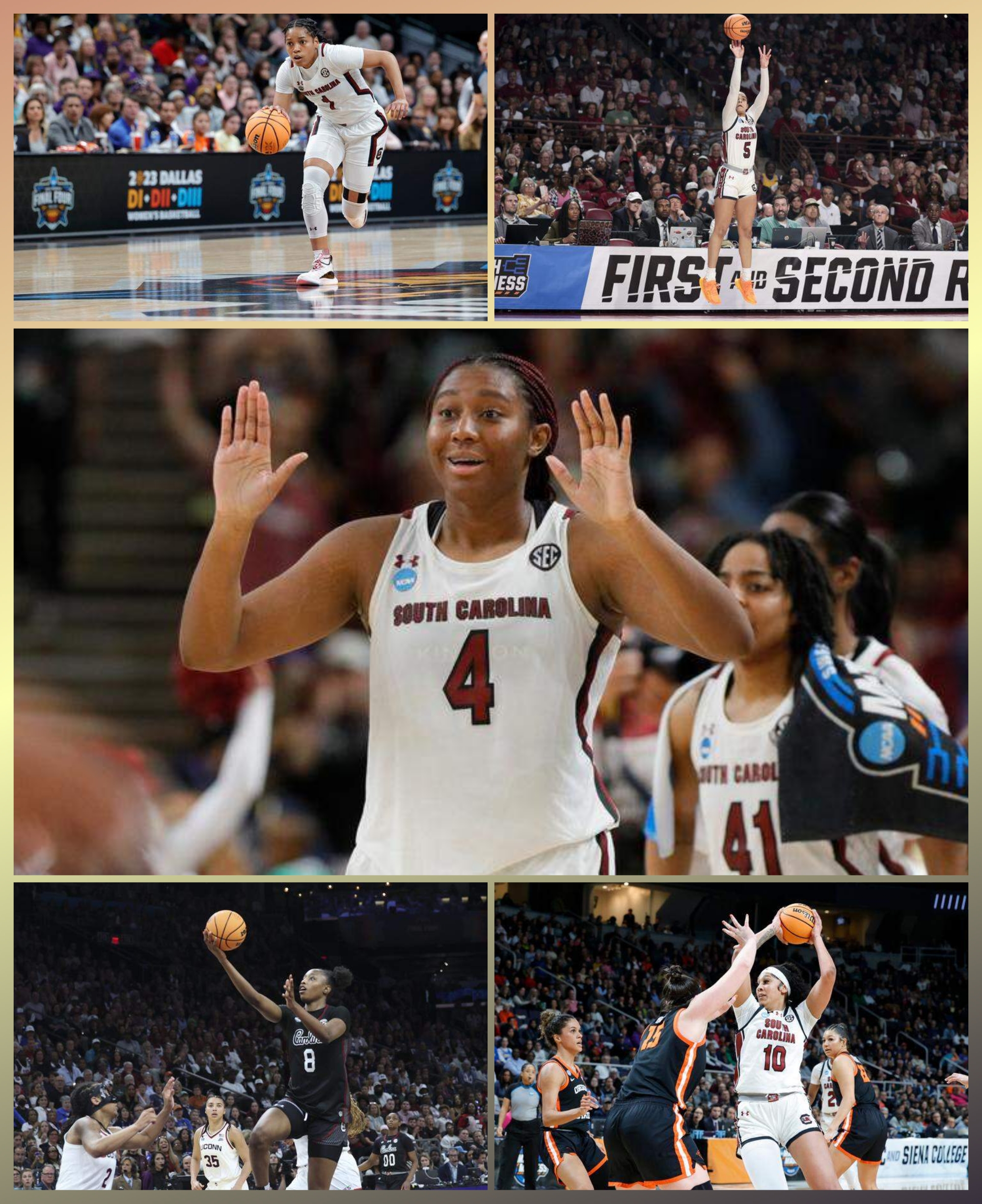
No. 4 — Aliyah Boston (2019-23)
Of all the selections in this range, this one requires the least deliberation.
Aliyah Boston is the second-best player in South Carolina women’s basketball history — a claim that carries genuine weight given the program’s recent dynasty — and the argument for eventually retiring her jersey alongside A’ja Wilson’s in the Colonial Life Arena rafters is entirely reasonable. She left South Carolina as the most decorated player in program history, with a list of accolades that demands enumeration: four-time All-American, four-time SEC Defensive Player of the Year, two-time National Defensive Player of the Year, Honda Cup winner, and 2022 National Player of the Year.
Boston started all 138 games she appeared in — a program record — and averaged 14.1 points and 10.8 rebounds per game across four seasons. She was the cornerstone of the 2022 national championship team and the connective tissue between South Carolina’s first championship era and its sustained dynasty. No. 4 belongs to her, unambiguously.
No. 5 — Tessa Johnson (2024-present)
The selection of Johnson over legitimate contenders like Markeshia Grant, Victaria Saxton, and Khadijah Sessions reflects both the quality of her current play and the trajectory her career appears to be on.
Johnson’s development mirrors the patience that Staley’s system rewards. She came off the bench in her first two seasons, learning the program and absorbing what it demands before earning a full-time starting role in her junior year. The result was one of the finest individual shooting seasons in recent program history — 44.8% from three-point range on 90 makes, third-most in a single season in program history, accompanied by a 12.8 points per game average, her first All-SEC selection, and a crucial 14-point performance in the national championship game when the offense struggled around her.
The critical phrase here is that Johnson “has one more year to further prove it” — a senior season that, given the roster around her and the expectations of the program, could elevate this selection from defensible to definitive.
No. 8 — Joyce Edwards (2025-present)
Edwards holds the distinction of being the only player in program history to wear No. 8 — but the argument for her selection requires no such technicality.
She has been one of the most impactful players in the country since her first game in garnet and black. As a freshman, Edwards led the Gamecocks in scoring primarily off the bench, earning All-SEC Freshman Team and All-SEC First Team honors in the same season — a combination that speaks to immediate, undeniable impact. As a sophomore, she led the team outright with 19.2 points per game and collected All-American recognition from four separate organizations.
She is a Camden, South Carolina native who chose to stay home and build her legacy at the state’s flagship program. With two years of college basketball remaining, Edwards has the profile and the production to challenge for a place among the program’s all-time greats before her career is complete.
No. 10 — Kamilla Cardoso (2021-24)
The honest version of this selection acknowledges how close the race is. Allisha Gray wore No. 10 for one season — 2016-17 — and averaged 13.2 points per game while playing an integral role in bringing South Carolina its first national championship. That is a legitimate legacy by any standard.
But Cardoso’s three-year tenure and sustained excellence earns the nod. She arrived from Syracuse as a transfer, spent two seasons developing her game as a reserve, and emerged in her junior year as the SEC Sixth Woman of the Year, averaging 9.8 points, 8.5 rebounds, and 1.9 blocks. Her senior season was the culmination — All-American honors from four organizations, 14.4 points, 9.7 rebounds, and 2.5 blocks per game, and a second national championship to close out her career.
The 6-foot-7 Brazilian center gave South Carolina a dominant interior presence that changed what opposing offenses could attempt, and her development arc — from patient reserve to All-American — is precisely the kind of story the program produces again and again.
From Beth Hunt’s 35-year-old records to Joyce Edwards’ growing legend, the numbers from 00 to 10 collectively tell the story of a program that has consistently attracted and developed transformative talent. The best is yet to come — both for the series, and for South Carolina women’s basketball.
About The Author