Dawn Staley’s Guards Are Quietly Building Something Dangerous — And The Gamecocks Are Hiding It In Plain Sight
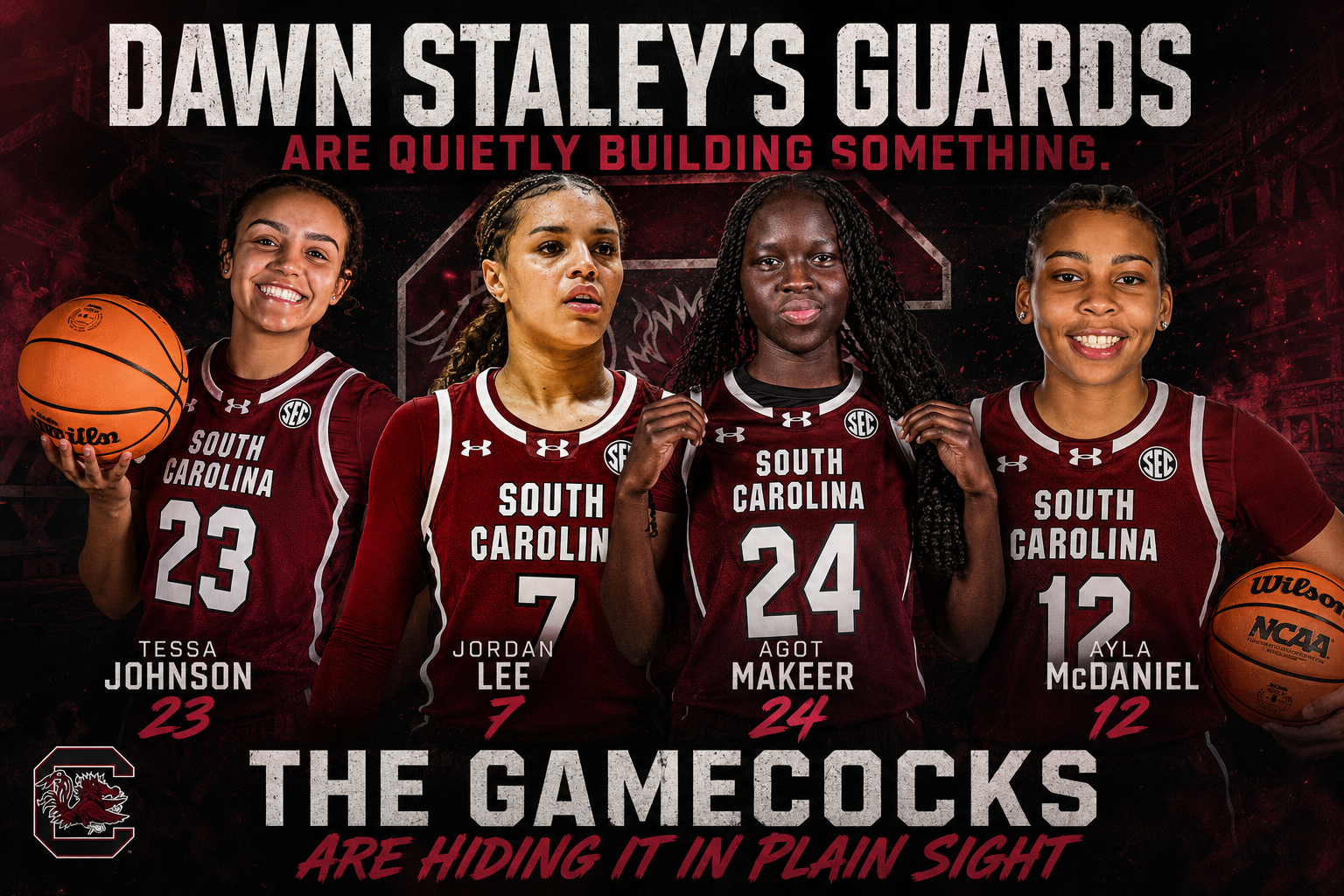
South Carolina enters the 2026-27 season without Raven Johnson, its most important player from a year ago, and without a proven starting point guard. On paper, that sounds like a problem. In reality, Staley has quietly assembled a guard group that could be more versatile, more dangerous, and far deeper than anything she’s fielded in recent memory. Here’s what every Gamecock fan needs to know about the women doing the work this offseason.
Tessa Johnson Is One Decision Away From Being A First-Round Pick
The numbers are already staggering. Johnson led the SEC in three-point shooting percentage last season and finished fourth nationally, converting at a 44.8% clip on 90 made threes — the third-most in a single season in program history. Her career mark of 44.0% from deep is second all-time at South Carolina. She is, without question, one of the most dangerous shooters in the country.
But shooting is only half of Johnson’s story heading into her senior year. The bigger conversation is defense. Forced into the role of primary wing defender last season, Johnson posted the second-worst defensive rating on the team — a liability the Gamecocks couldn’t afford and won’t be able to carry if they want another championship run.
The good news? She won’t have to carry that burden alone anymore. The arrivals of Jordan Lee and the continued emergence of Agot Makeer mean Johnson can return to what she does best: shooting, scoring, and running backup point guard duties when needed.
That last part matters enormously. There is currently no dedicated backup point guard on South Carolina’s roster, and Johnson has the most experience in that role. If she can prove competence there while tightening her defensive effort, a first-round WNBA draft grade becomes realistic.
The next step for Johnson isn’t more of the same. It’s dominance.
Jordan Lee Is the Transfer Piece That Makes Everything Else Work
When South Carolina landed Jordan Lee out of Texas, it didn’t just add a shooter. It solved a structural problem.
Lee averaged 13.2 points, 2.5 assists, and 1.5 steals per game last season while functioning as practically the only perimeter threat the Longhorns had. She balanced that offensive burden with elite defensive effort — the kind of smothering, athletic defense that fits Staley’s system like a glove.
Her weaknesses are real but correctable. Her three-point percentage slipped from 38.9% as a freshman to 34.8% last season, and her overall field goal percentage of 42.2% suggests she’s leaving points inside the arc. The drop in shooting efficiency, though, is largely a product of being overloaded offensively at Texas. At South Carolina, surrounded by legitimate scoring threats, Lee won’t be hunted on every possession.
The larger adjustment is cultural and systemic. Vic Schaefer’s offense at Texas and Dawn Staley’s pro-style system are worlds apart. As the article notes plainly, first-year Gamecocks often don’t feel fully comfortable until after Christmas. If Lee follows that pattern, expect a slow build into February dominance.
When she arrives, the impact is clear: Johnson no longer guards the opponent’s best perimeter player. That single defensive reassignment could unlock Johnson’s full offensive ceiling.
Maddy McDaniel Is Stepping Into the Most Pressure-Packed Job in Women’s Basketball
Point guard at South Carolina is not a position. It’s an institution. With Raven Johnson — arguably the program’s most important player last season — now gone, “Mouse” McDaniel steps into the spotlight whether she’s ready or not.
The case for McDaniel is built on one extraordinary number: an assist-to-turnover ratio of 5.18 last season. That figure would have shattered the official national leader (Quinnipiac’s Paige Girardi at 4.40) had McDaniel logged enough minutes to qualify. She simply does not give the ball away — a trait Staley prizes above almost everything else at the point guard position.
The case against her is the shooting. McDaniel dropped from 50.0% overall as a freshman to 35.5% last season, and her three-point shooting at 33.3% remains a work in progress. More concerning is a tendency toward what can only be described as empty aggression — driving baseline, reaching the rim, and finding no clean finish or pass available. That habit worked as a reserve behind a superstar. As a starter, it becomes a crutch opponents will exploit.
Staley has done everything possible to set McDaniel up for success, building the deepest and most talented roster around her in years. The expectations are clear: contribute more positives than negatives, protect the ball, and run the show. If she does that, the supporting cast will handle the rest.
Agot Makeer Could Be South Carolina’s Most Important Player — If She Can Stay Healthy
The most tantalizing question in Staley’s guard rotation doesn’t involve any of the veterans. It’s about a sophomore who showed flashes of brilliance so spectacular they borderline defy logic.
In the NCAA Tournament, Makeer was a problem. She shot 38.5% from three, locked down elite perimeter scorers, and outplayed Azzi Fudd and Olivia Miles — the first two picks in the WNBA Draft — head-to-head on the sport’s biggest stage. That is not a small thing.
During the regular season, however, Makeer shot just 22.6% from three and was inconsistent enough to raise legitimate questions. A November concussion and a January injury contributed to that unevenness, but the gap between her tournament form and her regular-season form remains the central mystery of South Carolina’s guard group.
Defensively, she may already be the best perimeter defender on the roster. With Raven Johnson gone, Makeer inherits the mantle of the program’s defensive anchor — a responsibility she’s physically and instinctively built for. The only limitation right now is strength; the Gamecocks couldn’t always match her against bigger guards last season.
If she can bottle that tournament version and play it for 38 games instead of six, South Carolina’s guard group goes from excellent to historically dangerous.
Ayla McDowell Has One Path to Playing Time — And She Knows It
McDowell is the most straightforward projection in the group. She made 29 threes last season at a 36.3% clip — legitimate numbers, not garbage time volume. Three-point shooting is a real skill, and she has it.
Everything else about her game needs work. She took nearly twice as many threes as twos, suggesting an offensive one-dimensionality that opponents can game plan around. More critically, she posted the worst defensive rating on the team — a near-disqualifying mark on a squad that treats defense as a prerequisite for minutes.
On a roster this deep, there is no hiding. McDowell’s only viable path to consistent playing time runs directly through her defensive development. The encouraging sign is her background: a late-bloomer in high school who didn’t emerge as a top recruit until her senior year, McDowell has already demonstrated she knows how to improve. Her best basketball is very likely still ahead of her.
Whether that basketball comes this season or next is entirely up to her.
South Carolina’s guard room doesn’t have a single glaring weakness — it has several small ones that, if corrected, produce a unit that might be the most complete Staley has ever coached. The talent is there. The hunger is evident. The only question is whether the growth happens fast enough to matter come March.
About The Author