Ranking Every SEC Women’s Basketball Coach: Why Dawn Staley and Kim Mulkey Stand Alone
The SEC might have the best collection of women’s basketball coaches in the country, but not all 16 are created equal. Ranking them requires more than a single stat — the criteria here prioritizes NCAA Tournament success, especially Final Fours and championships, alongside SEC history and results at each coach’s current school, with each tier listed alphabetically rather than ranked internally.
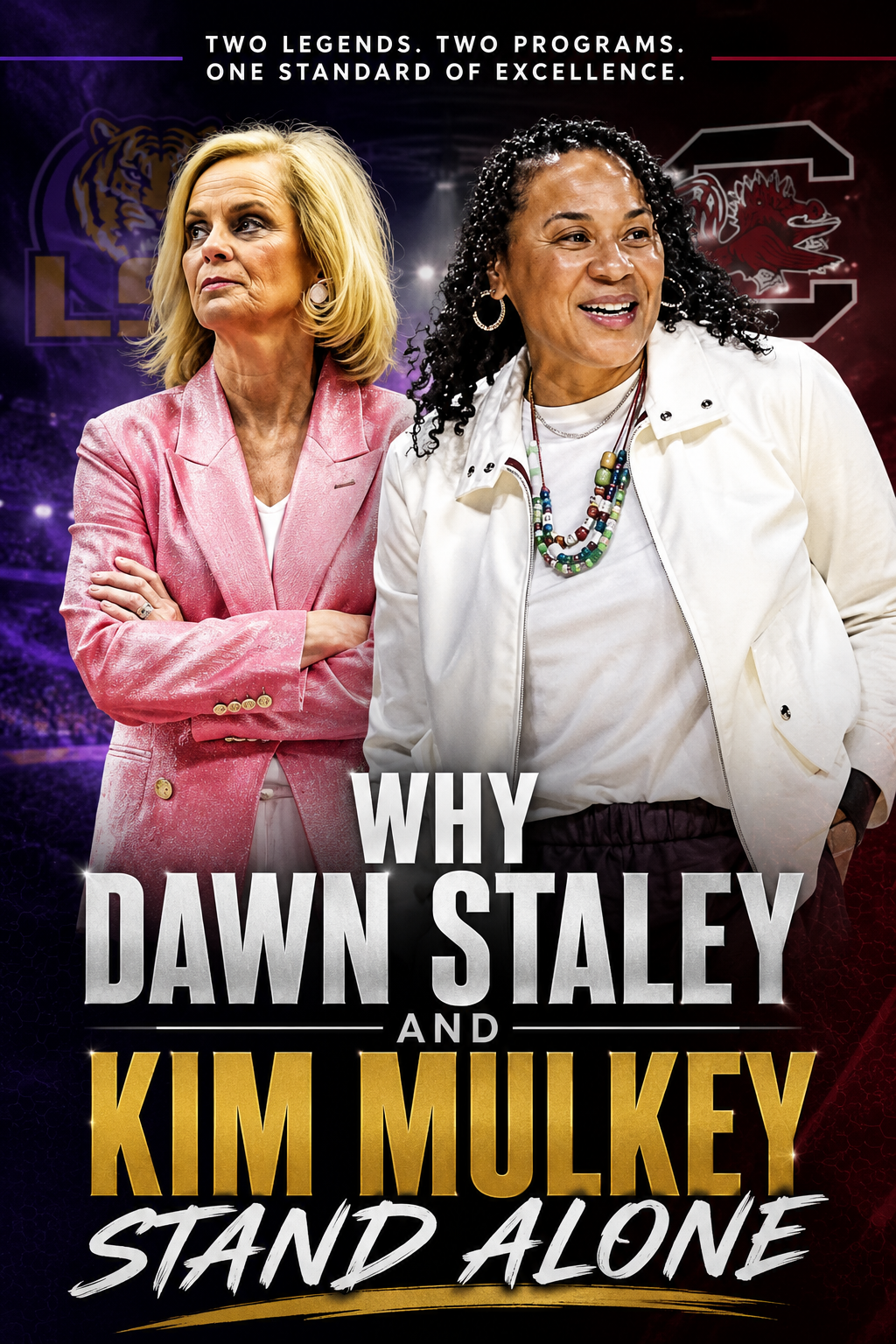
Elite: Kim Mulkey (LSU), Dawn Staley (South Carolina)
At the top sit two coaches who aren’t just the best in the conference — they’re among the best in the sport, period. Very few fan bases in the country wouldn’t trade their own coach for one of these two.
The championship math favors Mulkey slightly on its face: she ranks second among active coaches and third all-time with four national titles, while Staley sits tied with former Stanford coach Tara VanDerveer for third all-time with three. But nearly every other measure tilts sharply toward Staley. Her career winning percentage sits at .780 overall and .819 at South Carolina specifically, and since the 2021-22 season — when Mulkey took over at LSU — Staley has posted a .942 winning percentage compared to Mulkey’s .853 over that same stretch.
The gap becomes even starker within the conference itself. Staley rules the SEC outright: Mulkey has never won a regular-season or conference tournament title in the league, and has never beaten Staley while at LSU, whereas Staley holds a combined 19 wins in those same settings (a head-start advantage, admittedly, given her tenure length). Staley also holds an 8-5 edge in Final Four appearances and has turned South Carolina into a perennial championship-game participant, with six straight Final Fours and counting. LSU simply isn’t operating on that level of sustained dominance. Still, Mulkey’s extra national championship is enough to keep both coaches in the same top tier — for now.
Almost: Vic Schaefer (Texas)
Schaefer wins consistently, but rarely wins the games that matter most. His overall winning percentage of .694 is dragged down by an 80-110 record at Sam Houston State in the 1990s, though his mark across his two SEC-era stops improves to .806.
He’s made four Final Fours, finishing runner-up twice, and has claimed four regular-season conference titles along with four tournament titles (only two of those tournament titles coming in the SEC). He’s finished below third in his conference just once since 2014 — a genuinely strong sustained record.
But the deeper he gets into March, the more the pattern repeats. Three of his four Final Four losses weren’t competitive, and the fourth ended with his team surrendering the largest blown lead in Final Four history (after also blowing a 16-point lead in one of his two Final Four wins). That pattern — reaching the sport’s biggest stage and consistently faltering once there — is precisely what separates “Almost” from “Elite.” His career 1-8 postseason record against Staley reinforces just how far apart the two actually are, and a pivotal season now looms after three of his top returning players transferred out and weren’t complimentary about the program on their way out.
Pretty, Pretty Good: Kenny Brooks (Kentucky)
Brooks inherited a dismal Kentucky program and made it competitive almost immediately, working primarily with under-the-radar transfers rather than blue-chip signees — though standout talents like Georgia Amoore and Clara Strack have passed through. Kentucky isn’t yet competing for SEC titles under his leadership, but Brooks’ 2023 Final Four run at Virginia Tech — a program with limited historical pedigree — still carries real weight. No other coach outside the top two tiers can claim a tournament achievement of that caliber.
Pretty Good: Jennie Baranczyk (Oklahoma), Yolett McPhee-McCuin (Ole Miss), Shea Ralph (Vanderbilt)
The connective thread across this tier is turnaround success without a tournament breakthrough. All three coaches took over struggling programs and built them into top-15 outfits, but none has yet won big in March or genuinely contended for an SEC title.
Baranczyk inherited an Oklahoma program that had gone just 48-67 over the previous four seasons and won the Big 12 in both her second and third years. Her SEC transition has been rockier — finishing fourth and fifth in conference, though still cracking the top 11 nationally in both postseason polls. The core issue is a March ceiling: Oklahoma failed to escape the second round of the NCAA Tournament in Baranczyk’s first three seasons and hasn’t gotten past the Sweet 16 since. An up-tempo system that wins consistently in the regular season but stalls in the tournament — reflected in a 6-5 conference tournament record and 7-5 NCAA Tournament mark — suggests a stylistic ceiling as much as a talent one.
McPhee-McCuin’s Ole Miss rebuild is arguably the most impressive turnaround in the sport. Ole Miss had recorded just one 20-win season since Van Chancellor departed after the 1996-97 campaign, and Yo has now delivered five consecutive 20-win seasons. But the program has plateaued at the ceiling: never finishing higher than third in the SEC, including two straight sixth-place finishes, and never advancing past the Sweet 16. A pattern has emerged of a splashy offseason portal haul followed by a low-scoring, disappointing tournament exit.
Vanderbilt’s history makes Ralph’s task look different on paper — the Commodores had just two losing seasons between 1983 and 2016, but hadn’t posted a winning record in the five years before her arrival. A longtime UConn assistant who had turned down other opportunities, Ralph appears to be a natural fit. Last season’s second-place SEC finish and No. 6 national ranking, powered by one of the country’s best players in Mikayla Blakes, represent real progress on the recruiting trail. But bad losses to Ole Miss and Georgia, followed by an SEC Tournament quarterfinal upset and a Sweet 16 exit, leave an open question: were those growing pains for a young program, or a deeper issue Ralph needs to correct? That answer should become clearer by next summer.
Good: Sam Purcell (Mississippi State), Joni Taylor (Texas A&M), Larry Vickers (Auburn)
None of these coaches represents a genuine threat to win the SEC, but all three field well-coached teams that punch above their roster’s talent level — the kind nobody wants to face in a first-round matchup.
Purcell and Vickers both fall into a “do more with less” category. Every offseason, Mississippi State’s best talent gets picked over by bigger programs, and Purcell rebuilds and stays competitive regardless — raising a fair question about what he might accomplish somewhere with better retention and development infrastructure. Vickers, meanwhile, inherited what’s described as a “dumpster fire” at Auburn and had to build a roster almost from scratch after being hired just two days before the transfer portal opened — meaning after every other program had already made its moves. Auburn still finished just 15-17 (3-13 in the SEC), but the Tigers were surprisingly competitive and knocked off a ranked Alabama team. His track record before Auburn — four consecutive regular-season MEAC titles and three straight tournament titles at Norfolk State, with a 49-7 conference record over that stretch — adds real credibility that he can win when the playing field is level.
Taylor has struggled at Texas A&M, but her past success — SEC Coach of the Year in 2021 at Georgia — suggests she knows what she’s doing. Injuries derailed both her 2024 tournament team and her 2025 season, and after going all-in on the transfer portal last season, the Aggies were playing like a tournament team by season’s end despite a slow start. After nearly two decades under Gary Blair, it remains unclear whether Texas A&M’s current institutional support actually matches its ambitions.
Prove It: Kim Caldwell (Tennessee), Kellie Harper (Missouri), Kelsi Musick (Arkansas)
This tier is reserved for coaches who make rival fan bases happy with their own hire.
Harper had successful runs at Western Carolina and Missouri State but was fired by NC State in between, then presided over Tennessee’s decline into irrelevance. She finished third in the SEC in each of her first four seasons before a fourth-place finish — compounded by a forgotten timeout that cost Tennessee a defensive matchup against Kamilla Cardoso — ended her tenure. The win totals masked how far Tennessee had actually fallen behind the SEC’s real contenders. Missouri’s decision to hire her afterward felt, at the time, like an attempt to appear invested in women’s basketball without genuinely committing to it.
Ironically, the best thing to happen to Harper’s reputation may be Caldwell’s own struggles at Tennessee, which have made Harper’s tenure look better by comparison. Caldwell finished eighth in the SEC in her first season — tied for the worst finish in program history — under the stated excuse that she needed to install her own roster. She did exactly that, and Tennessee finished 8-8 again, tied for the second-worst record in program history, capped by a program-worst eight-game losing streak and blowout losses to both UConn and South Carolina. Her response was to force out the entire roster and half the coaching staff, several of whom quickly found new jobs elsewhere, including a head coaching position — placing the blame squarely on personnel fit. Whether that diagnosis proves correct, or whether it was simply an excuse, should become clear soon: either Caldwell moves off this tier next year, or she’s searching for a new job.
Musick found success at Division II Southwestern Oklahoma State, reaching two Regional Semifinals and a runner-up finish in 2019. But across four Division I seasons, she has never reached the NCAA Tournament and has lost her only postseason appearances in the WNIT and WBIT. Her clearest qualification for the Arkansas job appears to have been affordability rather than a proven track record at the top level.
Incomplete: Tammi Reiss (Florida)
Reiss compiled a .654 winning percentage across seven seasons at Rhode Island, winning two Atlantic 10 regular-season titles and reaching the NCAA Tournament last season — a solid overall track record. But Florida represents a fundamentally different tier of competition, and it wouldn’t be fair to rank her meaningfully before she’s actually coached a game there.
Unknown: Pauline Love (Alabama), Ayla Guzzardo (Georgia)
Neither coach has previously held a power-conference head coaching job, leaving both largely unranked until they prove themselves. Love brings a decade of SEC assistant experience across stops at Arkansas, Alabama and Oklahoma, while Guzzardo spent that same period as a head coach at Southeastern Louisiana and McNeese, leading the Lady Lions to the 2023 NCAA Tournament. It’s genuinely unclear which background better prepares a coach for the SEC’s demands — and the challenge is compounded by the fact that both are inheriting the two programs with the lowest current investment in women’s basketball in the conference.
About The Author