The NCAA Just Changed March Madness Forever — And Geno Auriemma Is Already Furious About It

College basketball’s biggest stage is getting bigger. Starting in 2027, the NCAA Tournament — both men’s and women’s — will expand from 68 to 76 teams, the most significant structural change to the bracket in over a decade. The reaction from coaches, fans, and programs has been anything but unanimous, and the debate it has sparked cuts straight to the heart of what March Madness is supposed to mean.
What’s Actually Changing
This is the first expansion of the men’s tournament since 2011 and the first on the women’s side since 2022 — both of which grew the field to the current 68-team format. The new structure adds eight teams and reshapes how the tournament opens entirely.
Gone is the First Four. In its place comes the “Opening Round” — 12 games featuring 24 teams competing for spots in the Round of 64. Think of it as a significantly expanded First Four with a cleaner name and a bigger footprint. The bracket will now carry 32 automatic bids and 44 at-large bids, giving more conferences and more programs a legitimate path to the dance.
The Opening Round structure breaks down deliberately. On the automatic qualifier side, there will be two No. 15 vs. No. 15 seed matchups and four No. 16 vs. No. 16 seed games. On the at-large side, two No. 11 vs. No. 11 seed games and four No. 12 vs. No. 12 seed games will determine who advances. The winners of all 12 Opening Round games move on to the Round of 64.
Dawn Staley Is Torn — And Her Honesty Is Refreshing
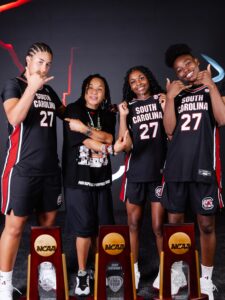
When The State asked South Carolina head coach Dawn Staley about expansion at SEC Spring Meetings in Miramar Beach, Florida, she gave the kind of answer that only someone with real credibility in the sport can afford to give — honest, nuanced, and slightly contradictory.
“I don’t think it’s competitive enough to handle adding more teams,” Staley told The State. “But it creates more opportunities for student-athletes to get an experience of playing in the NCAA Tournament, and I value that.”
Both halves of that statement are defensible. The 2026 women’s tournament was remarkably chalk — only six upsets across the first two rounds spanning 48 games, and the same four No. 1 seeds made the Final Four for the second consecutive year. If the existing 68-team field is already producing limited competitive variance, the argument for adding eight more teams on pure competition grounds is genuinely thin.
But Staley’s second point carries real weight in a different way. Women’s basketball is experiencing a cultural moment unlike anything in the sport’s history. More teams in the tournament means more programs receiving national exposure during the sport’s highest-visibility window. More wins mean more NCAA revenue units flowing to programs that desperately need financial investment. For mid-major programs trying to build something, a single tournament win can be transformational.
Geno Auriemma Isn’t Buying It
Not everyone is as measured as Staley. UConn head coach Geno Auriemma came in with both barrels.
“To me, this is strictly a money grab for the Power 4 conferences to get teams that finish 6-10 in their conference to get into the tournament,” Auriemma said. “If that’s not the plan to let more mid-majors in, then it doesn’t make any difference.”
Auriemma’s cynicism is grounded in a legitimate concern. Expansion only serves its stated purpose — broader access and opportunity — if the new spots actually go to deserving mid-major programs rather than mediocre Power Four teams that would have been watching from home under the old format. If the 44 at-large bids simply reward conference brand recognition over performance, expansion becomes exactly what Auriemma says it is: a revenue mechanism dressed up as democratization.
His concern is not unfounded. The selection committee has historically shown a bias toward Power Four programs with name recognition, and eight additional at-large bids create eight more opportunities to reward mediocrity over merit. Whether the committee resists that temptation remains the central unresolved question of this entire expansion.
On the other side, coaches like Georgia Tech’s Karen Blair and Mississippi State’s Sam Purcell have publicly embraced the change, citing the increased opportunities it creates for programs trying to break through. Their optimism reflects real hope that the new spots open genuine doors — not just wider hallways for the same old programs.
What This Means For South Carolina — Almost Nothing
Here’s the honest reality for Gamecock fans: tournament expansion is largely irrelevant to South Carolina women’s basketball in its current form.
The Gamecocks have made six consecutive Final Fours under Staley. They have been a No. 1 seed so consistently that the Opening Round — which features No. 11 through No. 16 seeds — might as well be happening on a different planet from where South Carolina is seeded. Under the new format, the Gamecocks would still be matched up with a Round of 64 opponent who survived the Opening Round, which is functionally identical to how they’ve already been paired with First Four survivors in recent tournaments.
The only scenario in which South Carolina finds itself anywhere near Opening Round territory is a program collapse so severe it would represent an entirely different conversation. Given the recruiting class Staley has just assembled — ranked No. 2 nationally, anchored by five-star forward Oliviyah Edwards — that scenario is not on the horizon.
The Bigger Picture
The 2027 expansion is a genuine inflection point for both tournaments, and the debate around it is worth having seriously. If the new spots deliver meaningful access to mid-major programs that deserve a national stage, expansion will be remembered as a democratizing moment for college basketball. If Auriemma’s prediction proves correct and Power Four bubble teams simply absorb the extra bids, the change will be little more than a bracket cosmetic surgery that enriched the right conferences without improving the sport.
The answer won’t be known until Selection Sunday 2027. Until then, the argument is very much alive — and coaches like Staley and Auriemma are making sure it stays that way.
About The Author