Dawn Staley’s 2026 Roaster are Turing heads With Their Resemblance & Comparison With College Basketball’s Biggest Names
South Carolina’s incoming freshman class is ranked No. 2 in the country for a reason. Five players, multiple five-stars, and a collection of skill sets that fit Staley’s system like they were custom-built for it. But rankings only tell part of the story. To understand what this class actually means for the Gamecocks, you have to look at who these players remind you of — and the comparisons are genuinely exciting.
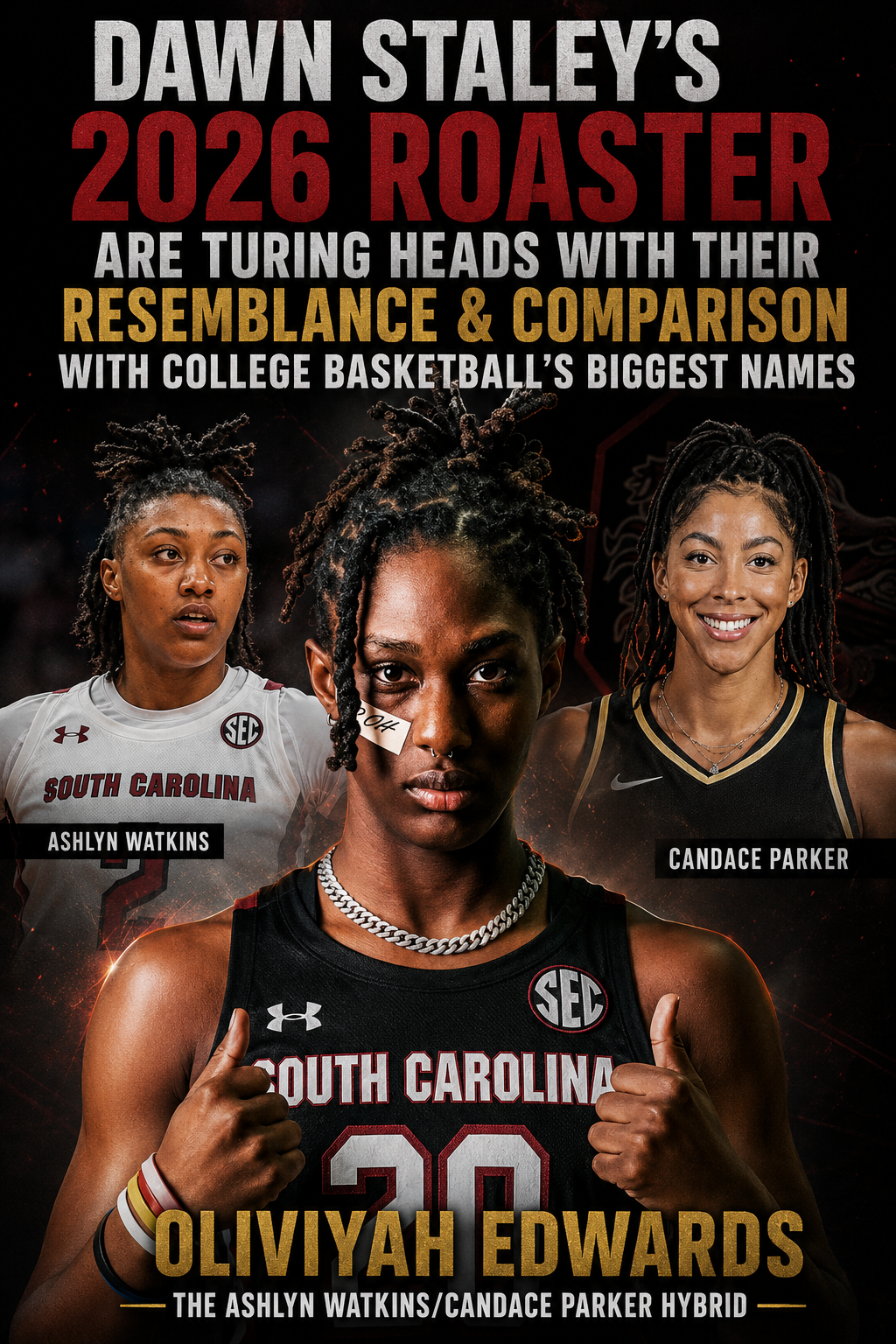
Oliviyah Edwards — The Ashlyn Watkins/Candace Parker Hybrid
The crown jewel of the class draws a comparison that requires no apology. Edwards, the 6-foot-3 forward who flipped from Tennessee to South Carolina after the Lady Vols’ mass exodus, is being described as a physical hybrid of two of the most impressive athletes the women’s game has ever produced.
The physical frame and raw power remind evaluators of Ashlyn Watkins — strong, explosive, and difficult to move off her spot. But Edwards carries something Watkins doesn’t quite have in the same measure: fluidity and offensive versatility. That’s where Candace Parker enters the conversation. Parker’s ability to operate at multiple levels with a smoothness that belied her size made her arguably the most complete women’s basketball player of her generation.
Edwards isn’t Parker yet — and may never be. But the fact that Parker represents her ceiling rather than her floor tells you everything about the kind of talent walking into Columbia this fall. At 6-foot-3 with athleticism that includes the ability to dunk, Edwards has already done things that most players her size simply cannot do. The question isn’t whether she can play at this level. It’s how quickly she gets there.
Jerzy Robinson — The Next JuJu Watkins
The comparison isn’t made casually, and it isn’t made simply because Robinson broke JuJu Watkins’ career scoring record at Sierra Canyon High School. It goes deeper than a record. It goes to how they play.
Robinson, a 6-foot-2 guard ranked No. 6 in the class of 2026, operates with the kind of patient, NBA-style offensive game that you rarely see at the high school level. She’s a three-level scorer who can post up, pull up, or attack — and she does it without relying on speed. Like Watkins, Robinson uses angles, footwork, and pure skill to manufacture advantages that quicker players can’t replicate. She makes the game look slow because she’s always two reads ahead.
The stakes of that comparison are significant. Watkins set the NCAA freshman scoring record and won national Player of the Year as a sophomore at USC. The pressure of following that path into Greenville’s Bon Secours Wellness Arena on November 15 — when Robinson and Watkins will face each other directly — will be one of the most compelling individual storylines of the early women’s basketball season.
Robinson isn’t walking into South Carolina to play a supporting role. She’s walking in as a potential star from day one.
Kaeli Wynn — The Winning Basketball Player
The Kayla Thornton comparison for the 6-foot-2 wing is instructive precisely because Thornton wasn’t always a household name — until she was. Thornton spent years grinding on WNBA rosters as a defensive specialist before Golden State finally gave her a full offensive role, and the result was an All-Star season that validated everything she’d been building toward.
Wynn enters South Carolina with a slightly more polished shooting touch than Thornton had early in her career, and perhaps a tick below Thornton’s defensive intensity at this stage of development. But the most important element of the comparison has nothing to do with individual statistics. Both players, at their core, play winning basketball — the kind of unseen, connective tissue work that championship rosters are built around.
On a team with the individual talent South Carolina is assembling, Wynn’s ability to do the right thing consistently — defend, move the ball, hit open shots — could end up being as valuable as anyone’s highlight reel.
Kelsi Andrews — Jump-Shooting Kiah Stokes, With More Upside
The Andrews comparison requires the most honest caveat of any player in this class: injuries have clouded the projection. When you can’t count on a full, healthy season of film, building a definitive scouting report becomes genuinely difficult.
What evaluators can see right now reminds them of Kiah Stokes — a 6-foot-3 defensive-minded forward who rebounds with purpose and makes life difficult for opposing post players. Stokes was valuable enough that A’ja Wilson insisted her second Defensive Player of the Year Award be shared with her, which is about as meaningful an endorsement as the position can receive.
The difference — and this is where Andrews becomes truly intriguing — is the jumper. Andrews already shoots better from the perimeter than Stokes does, and her offensive ceiling appears higher. If she stays healthy for a full season inside South Carolina’s development system, the combination of Stokes-level defensive impact and a credible offensive threat from the forward position could make her one of the most versatile pieces on this roster.
The if is real. But the upside is just as real.
Justine Loubens — European Joe Ingles, And That’s A Compliment
The most creative comparison of the group belongs to the French wing who followed Alicia Tournebize to Columbia. Loubens, a 6-foot-1 lefty, carries a distinctly European feel to her game — and the closest analog the evaluators could find wasn’t another women’s player at all. It was Joe Ingles, the left-handed Australian forward who spent the bulk of his NBA career with the Utah Jazz.
The parallels are specific and genuine. Ingles — 6-foot-8 — was never the most athletic player on the court, but he had a lightning-quick release and an uncanny ability to get to the rim through timing, deception, and cutting rather than athleticism. Loubens at 6-foot-1 operates with the same traits: quick release, smart movement without the ball, and a finishing ability that consistently surprises defenders who underestimate her.
The primary mechanical difference is the path to the basket. Ingles typically got there off the dribble; Loubens gets there through off-ball cuts — a skill that fits perfectly inside Dawn Staley’s motion-heavy offense. A player who can cut to the rim, finish consistently, and knock down perimeter shots with a fast release is exactly the kind of European hidden gem Staley and Lisa Boyer were describing when they talked about international recruiting. Loubens might be the best example of that philosophy bearing fruit.
What This Class Means As A Whole
Five freshmen. Five distinct skill sets. Five players who, collectively, address depth, versatility, and scoring at nearly every position on the floor.
Edwards provides the elite frontcourt anchor. Robinson provides the next-generation scoring guard. Wynn provides the winning glue. Andrews provides defensive versatility with offensive upside. Loubens provides the international wildcard with a game built for Staley’s system.
This isn’t a class built around one transcendent talent hoping the rest fills in. It’s a class assembled with purpose — and if even three of these five comparisons prove accurate, South Carolina’s 2026-27 roster may be the most talented Dawn Staley has ever coached.
About The Author