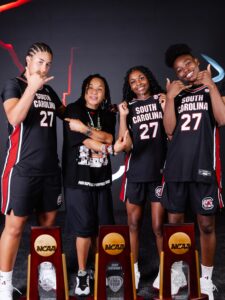
Dawn Staley Just Did Something Almost No Coach In America Can Do
In the modern era of college basketball, roster continuity is the exception. The transfer portal has fundamentally reshaped how programs are built, how coaches plan, and how quickly a team can unravel between March and October. Against that backdrop, what Dawn Staley just accomplished deserves to be stated plainly: every single player with remaining eligibility is coming back to South Carolina next season. Not one Gamecock entered the portal.
That is not normal. That is extraordinary.
The Numbers Put It In Perspective
South Carolina was one of just 14 programs nationally to emerge from the spring portal window without losing a single player. Among Power Four programs — the schools with the resources, the brand power, and the roster depth that make transfers most tempting — only South Carolina and UCLA pulled it off.
This isn’t the first time Staley has done it. It’s the third time since the portal’s inception in 2018, and in the years between, South Carolina has lost an average of just over one player per cycle — a figure that already ranked among the best retention rates in the sport. The complete shutout is rarer still, and the timing of it — coming off a season where the roster is as deep and as talented as it has been in years — makes it more meaningful, not less.
When a program is thin, players stay because the path to minutes is clear. When a program is loaded, the calculus changes entirely. Bench players can look across the country and find starting jobs. Role players can find featured roles. The fact that nine returners, many of whom will fight for limited minutes next season, all chose to stay in Columbia anyway is the real story here.
Culture Is Not A Talking Point — It’s The Product
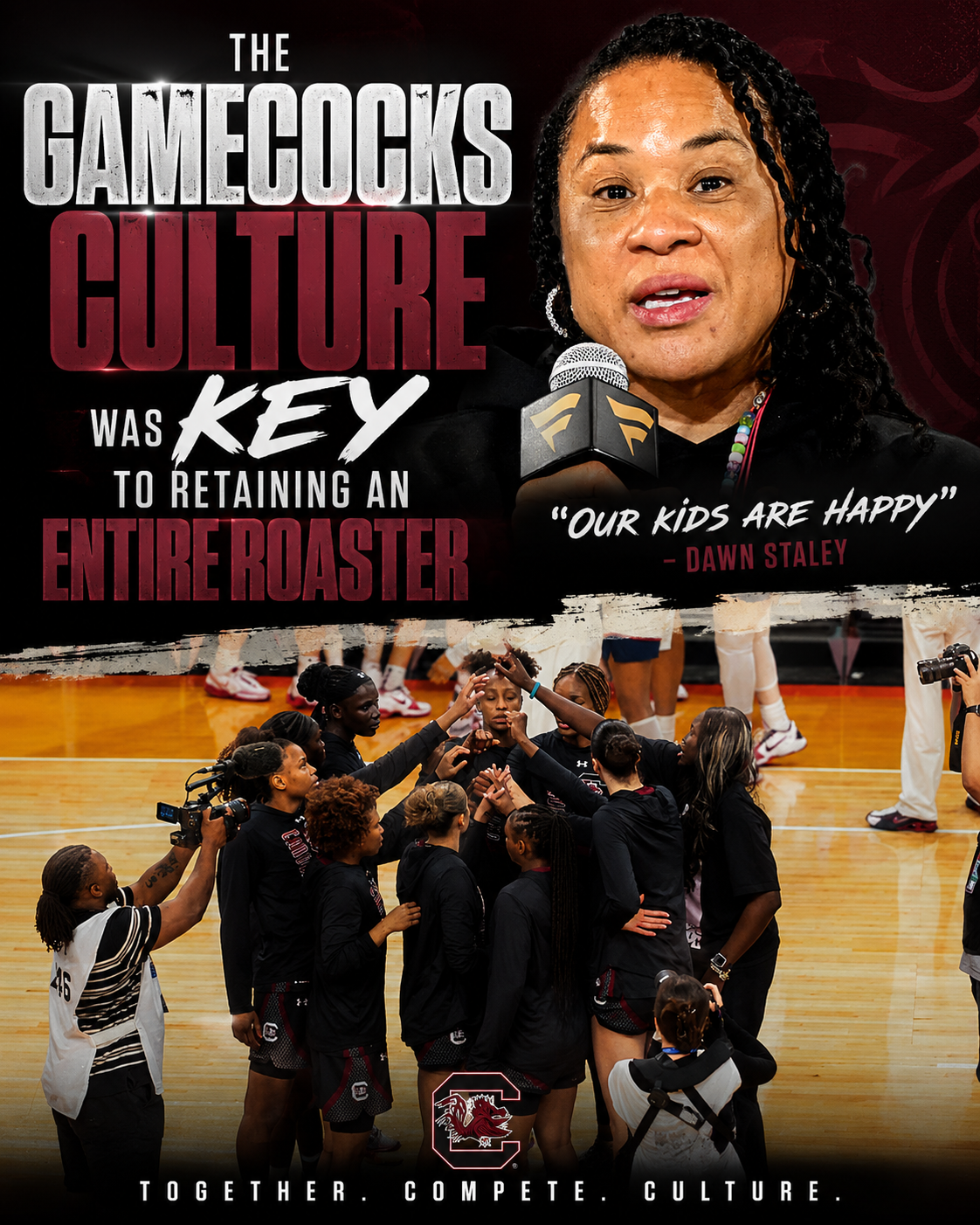
When Staley was asked about the key to keeping such a talented group together at SEC Spring Meetings in Miramar Beach, Florida, she didn’t reach for recruiting rankings or NIL packages. She went straight to the root.
“I think culturally speaking, our kids are happy,” Staley told The State. “Their parents are happy. When you’re in a situation where maybe everything isn’t 100% as you visualized, but when you’re genuinely happy, and when you have a voice, and when you have a path to success, it makes it a little bit easy to stay where you know what’s happening versus trying to go somewhere else and figure things out.”
That answer is worth unpacking carefully, because it addresses something most programs never solve. Staley isn’t claiming every player gets exactly what they want. She’s acknowledging that some players are not playing as many minutes as they imagined, not occupying the role they expected. That gap between expectation and reality is exactly where transfers are born — and Staley is closing it not by changing the reality, but by making the environment compelling enough that players choose to navigate it rather than escape it.
Having a voice. Having a path. Being genuinely happy. Those aren’t soft concepts — they’re retention mechanisms that money cannot manufacture.
What These Nine Players Are Returning To
The returning group is loaded in every sense of the word. Maddy McDaniel, Tessa Johnson, Joyce Edwards, Adhel Tac, Chloe Kitts, Ayla McDowell, Alicia Tournebize, Agot Makeer, and Ashlyn Watkins all carry remaining eligibility, and all will be back in Columbia.
Collectively, every one of these nine players returns with national championship playing experience — a baseline of high-stakes basketball that cannot be recruited and cannot be transferred in. Three of them — Johnson, Kitts, and Watkins — have national championship winning experience, the kind of institutional memory that shapes how a locker room handles pressure in February and March.
Kitts and Watkins, both returning from ACL injuries, represent perhaps the most significant wild cards in women’s college basketball heading into next season. When healthy, Kitts was a starter and one of the most physically imposing forwards in the SEC. Watkins was a rebounding force before her injury. Their returns alone would have made South Carolina a preseason contender. The fact that they return alongside Joyce Edwards — who elevated from 12.7 points per game as a freshman to 19.2 as a sophomore — gives the Gamecocks three legitimate stars in their frontcourt before the freshmen even arrive.
Now Add The Incoming Class
If full roster retention was the foundation, the recruiting class is the roof. South Carolina adds five true freshmen — five-stars Oliviyah Edwards, Kaeli Wynn, and Jerzy Robinson, alongside four-stars Kelsi Andrews and Justine Loubens — all joining a program ranked No. 2 nationally in recruiting. Texas transfer Jordan Lee, an All-SEC caliber perimeter defender and scorer, slides in as perhaps the most immediately impactful addition.
The combined effect is a roster that could realistically be the deepest in the history of the program. Fourteen to fifteen players. Multiple All-Conference caliber returners. An incoming class with legitimate star power at multiple positions. And zero off-season attrition to manage around.
That last point is what separates South Carolina from almost every other elite program in the country right now. While rivals spend the offseason patching portal holes and reintegrating new systems, Staley enters the fall with a full, stable, chemistry-intact roster that has already lived inside her system. The headstart is real and it is significant.
Why Players Stay Even When They Could Start Somewhere Else
This is the hardest thing to replicate and the easiest thing to underestimate. Several of the nine returning players — Tac, McDowell, Tournebize, McDowell, and Makeer among them — could plausibly transfer to other programs and earn starting positions or significantly expanded roles immediately. The portal would welcome them. Coaches would call.
They stayed anyway. And Staley’s second quote from Miramar Beach explains exactly why.
“I think it all has to do with culture, and I think whoever their support systems are that are in place knowing that they’re happy,” Staley told The State. “They feel it, they understand it. It may not always be that way, but for where they are today. I think a lot of young people actually feed off what’s happening to them today, what they’re feeling today.”
What they’re feeling today, at South Carolina, is winning. Six consecutive Final Fours. Four national championship games. Two national titles. A 206-16 overall record in that span, including 91-5 in SEC play. Four SEC Tournament championships. These are not recruiting pitches — they are lived experiences that every returning player has been part of. When the choice is between a starting role at a program still trying to find itself and a reserve role inside a dynasty with a genuine chance to cut down nets in April, the answer, apparently, keeps coming back the same way.
Stay in Columbia. Trust the culture. Chase the banner.
For the third time since 2018, every Gamecock agreed.
About The Author