
She’s Won 3 Gold Medals and Hasn’t Played a College Game Yet — South Carolina’s Newest Freshman Just Keeps Winning
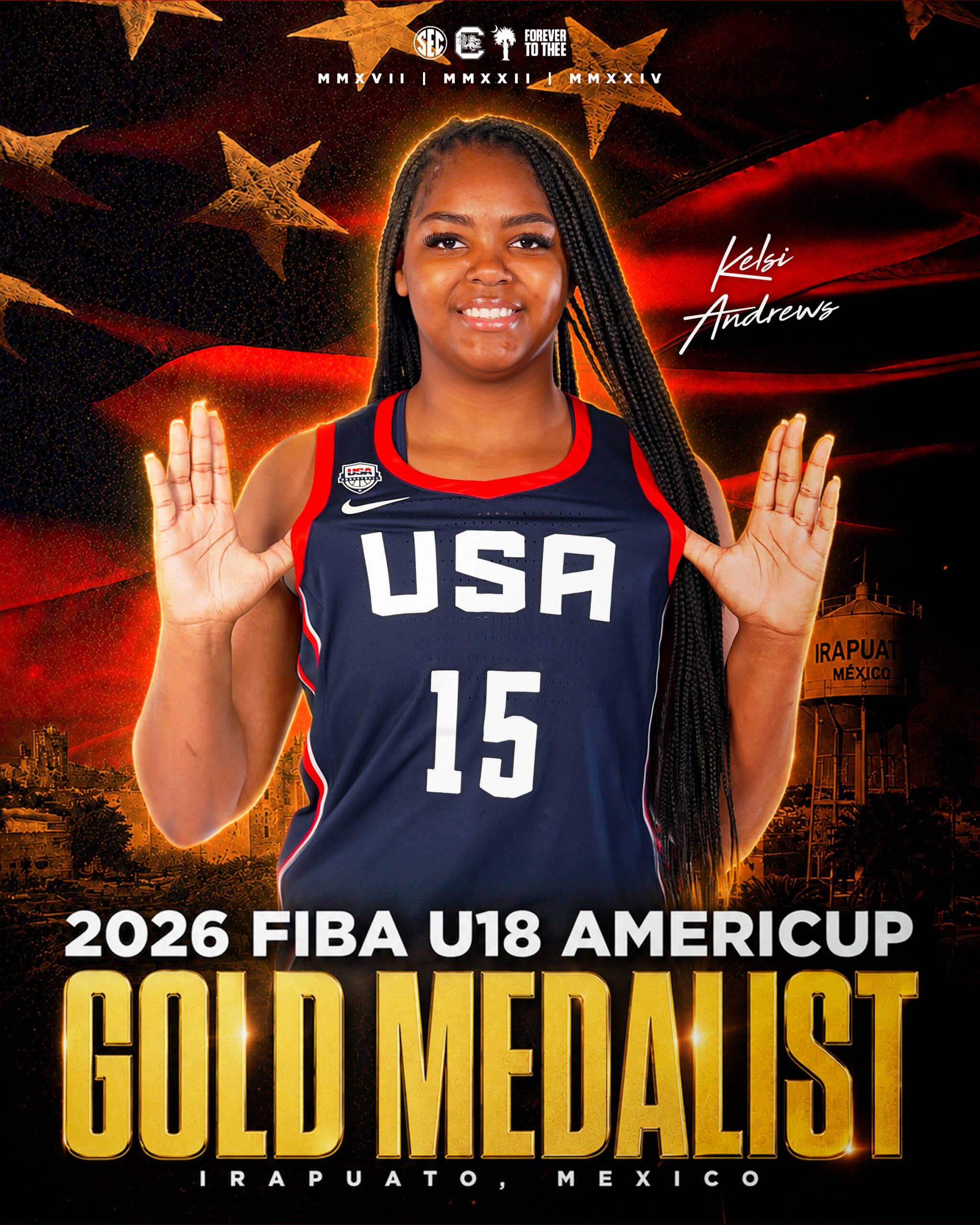
Some freshmen arrive on campus having played high school basketball. Kelsi Andrews arrives having conquered a continent.
The South Carolina incoming freshman capped her pre-college career this week by helping the United States claim its 12th-consecutive gold medal at the FIBA U18 AmeriCup in Irapuato, Mexico, with a 90-72 victory over Canada. It is Andrews’ third international gold medal — joining titles at the 2024 FIBA U17 World Cup and the 2023 FIBA U16 AmeriCup — and she has yet to play a single college game.
That résumé, accumulated across three different age-group tournaments over three consecutive years, is not accidental. It is a pattern — and patterns at the international level tend to be predictive.
What the Tournament Actually Revealed
Andrews’ raw averages for the tournament — 6.2 points, 3.8 rebounds, and 2.2 assists in 12.2 minutes per game — won’t dominate a highlight reel. But those numbers require the correct analytical frame. She was operating in a rotation on a loaded USA Basketball roster, logging just over 12 minutes per contest while contributing meaningfully across multiple statistical categories. Efficiency within a limited role on an elite team is a more revealing indicator of a player’s readiness than inflated numbers on a weaker squad.
The semifinals against Venezuela provided the clearest window into Andrews’ ceiling. In 14 minutes against an overwhelmed opponent, she posted 13 points and 10 rebounds — her first double-double of the tournament — while shooting 6-of-9 from the field. The four offensive rebounds are particularly telling. Offensive rebounding requires anticipation, physicality, and a willingness to compete in traffic. It is not a skill that shows up in recruiting rankings, but it consistently separates good players from great ones at the next level.
The Gold Medal Game — And the Moment That Mattered
The final against Canada was not the coronation walk the semifinals suggested it might be. The U.S. struggled offensively early, found themselves locked in a tight first quarter, and had to grind through a back-and-forth second period before a 9-0 run opened a 12-point lead and gave the Americans breathing room heading into halftime.
Even with a 16-point cushion at the break, Canada refused to fold. The Canadians clawed back to within single digits with just over four minutes remaining — the kind of momentum shift that can unravel a young team if the wrong player touches the ball in the wrong moment.
Andrews touched it.
A fast break layup in that window pushed the American lead back to double digits and, functionally, ended the competitive portion of the game. That sequence — making the right play, at the right time, when the pressure is highest — is what separates players who accumulate statistics from players who accumulate wins.
Andrews has accumulated wins at every stop across three years of international competition.
What Three Gold Medals Actually Mean
The medal collection deserves context beyond the headline. USA Basketball’s youth programs are among the most competitive selection processes in amateur sports. Making one roster is an achievement. Making three consecutive rosters across different age groups — and contributing to championship runs each time — indicates a player who not only meets the standard but consistently clears it.
The progression is also notable. Andrews competed at the U16 level in 2023, the U17 level in 2024, and the U18 level in 2025. Each tournament represented a step up in competition, age, and physical intensity. Each time, she was selected. Each time, the United States won gold. The consistency across that arc is not coincidence — it is a competitive identity being established in real time.
The South Carolina Implication
Dawn Staley has built a program that does not develop winning mentalities from scratch — she recruits them. The players who have defined South Carolina’s dynasty didn’t simply learn how to win in Columbia. They arrived already knowing, and the program sharpened what was already there.
Andrews arrives in Columbia having won more international hardware before her first college practice than most players accumulate across an entire career. She has competed under pressure, delivered in critical moments, and embraced a role-player’s responsibilities on teams built to win rather than showcase individuals.
That is precisely the profile Staley’s system rewards.
The on-court development that comes with a full preseason, SEC competition, and daily practice against elite teammates will determine how quickly Andrews translates her international track record into meaningful college minutes. But the foundational ingredient — an absolute refusal to lose — appears to be firmly in place.
Three gold medals before your first college game says something that statistics alone cannot.
South Carolina’s freshman class just got a little more interesting.
About The Author