She Grew Up in France, Her Mom Battled Dawn Staley — Now She’s Coming for the Paint at South Carolina
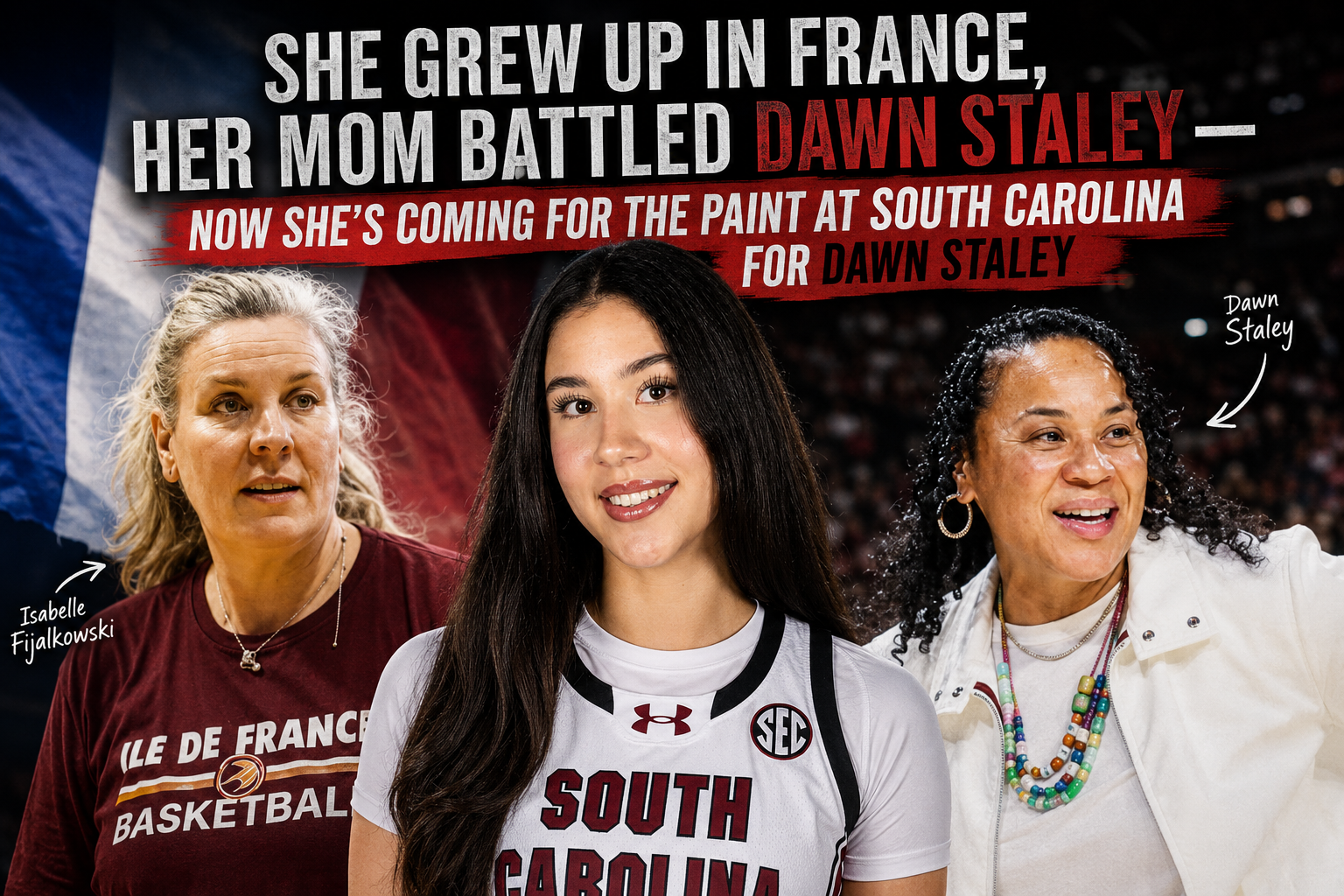
Thirty-two summers ago, Isabelle Fijalkowski stood across the court from Dawn Staley at the 1994 Goodwill Games in St. Petersburg, Russia. France fell 87-63 to the United States that day, and the two competitors went their separate ways — Staley toward Olympic glory, Fijalkowski toward a decorated European career that would ultimately land her in the Women’s Basketball Hall of Fame on June 27.
What nobody could have predicted was that their rivalry would one day produce something far more interesting than a box score.
Fijalkowski’s daughter, Alicia Tournebize, is now wearing a Gamecocks uniform.
A Hall of Fame Bloodline
To understand what South Carolina may have on their hands, you first have to understand the mother.
Fijalkowski, a 6-foot-5 center from Clermont-Ferrand, France, is not simply a former professional basketball player — she is one of the most decorated women’s players in European history. After a single college season at Colorado in 1994-95, she entered the WNBA in 1997 and won an Eastern Conference title with the Cleveland Rockers in 1998. But it was back in Europe where her legacy was truly cemented: two EuroLeague championships, five French League titles, and two French League MVP awards. Her Hall of Fame induction is not a courtesy nod — it is a long-overdue acknowledgment of a career built across two continents.
That pedigree matters when projecting what Tournebize could become. Elite athletic bloodlines don’t guarantee elite athletes, but they do tend to guarantee something rarer: elite fundamental development. South Carolina associate head coach Lisa Boyer made that connection immediately.
“Ali’s very skilled. I think her mother had a lot to do with some of her early training,” Boyer said.
A Diamond Still Being Cut
Tournebize, 18, is not yet the finished product. She committed to South Carolina in December and joined the team mid-season — skipping the full summer of preseason conditioning and strength work that most freshmen lean on to bridge the gap between recruitment and real minutes. In 20 games, she averaged 4.0 points and 3.4 rebounds on 41.8% shooting. Those are quiet numbers.
But quiet numbers have context.
The 6-foot-7 forward arrived into a frontcourt that already featured 6-foot-6 center Madina Okot, which organically slotted Tournebize into a more measured role — learning the system, getting comfortable in the paint, building her footing without being thrown into a starting role she wasn’t yet ready for. That is actually ideal development. High-ceiling prospects burn out when they’re overexposed too early. Tournebize, by all indications, has been handled carefully.
What the coaching staff has seen in that limited sample has them genuinely excited.
“She is very, very fundamental,” Boyer said. “There’s very few flaws in her game when it comes to like how she shoots and all that kind of stuff. She’s got a pretty shot.”
That is a striking endorsement when you consider who is delivering it. Boyer has coached at the highest levels of women’s basketball for decades. “Very few flaws” at 18 years old — arriving mid-season, no preseason — is not standard praise. It is a signal.
The Wingspan of Possibility
What makes Tournebize genuinely intriguing as a prospect is the rare combination of size and fluidity she brings. At 6-foot-7, she carries the height and length typical of a traditional post center — but her game moves like a wing guard’s. She doesn’t lumber. She flows.
That duality creates matchup problems that most frontcourt players simply don’t produce. When Okot departed for the WNBA, it opened the door for a more dynamic usage of Tournebize heading into 2026-27. With Joyce Edwards (6-foot-3) and Chloe Kitts (6-foot-2) occupying the frontcourt alongside her, the Gamecocks have the pieces to build a genuinely versatile inside game. Tournebize can work the high-low with either — drawing defenders and feeding cutters — or station herself closer to the rim, especially against smaller looks.
There’s also the dunk factor. She has thrown down one- and two-handed dunks at the professional level in France. She hasn’t done it in a college game yet, but the threat alone changes how defenders position themselves. Tournebize herself seems measured about it — she won’t force it — but that restraint is actually a sign of basketball IQ, not timidity.
“Ali, she’s going to be a monster, I think,” Boyer said plainly. “Her mother was a tough cookie.”
The X-Factor in Waiting
South Carolina does not need Alicia Tournebize to save them in 2026-27. Their roster is loaded. But the most dangerous teams aren’t just built on starters — they’re built on depth that opponents can’t prepare for. A 6-foot-7 forward with fundamental shooting, professional experience, elite bloodlines, and a full preseason finally under her belt is exactly the kind of off-the-bench weapon that unravels opposing game plans.
Thirty-two years ago, her mother couldn’t beat Dawn Staley.
This time around, Fijalkowski has sent Staley something better than a challenge — she’s sent her a weapon. Whether Tournebize becomes an X-factor reserve or something much bigger may well depend on what this coming summer reveals.
The early evidence suggests the Gamecocks may have stumbled into one of the more fascinating developmental stories in women’s college basketball.
About The Author