South Carolina Athletics: A Program at a Crossroads Between Present Obligations and Future Ambitions
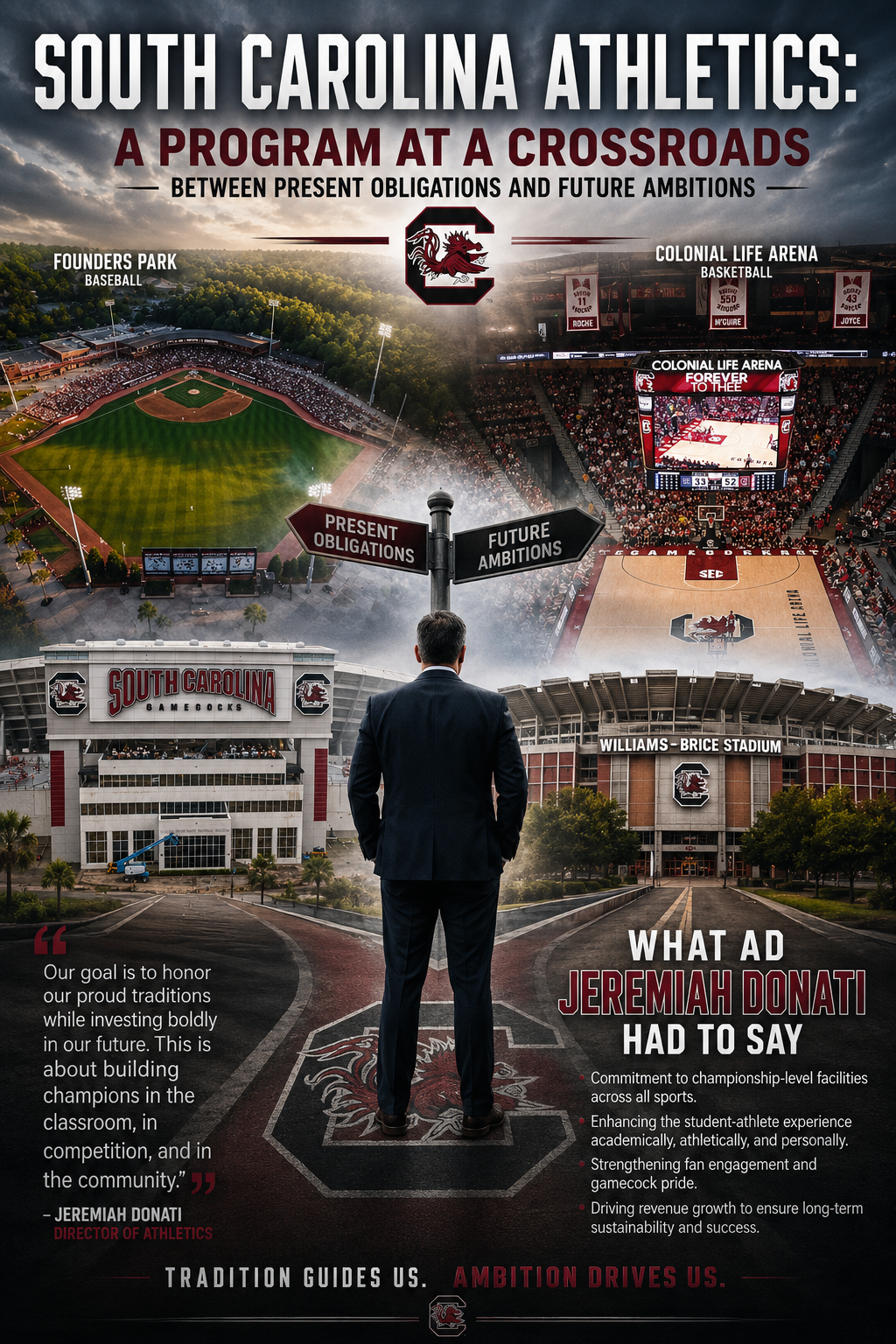
Athletics director Jeremiah Donati finds himself navigating one of the most consequential stretches in South Carolina athletics history — simultaneously closing out a turbulent coaching search, overseeing the largest capital project in program history, and laying the groundwork for what comes next across a facilities portfolio that is, by his own admission, beginning to show its age.
The Baseball Search: Closure After Uncertainty
The abrupt dismissal of Paul Mainieri on March 21 — mid-season, no less — signaled that Donati was unwilling to let the baseball program drift. What followed was a two-month-plus search that culminated in the June 10 hiring of Kevin Schnall. The deliberate pace of that process suggests Donati prioritized fit over speed, a meaningful choice given the instability the program had just experienced.
The hire itself represents a bet on upward trajectory. Donati framed it accordingly: “To be honest, the biggest thing for us was finding the right head coach to take this thing and get us back in a really good place.” That language — get us back — is telling. It acknowledges regression while projecting confidence in the corrective path forward.
Williams-Brice: The $350 Million Anchor
Dominating Donati’s bandwidth is the ongoing $350 million renovation of Williams-Brice Stadium, a project that won’t reach full completion until the 2028 football season. With the first phase slated to be ready ahead of this coming season, the pressure to deliver on schedule is immense — both financially and reputationally.
Donati is candid about where the organizational focus must remain: “I think the priority right now has to be the stadium. For obvious reasons, we’ve got a lot of money soaked into that.” There is no ambiguity in that statement. Until Williams-Brice is complete, it commands the lion’s share of strategic attention and capital allocation. Every other facilities conversation happens in that shadow.
Colonial Life Arena: An Aging Asset
Perhaps the most striking disclosure to emerge from Donati’s recent comments concerns Colonial Life Arena. The nearly 24-year-old venue — home to both basketball programs and a marquee concert and events destination — has never undergone a full-scale renovation since opening. Donati was unusually direct in assessing its condition: “The reality is that facility is probably near the end of its life cycle.”
That is a significant statement from an AD. “End of life cycle” language typically precedes one of two outcomes: a major renovation or a replacement conversation. Donati stopped short of committing to either, defaulting instead to a measured framework: “What I would say is, like any other project we’ve done, let’s take a look at what needs to be fixed or what needs to be upgraded, and then let’s put a plan together.”
The prudence is understandable — you don’t announce a $300 million arena project while still building out a $350 million stadium. But the clock is ticking, and the longer Colonial Life Arena goes without capital investment, the more urgent that conversation becomes. For a basketball program trying to compete nationally in both the men’s and women’s games, the facility gap is not a minor issue.
Founders Park: Potential Waiting in the Wings
While Colonial Life Arena may be the more pressing infrastructure concern, Founders Park carries its own distinct energy in the fan base. AI-generated renderings have been circulating on social media, with supporters imagining expanded and modernized versions of a ballpark that has remained largely unchanged since its 2009 debut. The locker room area is receiving upgrades this summer — proof that investment isn’t off the table — but a comprehensive reimagining has yet to materialize.
The most tangible near-term development is the transfer of the parking lot at the corner of Blossom and Williams streets to the university. No immediate changes are planned, but the possibility of vertical development — a parking garage, for instance — keeps future expansion of the footprint alive. That kind of land consolidation rarely happens without a longer-term purpose in mind.
Donati acknowledged the moment while managing expectations: “There will come a time — and probably soon — that we really need to take a deep dive and see what’s possible here at Founders.”
The Broader Picture
What emerges from surveying all of this is a program operating in a careful sequence. The baseball hire is done. Williams-Brice is the present obligation. Colonial Life Arena and Founders Park are the next chapters — but chapters that can only be written once the current one is finished.
The challenge for Donati is that athletics facilities competition doesn’t pause while you finish your last project. Rival programs are investing aggressively. Recruiting battles are increasingly won and lost in locker rooms and weight rooms before they ever reach the field or court.
South Carolina’s ability to sustain momentum — in baseball, basketball, and beyond — may ultimately depend on how quickly and boldly Donati can turn the page once Williams-Brice is in the rearview mirror. The framework is there. The land is being assembled. The need has been publicly acknowledged. What remains is execution.
About The Author