Adidas Girl, Nike School — Can Oliviyah Edwards’ Brand Deal Stop Her From Becoming A Gamecock, Or Is South Carolina’s $70 Million Nike Contract The Ultimate Counter Offer?
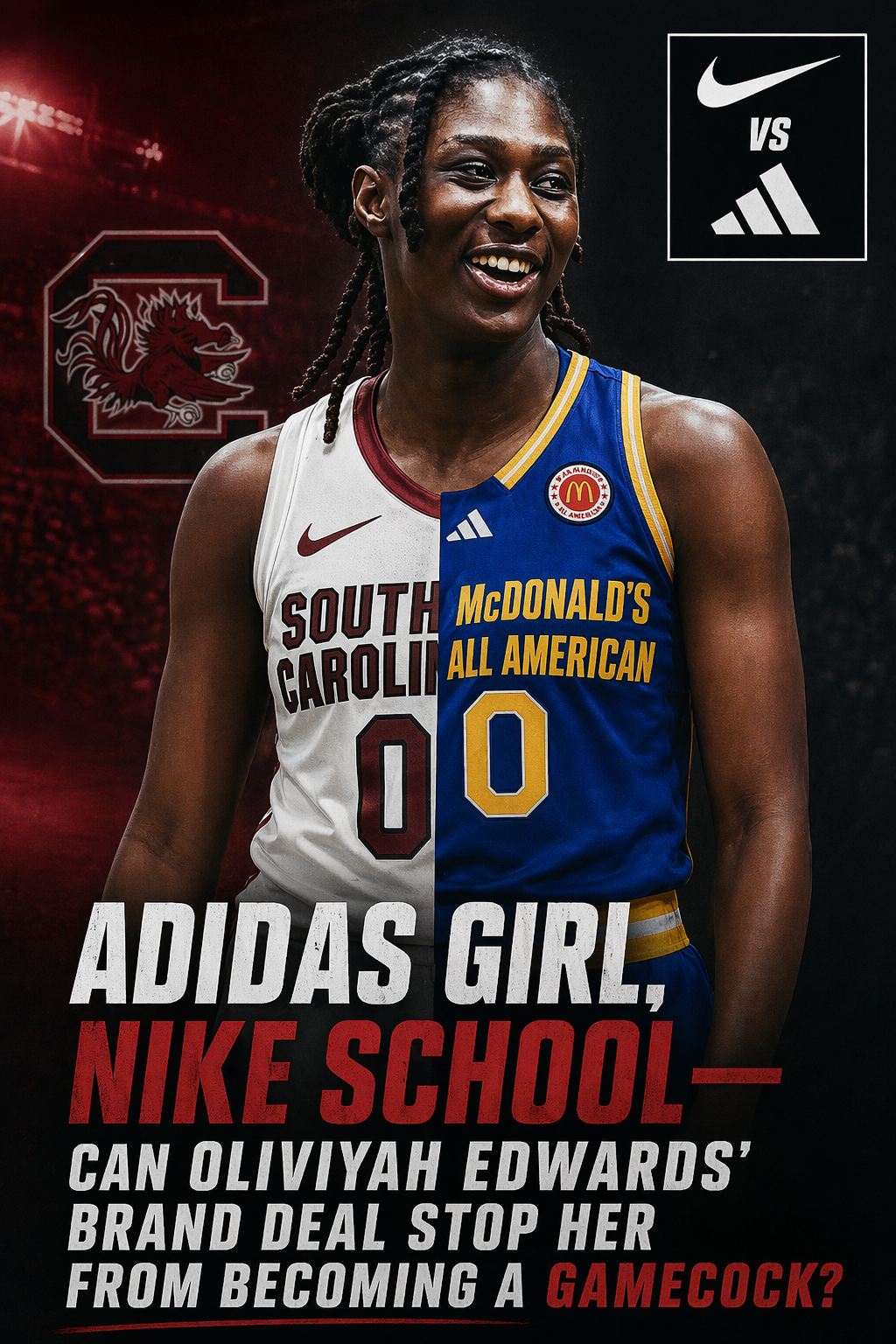
In the modern era of college basketball recruiting, the conversation has expanded far beyond campus visits, coaching relationships, and playing time promises. In 2025, five-star recruits arrive with their own brand partnerships, their own NIL portfolios, and their own business considerations that can genuinely influence where they choose to play. And for Oliviyah Edwards — the No. 3 overall recruit in the Class of 2026 — one of those business considerations has introduced a fascinating wrinkle into what is already one of the most closely watched recruitments in women’s college basketball.
She has an Adidas deal. South Carolina is about to become a Nike school.
The question is whether that conflict is a dealbreaker — or simply a storyline that ultimately gets resolved by everything else Columbia has to offer.
Who Is Oliviyah Edwards And Why Does This Matter?
Before diving into the brand dynamics, the basketball context demands acknowledgment. Oliviyah Edwards is not simply a highly ranked recruit. She is a 6-foot-3 forward whose combination of size, skill, and positional versatility places her among the most coveted prospects in her class — a player who, wherever she lands, will immediately change the competitive calculus of that program’s frontcourt.
She originally committed to Tennessee, and the Lady Vols were a logical destination for multiple reasons. One of the most specific was brand alignment — by the time Edwards would have arrived on campus, Adidas would have become Tennessee’s official uniform supplier, perfectly matching the NIL partnership Edwards signed with the brand in May 2025. The pieces fit cleanly.
Then she decommitted. And suddenly, the landscape of her recruitment — and the brand equation at its center — became considerably more complicated.
South Carolina, Texas, and Louisville have all emerged as serious contenders following her decommitment. Edwards has visited Columbia and taken a look at what Dawn Staley’s program offers. Louisville is an Adidas school, which maintains the brand alignment she had with Tennessee. Texas is Nike. South Carolina is about to be Nike too — completing a transition from Under Armour that becomes official on July 1st following a landmark 10-year, $70 million partnership announced in August.
The Brand Conflict — A Roadblock Or A Speed Bump?
The honest answer, supported by how the NIL landscape actually operates, is that Edwards’ Adidas deal is a factor, not a barrier. It is a consideration that adds complexity to the decision without necessarily determining it.
Here is the practical reality: if Edwards chooses South Carolina or Texas, she can absolutely maintain her Adidas partnership. She can post Adidas content on Instagram. She can promote the brand across her social media platforms. She can be an Adidas ambassador in every context outside of official team activities.
What she cannot do is wear Adidas during games, practices, team activities, or official media appearances. In those contexts — the ones that are most publicly visible and most directly associated with her as a basketball player — she would be wearing Nike, lacing up Nike shoes, and representing the school’s official uniform supplier.
This is not an unusual situation in the NIL era, and the precedents are instructive. Flau’jae Johnson navigated exactly this dynamic at LSU — a Puma athlete playing for a Nike school, promoting Puma on social media while competing in Nike on the court. Jeremiah Smith at Ohio State signed with Adidas before his sophomore season despite the Buckeyes being a Nike program. And perhaps most relevant to the South Carolina conversation specifically, MiLaysia Fulwiley — who signed with Under Armour during her freshman year with the Gamecocks — maintained that partnership after transferring to LSU, an entirely different uniform supplier.
The framework exists. The precedent is established. Athletes at every level of college sports have successfully navigated brand conflicts between their personal NIL partnerships and their school’s official uniform deal. It requires management, contractual clarity, and a willingness from both the athlete and the brand to accept the boundaries — but it is entirely workable.
South Carolina’s Counter Offer — The A’ja Wilson Card
Here is where the South Carolina side of this equation becomes genuinely compelling — and where the Gamecocks’ new Nike partnership transforms from a potential liability into something that could actually be a recruiting advantage rather than a disadvantage.
Embedded within the terms of South Carolina’s $70 million Nike deal is a clause that is unlike anything any other program in women’s college basketball can offer. The contract explicitly states:
“Recognizing A’ja Wilson as an iconic USC athlete and ambassador, Nike will provide USC Basketball with Nike-branded A’ja Wilson signature sneakers (A’Two) including USC-specific colorways to wear on the court. Nike will also explore A’ja Wilson travel and other team gear for USC WBB during the term.”
Read that again slowly. Every player who suits up for Dawn Staley’s program going forward will wear A’ja Wilson’s signature shoe — in custom South Carolina colorways — on the court. Not a generic Nike basketball shoe. Not a standard team issue. The A’ja Wilson signature line, from a player who released her “A’One” shoe and clothing collection in May 2025 and whose cultural impact on women’s basketball extends far beyond anything her box score can capture.
For a recruit considering where to spend her college career, that detail is not a footnote. It is a conversation. What other program can tell a five-star recruit that she will be wearing the signature shoe of arguably the greatest women’s basketball player of her generation? What other Nike partnership in women’s college basketball carries that specific, tangible, culturally resonant benefit for the players who sign on?
The Adidas deal Edwards currently holds is valuable. But the question South Carolina can now legitimately ask is whether the Adidas partnership — maintained through social media and off-court promotion — is worth more than the complete package Columbia offers, including lacing up in A’ja Wilson’s signature shoes on the biggest stages in women’s college basketball.
The Louisville Factor — Why Brand Alignment Could Still Win
None of this analysis should minimize Louisville’s position in this recruitment. The Cardinals are an Adidas school, which means Edwards could walk into Louisville maintaining perfect brand alignment — wearing Adidas on the court, promoting Adidas off it, with zero conflict between her NIL partnership and her program’s uniform supplier.
In a world where everything else is equal, that alignment matters. It simplifies the business side of Edwards’ life as a college athlete and maintains the relationship she has already built with the brand. Louisville is not simply the path of least resistance — it is a legitimate basketball program with serious competitive credentials and a coaching staff that has clearly made Edwards a priority.
The brand question does not automatically push Edwards toward Louisville. But it does give the Cardinals a specific, concrete advantage over South Carolina and Texas in one dimension of a recruiting decision that has many dimensions.
What This Decision Is Really About
Strip away the brand dynamics, the NIL portfolios, and the uniform supplier contracts, and the core of Oliviyah Edwards’ recruitment comes down to the same fundamental question that has always driven the biggest recruiting decisions in college basketball: Where does she want to spend the most important developmental years of her basketball life?
South Carolina offers a dynasty, a Hall of Fame coach, a $70 million Nike partnership with an A’ja Wilson signature shoe clause, a returning frontcourt that she would immediately elevate, and the kind of program culture that has produced more WNBA players in recent years than virtually any other program in the country.
Louisville offers brand alignment, a serious basketball program, and a coaching staff that has invested heavily in her recruitment.
Texas offers another Nike environment, a program built around Madison Booker, and the kind of high-profile platform that the Big 12 and a massive university provide.
The Adidas question is real. But it is one variable in a decision that has many — and in the history of college basketball recruiting, the variable of where a player feels she can win, develop, and become the player she is capable of being has almost always outweighed the business considerations that surround it.
The Bottom Line
Oliviyah Edwards’ Adidas deal does not prevent her from becoming a Gamecock. It complicates the decision, adds a layer of business management that wouldn’t exist at Louisville, and gives the Cardinals a specific advantage in one dimension of a multifaceted recruitment.
But South Carolina’s counter is powerful. A $70 million Nike deal. An A’ja Wilson signature shoe clause that no other program in women’s college basketball can match. Dawn Staley. A dynasty. And the kind of winning environment that has a way of making business complications feel very small by comparison.
The brand question will be asked and answered. What happens after that is the real story.
And if Edwards ends up in Columbia wearing A’ja Wilson’s signature shoes on the floor of Colonial Life Arena — well, that might just be the most fitting image women’s college basketball has produced in years. 👟🏀
About The Author