There is a version of this story that is purely about basketball — two No. 1 seeds, a potential championship collision, and a recruitment that never quite closed. But the real story is something far more human than any of that, and it begins not on a court but in a hospital room in Los Angeles.
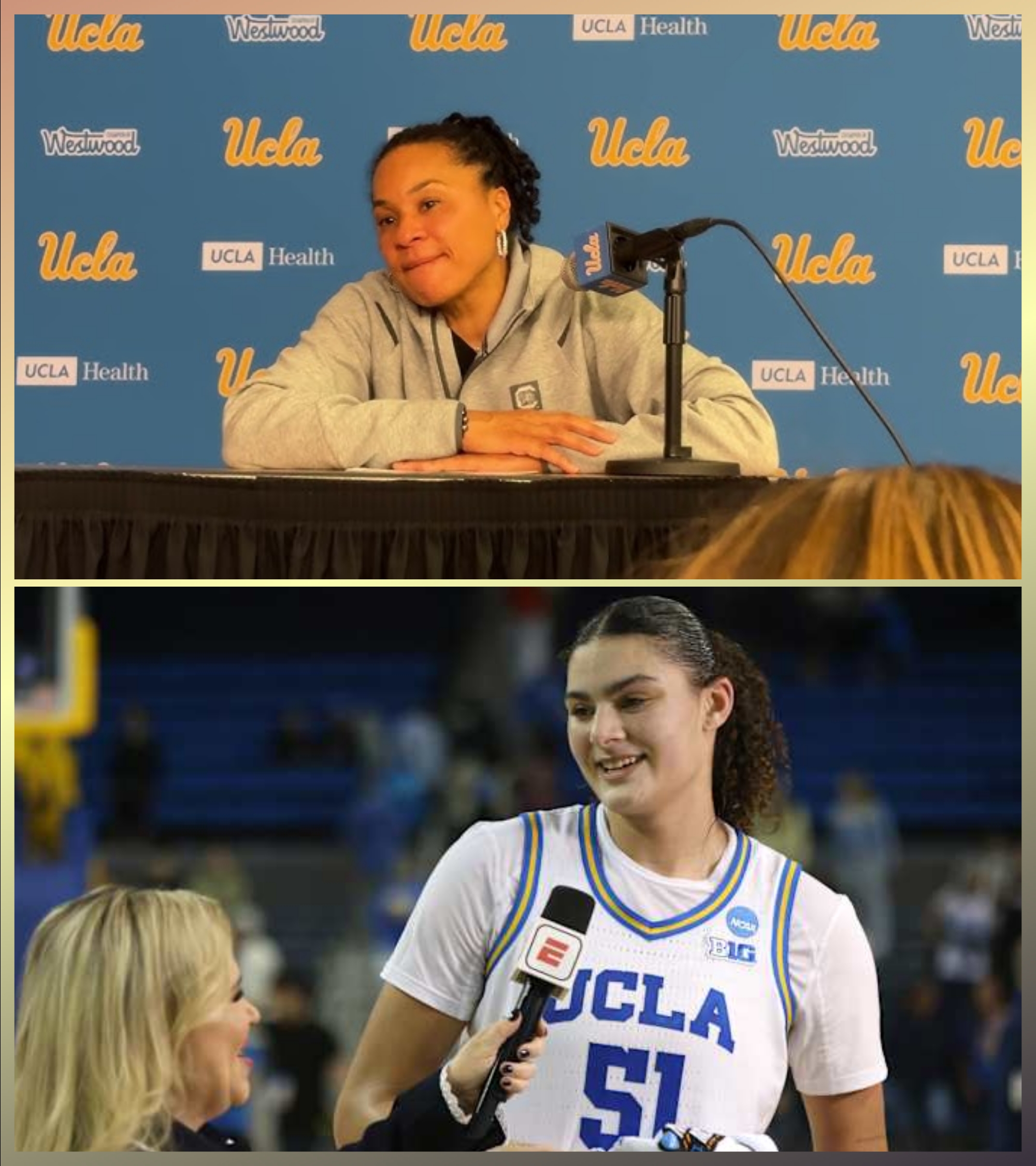
When UCLA star Lauren Betts published a piece in The Players’ Tribune on March 19 detailing her mental health journey, she included a detail that caught many by surprise: a quiet, private act of kindness from a coach whose team she never played for — South Carolina’s Dawn Staley.
“Dawn Staley, she spoke to my mom a little bit while everything was going on as well. And I don’t think a lot of people know that,” Betts wrote. “She’s been really amazing to me and my family through my entire basketball career.”
That Betts felt compelled to name Staley publicly, in a piece devoted to one of the most vulnerable periods of her life, says everything about the weight of that gesture.
A Relationship Built on Recruitment, Sustained by Character
To understand why Staley picked up the phone, you have to understand how their relationship began. Betts — a 6-foot-7 force who was the No. 1 recruit in the Class of 2022 out of Grandview High School in Colorado — was heavily recruited by the Gamecocks before ultimately choosing Stanford. She played one season for the Cardinal before transferring to UCLA, where she has spent the last three years becoming one of the most dominant players in the country.
The recruitment never resulted in a signed letter of intent, but Staley never treated it as a closed chapter.
“Her number’s still in my phone so I just reached out,” Staley said.
That detail is deceptively simple. Coaches recruit hundreds of players over the course of a career. Phone numbers get deleted. Relationships that don’t end in commitments often fade entirely. That Betts’ number was still there — and that Staley used it — speaks to a philosophy of human connection that extends well beyond the transactional nature of college recruiting.
Into the Dark: What Prompted the Call
In 2024, Betts stepped away from basketball and, as she wrote in The Players’ Tribune, checked herself into the UCLA hospital. The decision reflected the kind of courage that rarely gets enough credit — choosing to ask for help when the pressure of elite athletics, public expectation, and internal struggle converge into something unmanageable.
When Staley heard about it, she didn’t hesitate.
“I know when you’re in a dark place … you have to understand and combat whatever the evils of a dark place gives you, it overpowers you,” Staley said. “So I think you have to overpower with the opposite end of the spectrum, just pour into positivity, pour into just her getting on the other side of it.”
The language Staley uses here is precise and revealing. She doesn’t frame it as a coaching intervention or a recruitment opportunity rekindled. She frames it as spiritual and emotional counterweight — the idea that darkness, when it overpowers, must be met with an equally deliberate force of light. It is the philosophy of someone who has sat with pain long enough to understand how it works and what it needs to be pushed back.
“I think sometimes we’re in the middle of it and we can’t see our way out of it. Sometimes it just takes positive forces to help that,” Staley said. “I just wanted to be one of the people that reached out and hopefully help her get to the other side.”
What Staley describes is not heroism. She is careful to position herself as one voice among many — a positive force, not the solution. That humility is itself part of what makes the gesture so meaningful.
The Response She Didn’t Expect
Perhaps the most telling moment in Staley’s account is what she reveals about her own expectations when she made the call. She wasn’t reaching out to hear back. She was reaching out because it was the right thing to do, regardless of whether it landed.
“She responded, which was pretty cool. I wasn’t really expecting a response, but she responded,” Staley said. “That was the extent of it — trying to help a young person find their way.”
There is something quietly profound about that. In an era of transactional relationships and calculated public gestures, Staley made a private call with no expectation of return — and seemed genuinely moved that it was received at all. It reframes what mentorship and human decency look like at the highest levels of sport.
Staley then shifted the significance of the moment beyond herself and Betts entirely.
“Fortunately for us, she’s able to tell her story. I know telling her story will help some other young people, some other people who are dealing with some dark places,” Staley said.
It’s a generous reframing — taking what could have been a moment of personal credit and turning it outward. The real value, in Staley’s telling, isn’t in what she did for Betts. It’s in what Betts sharing her story might do for someone else sitting in a dark place right now, wondering if they’re alone in it.
The Player Who Came Back Stronger
The basketball backdrop to all of this is impossible to ignore, and it adds its own layer of poignancy to the story. Betts is currently averaging 16.5 points per game for No. 1 seed UCLA and is projected as a potential No. 1 overall pick in the upcoming WNBA Draft. The player who once checked herself into a hospital — who stepped away from the sport she had built her life around — is now one of the most feared players in the country.
Their history on the court has been split and contested. South Carolina defeated Stanford in Betts’ freshman year. But in 2024, Betts was a primary reason the Bruins dismantled the Gamecocks 77-62, posting 11 points and 14 rebounds in a performance that announced her as a player capable of deciding games at the highest level.
The fact that Staley reached out to her during the lowest stretch of that same period — not as a competitor but as a human being — makes the arc of their relationship genuinely remarkable.
A Championship Reunion, Possible but Not Yet Written
As the tournament unfolds, there is a mathematical possibility that these two programs meet again. But it would not come until the national championship game itself. Both hold No. 1 seeds, both have second-round games on March 23 — South Carolina faces No. 9 Southern Cal at 8 p.m. ET on ESPN, while UCLA takes on No. 8 Oklahoma State at 10 p.m. ET.
If that final does materialize, it will carry a subtext unlike almost any other matchup in the history of the tournament — a coach who made a private phone call to her opponent’s best player during the hardest moment of her life, and a player who made sure the world knew it.
For now, though, the bracket is secondary. What Lauren Betts put into writing on March 19 — and what Dawn Staley quietly did long before anyone was watching — is a reminder that the most important thing a coach can give a player is not a scholarship, a system, or a strategy. Sometimes it’s simply the willingness to pick up the phone when the lights go out.