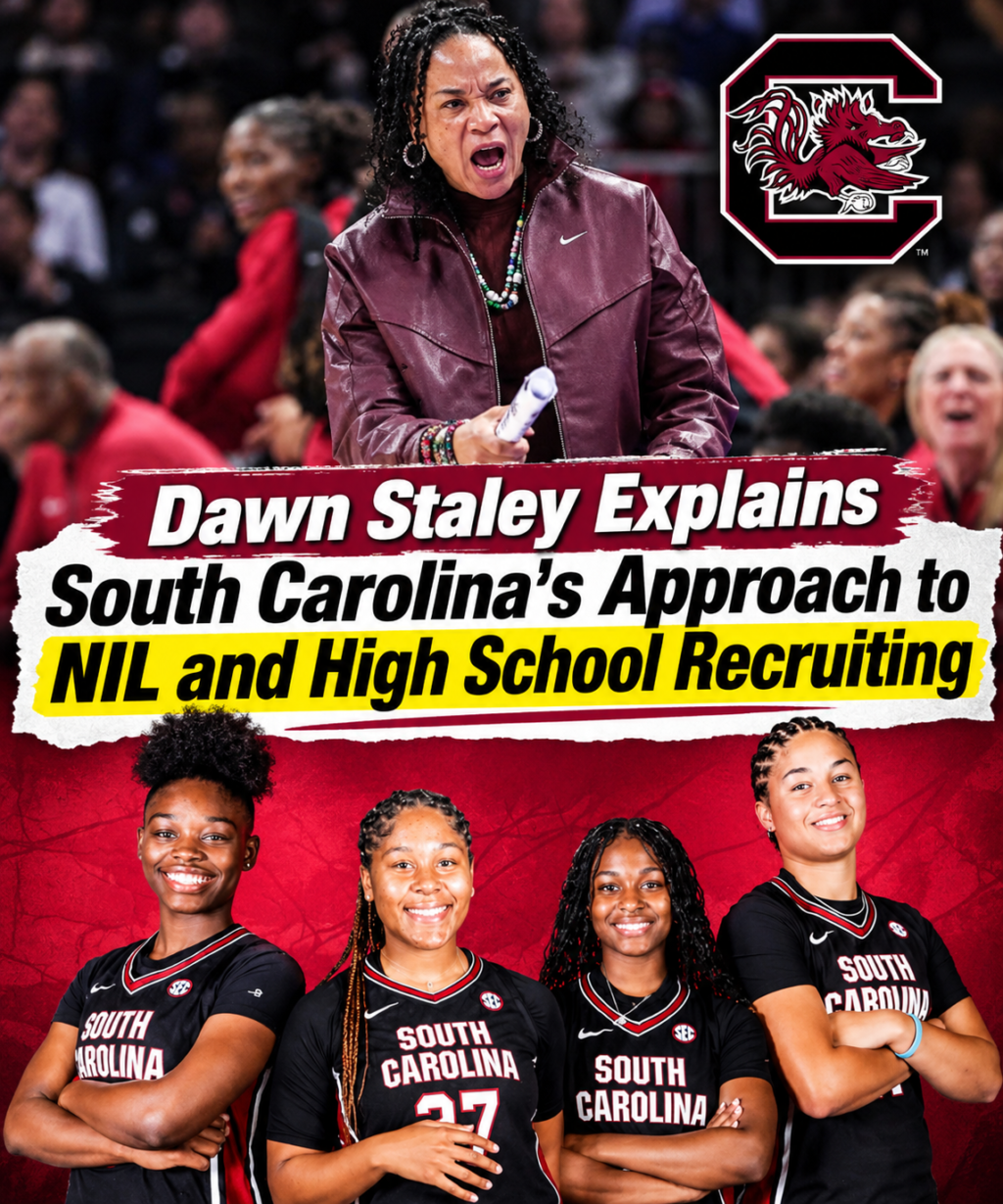
Dawn Staley Explains South Carolina’s Approach to NIL and High School Recruiting
The growing cost of recruiting elite high school basketball players has sparked debate among some of the biggest names in women’s college basketball. UConn’s Geno Auriemma and UCLA’s Cori Close have both questioned the increasingly large NIL deals being offered to top prospects, particularly reports of million-dollar payments to players who have yet to compete at the collegiate level.
South Carolina head coach Dawn Staley offered a different perspective, explaining how the Gamecocks approach recruiting finances while maintaining their program’s standards.
Auriemma and Close Question Rising NIL Payments
Auriemma raised concerns about the value of paying a high school recruit $1 million before the player has experienced college basketball.
“We don’t have cachet with guys that are getting a million dollars to go play someplace,” Auriemma said. “They’re getting the cachet. I just don’t see the value of paying a high school kid a million dollars to come out of high school that hasn’t dribbled the ball one time in college. I don’t get the idea of paying a kid a million dollars to come out of high school, and that’s more than 90% of the best players in the world in the WNBA.”
Close expressed similar concerns, arguing that the current financial structure creates an imbalance between college recruits and established professional players.
“Honestly, I think the numbers should go down,” Close told reporters. “When you’re talking about that, you’re talking about players getting paid more than A’ja Wilson, who’s arguably one of the best players in the world. There’s something wrong when our six seniors that all got drafted all took pay cuts to go to the WNBA. Like, something’s off with that. So the problem is that we don’t have a system that has really been thought through, there’s accountability, there’s transparency that can have us be a healthy model. So until that time, it’s keeping up with the Joneses, and no one likes it.”
Dawn Staley Explains South Carolina’s Recruiting Strategy
Staley approached the discussion from a practical standpoint. Rather than chasing every competing offer, South Carolina intends to establish its financial limits early and pursue players who fit the program.
“If somebody’s paying twice and three times as much as us, I say go get the money. Like really, it’s generational wealth for some kids,” Staley said. “… If the player is worth it to us, we might try to find the money. If we can’t find the money, we go back and say, ‘We can’t find the money. This is our last, final offer.”
She also explained that South Carolina prefers to communicate financial expectations before prospects arrive on campus, allowing both sides to understand what is available.
“When you’re recruiting young people and their families, we like to throw their number out there before they even come to campus. Like, you’re gonna come to campus with that number, and we can just get down to the business, and having a good time, and seeing if you fit here.
“For us, we’ve stuck to our numbers because that’s the numbers that we have. We’re not inflating. There’s the numbers that we see coming in for the following year, and if we get more money, we say, ‘Hey, we’ll share it.’ But you got to stick to it.
“Both coaches can draw the line wherever they need to draw the line. I got to draw the line where we have to draw the line. Fortunately for us, I think our players do — they do such a great job, and when these players and their families come on campus, they feel real good about it. The money is good. Don’t get me wrong; the money is good no matter where they go, but money really can’t make you feel better. Money can’t make you play better. Money can’t drive you when you’re not playing how you visualized.
“For us, we got all those other things outside of, you know, the high price tag of paying players a lot of money with all the other stuff. The comforts of knowing that this is hard, this is hard, and no matter how much money a kid makes, if they’re unhappy, they’re going to be unhappy. We try to provide making them happy.
“We’re not, by any means, we’re not cheap. We say what we have for certain players, and if they want it, great. If they don’t want it, man, you go. And I’ll say this: If somebody’s paying twice and three times as much as us, I say go get the money. Like really, it’s generational wealth for some kids. We make a lot of money. Like, we make a lot of money. If somebody said you only can make a certain amount and that’s it, like we would wrestle with that, right? It’s all what people are willing to pay. I mean, they pay me a lot of money. They do, whether they want to do it or not. They’ve done it, so you know it’s worth it to them. And if the player is worth it to us, we might try to find the money. If we can’t find the money, we go back and say, ‘We can’t find the money. This is our last, final offer.’”
What Staley’s Position Means for South Carolina
The three coaches highlighted different concerns surrounding NIL in women’s college basketball. Auriemma questioned the value of exceptionally large high school offers, while Close emphasized the need for greater transparency and accountability.
Staley, meanwhile, made it clear that South Carolina will compete financially without abandoning its budget or recruiting philosophy.
Her message is straightforward: money matters, but finding the right players and creating an environment where they can succeed matters just as much.
The Gamecocks are prepared to make competitive offers when a recruit fits their vision. However, Staley is equally comfortable allowing a prospect to choose another program if its financial offer exceeds what South Carolina can provide.
Ultimately, her approach reflects a willingness to recognize the financial opportunities available to young athletes while remaining disciplined about how the program allocates its resources.
About The Author