
Dawn Staley Is About To Have Five Elite Freshmen Sitting On Her Bench — Here’s Why That’s Actually A Good Sign
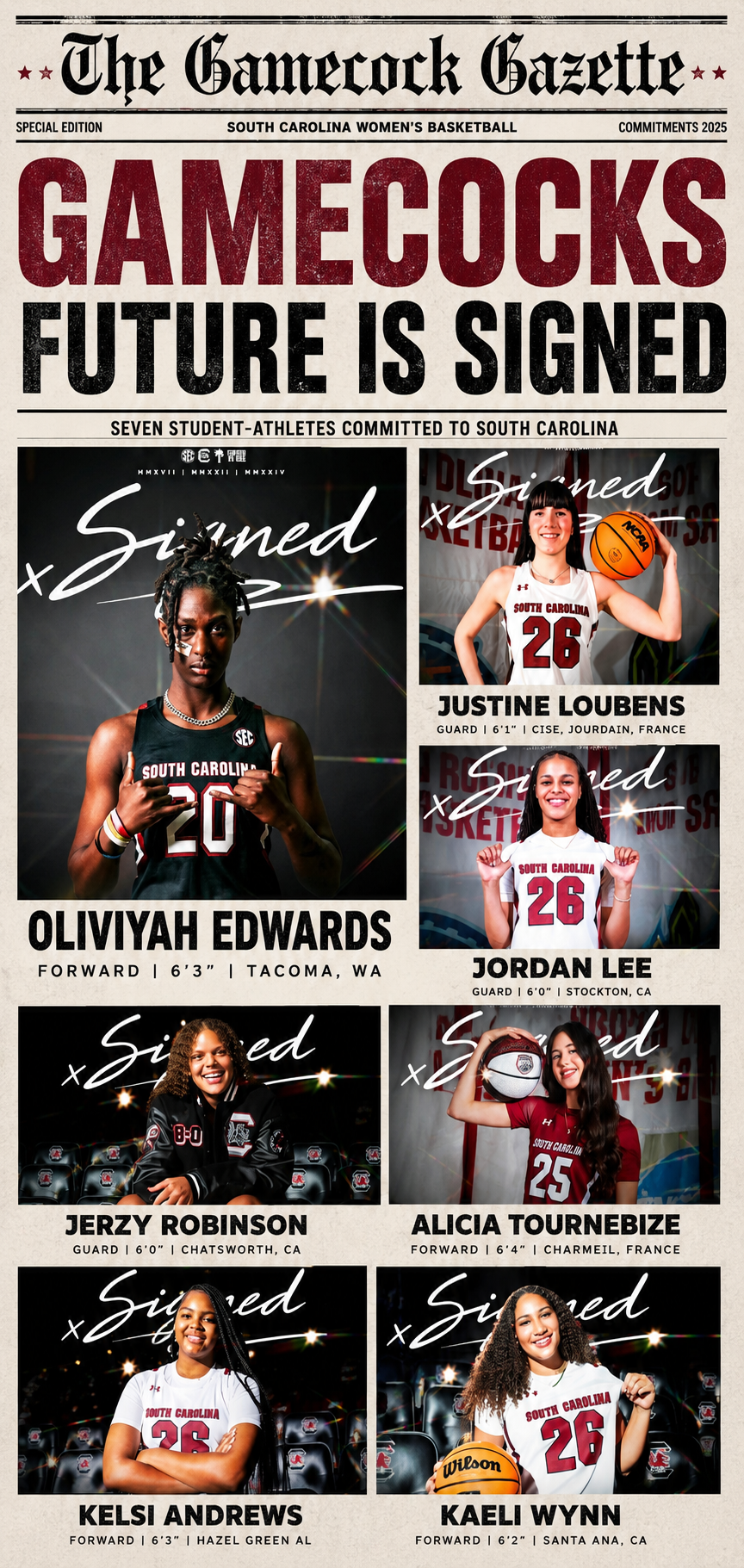
The cavalcade is coming. Over the next month, five highly touted freshmen will arrive in Columbia to join what is already one of the most talented rosters in women’s college basketball history. The expectations surrounding this freshman class are enormous — and yet, perhaps paradoxically, the most important thing each of them can do upon arrival is temper those expectations and embrace a role they have likely never had to play before: waiting their turn.
That is not a criticism. It is context.
South Carolina’s returning roster is so deep and so experienced that it would be a legitimate Final Four contender without adding a single new player. Add five talented freshmen on top of that foundation, and the Gamecocks become the probable national championship favorite. What that means practically for the newcomers, however, is that playing time will be precious — and in crunch situations, Dawn Staley will predictably lean on the veterans she trusts. The freshmen aren’t being asked to save this program. They’re being asked to grow within it.
That distinction matters, and it’s different for each of the five arrivals.
Oliviyah Edwards | Forward | 6-3
Edwards enters Columbia having spent her entire athletic life as the most physically gifted player on the floor. That is unlikely to change, and therein lies both her greatest asset and her most significant developmental challenge. The temptation to rely on pure athleticism — to simply outrun and outjump opponents — will need to be consciously set aside. At the college level, talent without refinement gets exposed quickly.
What will actually earn Edwards minutes early in her career is not the part of her game that made her a recruiting sensation. It is the fundamentals. Her size and instincts make her a natural rebounder and a potentially elite defender, and that combination is immediately valuable to a program that treats defense as a religion. The three-point range that dazzled at the high school level is essentially irrelevant at this stage — the longer college arc is a trap for young wings who haven’t yet earned their shot-creating freedom within a structured offense. Stay in the paint, defend with discipline, rebound everything in your area code, and the rest will develop organically.
Jerzy Robinson | Guard | 6-2
Robinson is a scorer. That is her identity, and it is a genuinely rare one — South Carolina doesn’t currently have another guard who can create and finish inside the way she can. That skill set has a place in this offense. But Robinson’s adjustment will be more cultural than physical, at least initially.
In high school and international competition, Robinson operated as a hub — someone around whom an entire system could rotate. In Columbia, she enters a system that already has its infrastructure firmly in place. Learning to blend, to move the ball, to play within the scheme before asserting individual brilliance — that is the transition that will define her freshman year. The physical adjustment is real too; she’ll face opponents who have been lifting for four years and won’t be moved the way younger competition was. But Robinson’s combination of scoring, rebounding, and defensive capability means the path to playing time is there if she embraces the process.
Kaeli Wynn | Wing | 6-2
For Wynn, patience isn’t a coaching philosophy — it’s a medical reality. She spent 2025 attempting to play through injuries, a decision that ultimately cost her the entire senior season. The basketball instincts, the defensive ability, and the perimeter shooting that scouts have raved about haven’t gone anywhere. But none of that matters until she is fully, genuinely healthy — not game-ready in a ceremonial sense, but physically capable of handling the rigors of high-level college basketball over a full season.
The adjustment for Wynn isn’t tactical. It’s physical conditioning. Getting into college shape after an extended absence requires a different kind of work than simply returning from injury, and the timeline for that process deserves respect rather than urgency. When she is healthy and in rhythm, her basketball IQ and three-point shooting give her a clear role in this system. Getting there the right way should be the only priority.
Kelsi Andrews | Forward | 6-3
Andrews’ situation mirrors Wynn’s in the sense that health and strength development are the foundational prerequisites before anything else can happen. A knee injury wiped out most of her pre-college preparation, and the ceremonial return at the end of her high school career — while meaningful — was not a genuine indication of where her body currently is.
The adjustment all post players face at the college level — the rude awakening that size and strength are no longer automatic advantages — will be particularly acute for Andrews given the compressed timeline of her recovery. The weight room isn’t supplementary for her development; it is the development. Once physically ready, her rebounding and shot-blocking instincts, combined with a reliable mid-range jumper, give her a legitimate contribution to make. The jump shot in particular is valuable on a team that wants spacing around its primary post threats.
Justine Loubens | Wing | 6-1
Loubens presents the most layered adjustment of the group, and not strictly because of basketball. Coming from France means navigating a new country, a new culture, a new language in an academic setting, and a new style of play — all simultaneously. The off-court transition is genuinely significant and deserves acknowledgment. Fortunately, she has a built-in resource in Alicia Tournebize, who made the same cross-cultural leap earlier and can serve as a guide through the parts of the adjustment that no amount of coaching can address.
On the court, Loubens’ skill set fits neatly into what South Carolina will want around its primary post players. With Joyce Edwards and Chloe Kitts commanding interior attention, a wing who can reliably space the floor from three-point range and intelligently work the baseline for open looks is genuinely useful. The role is clear. The challenge is settling into it without frustration if the minutes are slow to come early.
Taken together, the common thread running through all five situations is this: the program they’re joining is not waiting on them to be ready. South Carolina will compete for a national championship with or without significant freshman contributions. That reality, handled correctly, is actually a gift — it removes the burden of early expectations and creates space to develop at a pace that serves the player, not just the moment.
The freshmen who figure that out fastest will be the ones with the brightest futures in Columbia.
About The Author