Dawn Staley Just Lost Her Top Portal Target — Here’s the Backup Plan, and It Might Be More Creative Than You Think
South Carolina’s Point Guard Problem Is Real, But the Gamecocks Have Survived This Before — and Won a Championship Doing It
When Kymora Johnson made it official on Friday — withdrawing her name from the transfer portal and returning to Virginia for her senior season — South Carolina did not just lose a player. The Gamecocks lost the clearest, cleanest solution to their most pressing roster need heading into 2026-27. Johnson was the home run swing. She was the answer to the question Dawn Staley had been asking publicly since the final buzzer sounded in Phoenix.
Now South Carolina has to find a different answer. And the options, while limited, are more interesting than they might first appear.
The Problem Is Real — And It Cannot Be Ignored
Let’s be direct about the situation South Carolina now faces. With Johnson back in Charlottesville, the Gamecocks enter the offseason with exactly one point guard on the roster — rising junior Maddy McDaniel.
McDaniel is a legitimate college basketball player, and her numbers reflect a genuinely capable backup. She averaged 4.3 points and 2.7 assists last season, and her career assist-to-turnover ratio of 4.09 is the kind of number that tells you she takes care of the basketball and understands the position. That is real value.
But the limitations are just as real as the strengths. McDaniel has started only one game in her entire college career, and has missed four separate stints due to injury. That last detail is not a footnote — it is the central anxiety driving South Carolina’s portal search. A player who has demonstrated a pattern of availability issues is a shaky foundation to build an entire offensive operation around, especially for a program that expects to be playing meaningful basketball in March.
As one analysis put it plainly — trying to land Johnson was a home run swing that whiffed. The Gamecocks are no longer swinging for the fences. They are just trying to get on base.
Option One: Madison St. Rose — The Princeton Problem-Solver
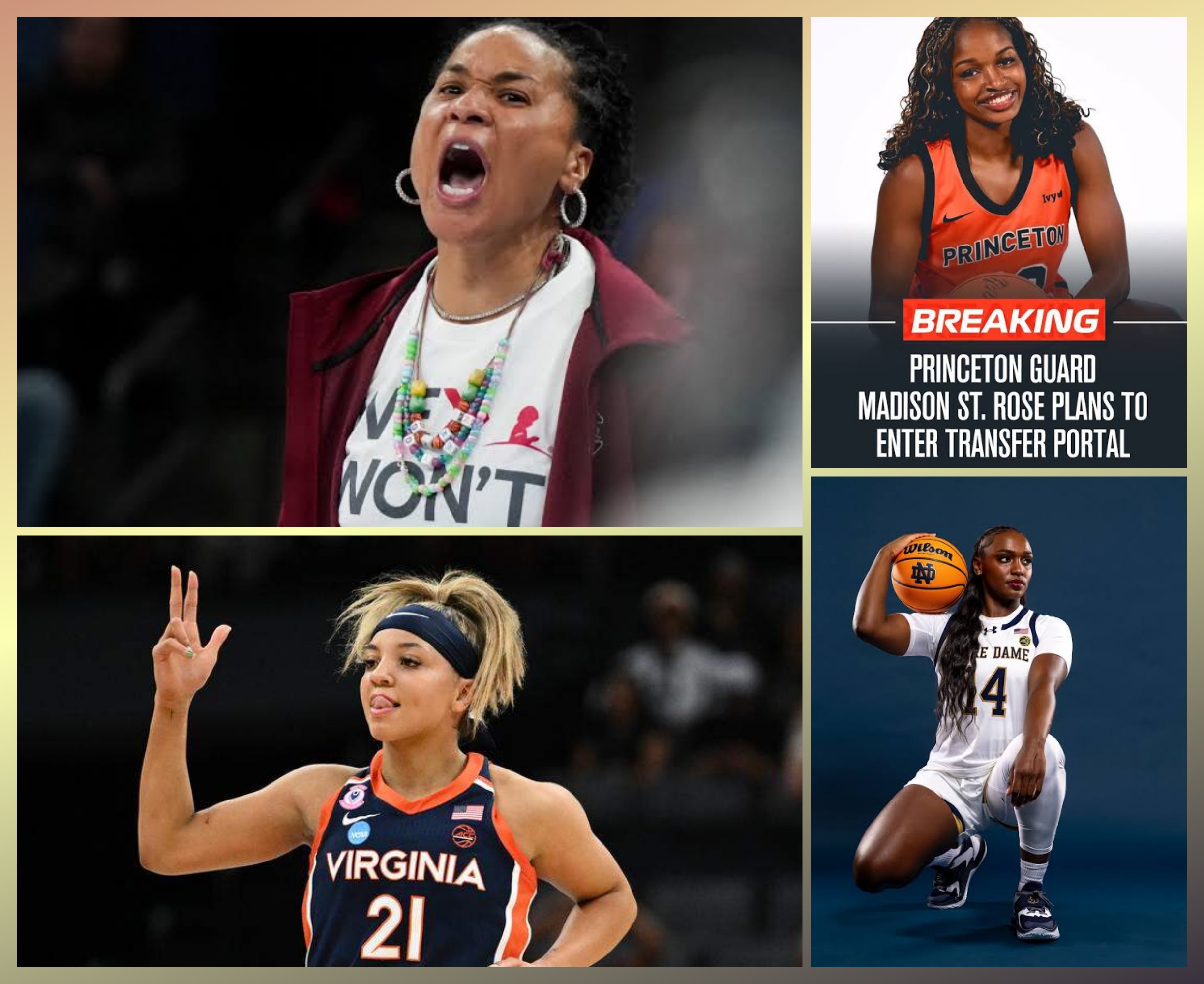
The first name South Carolina should have circled the moment Johnson made her decision is Madison St. Rose, a guard out of Princeton whose recruiting situation is genuinely unique.
St. Rose exhausted her Ivy League eligibility, but retains a year of NCAA eligibility because she redshirted during the 2024-25 season — the Ivy League does not permit graduate students to compete, creating an unusual eligibility pathway that gives her one more year of college basketball somewhere new. She averaged 15.8 points last season and can play both guard positions, giving her the kind of versatility that fits the demands of a Dawn Staley roster.
The catch? St. Rose has reportedly already narrowed her finalists to Notre Dame and Virginia Tech, suggesting her recruitment may be further along than South Carolina would like. Her below-30% career three-point shooting percentage is also a legitimate concern for a program that relies on spacing and efficient perimeter play.
But here is the broader question worth asking — did St. Rose’s decision to narrow her list coincidentally precede or follow Johnson’s portal withdrawal? There is a real possibility that a player who had been trending elsewhere might reconsider the moment South Carolina’s need becomes visible and undeniable. Programs pivot in recruiting all the time, and a phone call from Dawn Staley carries weight that most coaches simply cannot replicate.
Option Two: KK Bransford — The Veteran Wildcard
The second name that emerged with notable timing is KK Bransford, who entered the transfer portal almost at the exact moment Johnson announced her return to Virginia — a coincidence that recruiting insiders took notice of immediately.
Bransford brings an intriguing if complicated profile. She played three seasons at Notre Dame before sitting out the 2024-25 campaign due to injury, which creates its own durability questions. She was recruited as a point guard in high school and was listed as a combo guard in college, meaning it has been some time since she ran a full-time point guard operation at the college level.
What she does offer, however, is veteran presence, familiarity with high-level competition, and an ACC pedigree. For a team that would otherwise be relying heavily on McDaniel, adding Bransford’s experience to the rotation would at least give South Carolina two capable guards to work with, even if neither is the lead-guard difference-maker Johnson would have been.
The durability concern is real and cannot be brushed aside. Adding a guard who has already sat out a full season to partner with a guard who has missed four separate injury stints is not exactly building a fortress of reliability at the position. But in a limited portal market, veteran experience — even imperfect veteran experience — has tangible value.
The Remaining Market: Slim Pickings and Opportunism
Beyond St. Rose and Bransford, the honest assessment of what remains in the transfer portal at the point guard position is not encouraging. After those two, the options thin out considerably.
South Carolina could target a mid-major guard with experience — someone who may not be capable of logging 20 meaningful minutes per game in a national title contender’s rotation but would at least give Staley a warm body at the position and insurance against injury. It would not be glamorous. It would not move the needle. But it would be better than nothing, and sometimes in the portal era, better than nothing is the real victory.
The other option is purely opportunistic — hoping that a Power Four point guard, seeing South Carolina’s visible need and hearing Dawn Staley’s name attached to it, decides to enter the portal before the window closes. It walks right up to the edge of tampering without crossing it. Programs do it every offseason. And frankly, the South Carolina brand carries enough weight that a player could genuinely decide the Gamecock spotlight is worth chasing at the last possible moment.
The Championship Precedent: South Carolina Has Been Here Before
Here is where the narrative takes a turn that should bring genuine comfort to Gamecock fans spiraling over the point guard situation — because Dawn Staley has navigated this exact scenario before, and the result was a national championship banner.
Cast your memory back to the 2021-22 season. Backup point guard Raven Johnson tore her ACL in the second game of the year, leaving Destanni Henderson as the only true point guard on the roster with forward Laeticia Amihere serving as the emergency backup at the position. By every conventional measure of roster construction, that situation should have been a crisis.
South Carolina won the national championship.
That historical footnote is not just a feel-good story — it is a genuine blueprint for how Staley approaches positional flexibility and roster creativity. Her teams are not built around a single position’s depth chart. They are built around athleticism, unselfishness, defensive intensity, and the kind of competitive culture that paper depth charts cannot fully capture.
If the Gamecocks ultimately cannot add another true point guard before the portal closes, there is already a contingency plan built into the current roster — and it is more viable than most people are giving it credit for.
The “Non-Point Guards Who Played Point Guard” Plan
South Carolina’s roster actually contains three players who, while not traditional point guards at the college level, handled primary ball-handling responsibilities in high school. Tessa Johnson and Chloe Kitts, both seniors, and sophomore Agot Makeer all ran point for their respective high school programs — not because they were pure floor generals, but because they were simply the best athletes and ball-handlers on their teams.
That distinction matters. These are not true point guards being asked to improvise. These are highly coordinated, basketball-intelligent players returning to a role they previously inhabited, within a system built by one of the greatest coaches in the sport.
Johnson and Makeer already handled some lead guard responsibilities last season when McDaniel was sidelined with injury. Kitts, who entered college as a guard before her body evolved into a forward, has a 10-assist triple-double on her résumé — a line that reveals playmaking instincts that do not simply disappear because she spends most of her time in the post.
Would a rotation built around McDaniel and this trio of converted ball-handlers be ideal? Absolutely not. Would it be competitive? History says yes. Would it be a vote of confidence in McDaniel’s readiness for an expanded role? Without question.
The Bottom Line
South Carolina finds itself at an uncomfortable but manageable crossroads. The home run missed. The window is closing. The options are real but imperfect — St. Rose, if she can be flipped from her current finalists; Bransford, if her veteran instincts outweigh the durability concerns; a mid-major sleeper, if the market still holds one worth bringing to Columbia; or the in-house solution that once, in a different season under the same coach, produced a championship.
Dawn Staley has never needed perfect pieces to build something extraordinary. She has needed the right culture, the right commitment, and the right players buying into a system larger than any individual role.
The point guard situation is not solved. But it is far from hopeless. And in Columbia, far from hopeless has a way of becoming something nobody expected by the time April gives way to November.
About The Author