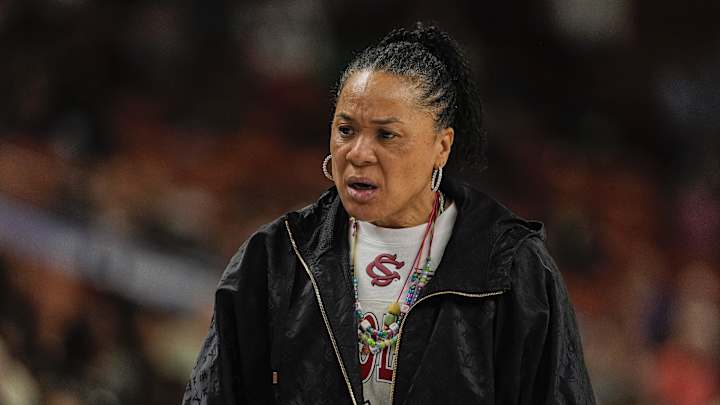
South Carolina head coach Dawn Staley delivered brutally honest assessments following her team’s 94-82 overtime defeat at Oklahoma, refusing to make excuses while acknowledging the Sooners simply outperformed the Gamecocks when it mattered most.
Overtime Breakdown
When asked what unraveled during the extra period, Staley’s response was refreshingly direct.
“They ran into a team that actually wanted to win more, and they made winning plays, and we didn’t. It’s not really rocket science; it’s really a simplistic thing,” Staley explained.
Her assessment cut through the complexity—Oklahoma executed while South Carolina faltered. No elaborate tactical explanations, just a straightforward acknowledgment that her team was outcompeted in the crucial moments.
Praising Oklahoma’s Freshman Star
Staley showed no hesitation in crediting Aaliyah Chavez, whose 26-point performance—including 15 in overtime—proved decisive.
“She was great, she ran her team, hit big shots, delivered the ball. Everything that you want a point guard to do. She’s having a great freshman year,” Staley said.
The Hall of Fame coach’s respect for Chavez’s performance reflects her characteristic class in defeat, recognizing excellence regardless of which jersey it wears.
Moving Forward: Accountability and Perspective
Addressing the path ahead before facing Vanderbilt, Staley emphasized honest evaluation without catastrophizing the setback.
“Conversations are real. We didn’t do enough to win. When you do that in our league, especially on the road, you pay for it. You pay for it with defeat. It’s not a familiar territory for us, but we’ll live. Our goals are still in front of us. Every single one of them is still right in front of us. We’ll live, we’ll learn, and we’ll move on and be back to prep for Vandy tomorrow,” Staley stated.
This response demonstrates championship-level perspective—acknowledging failure while maintaining focus on larger objectives. One conference loss doesn’t derail championship aspirations, but the lessons must be absorbed.
Ta’Niya Latson’s Offensive Struggles
Staley accepted partial responsibility for Ta’Niya Latson’s dismal 1-for-10 shooting performance, suggesting coaching adjustments are necessary.
“Just struggle. Didn’t really get good looks at the basket, didn’t really get out in transition a whole lot. I think we’ve got to do a better job of putting her in positions where she can score. She can make plays. Wasn’t there tonight, though she forced it a little bit. Sometimes you do that when you’re used to scoring points, but we got to do a better job and a better position to score and feel good about it,” Staley explained.
Rather than solely blaming her player, Staley acknowledged the coaching staff’s role in creating better opportunities—a mark of elite leadership that builds player trust even in difficult moments.
Defending Raegan Beers: Lessons Still to Learn
When questioned about the interior battle against Raegan Beers, Staley acknowledged her new frontcourt rotation hasn’t yet mastered the defensive principles necessary to neutralize elite post players.
“She’s a tough guard. I thought she got her positioning, which is her normal positioning that you can’t allow. You can’t allow her to have direct passes; you try to lob it over top and get some help behind it. We just didn’t have enough of that. Credit to Beers, she did a great job fighting for her position, and she was consistent with it. For us, I thought we’ve done better jobs in previous years, particularly last year. We got a new set of bigs that have to understand what you need to do on a possession-to-possession basis to not give her that sweet spot,” Staley observed.
Analysis: Staley’s post-game comments reflect elite coaching maturity—accepting accountability, crediting opponents, and maintaining perspective. Her willingness to shoulder responsibility for Latson’s struggles and her bigs’ defensive lapses demonstrates leadership that builds trust. The challenge now is translating these honest assessments into tangible improvements before Vanderbilt, proving this loss serves as catalyst rather than pattern.