For Jacarrius Peak, Leadership Waits Until Trust Is Earned — And Health Comes First
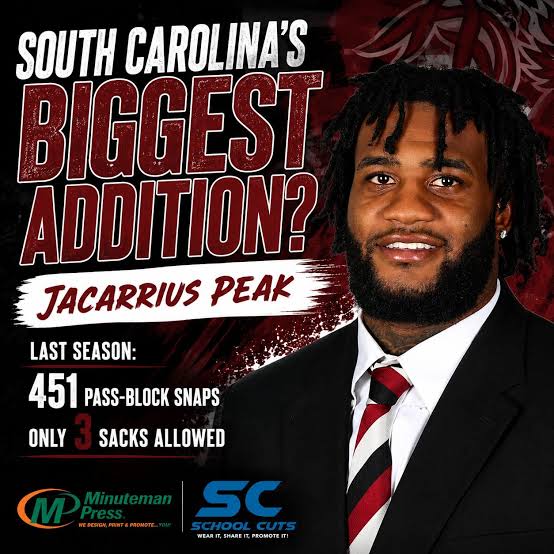
Trust doesn’t come easily to Jacarrius Peak. By his own philosophy, some people earn leeway, and others simply don’t — and figuring out which is which takes time he’s not willing to rush. That deliberate, guarded approach shapes nearly everything about how South Carolina’s new offensive tackle has navigated his first months in Columbia.
A moment that opened the door
For Peak, the turning point came unexpectedly, during a winter visit to South Carolina’s football facility. As one of the top-ranked linemen available in the transfer portal, he arrived to find the entire coaching staff waiting for him — defensive coaches included, not just the offensive line room he’d eventually join. “Just to see how big I was, I guess,” the 6-foot-4, 305-pound Peak said with a smile, recalling the moment. “Just little things like that. Like I knew this was family. I just needed to know the plan, and once I got inside the building and started talking to the coaches, I found out my plan and my reason to come here.”
Assistant offensive line coach Jason Smith described exactly the kind of evaluation process Peak brings to new relationships. “He watches everybody,” Smith said. “You have to earn his trust and his respect. He’s a very strong-hearted man who has his values very high.” That framing helps explain why the full-staff welcome mattered so much — for a player who studies people before extending trust, seeing that level of collective investment from a program he was still deciding on likely carried real weight.
A clear, simple mission
Asked directly what convinced him South Carolina was the right destination, Peak didn’t hesitate. “Get better as a man on the field and off the field,” he said. “And just go as God takes me.” That’s a notably broader framing than most transfer commitments get — Peak wasn’t describing a scheme fit or a depth chart opportunity, but a personal development goal that happens to be pursued through football.
An injury that derailed the original plan
What wasn’t part of that plan was the setback that followed. During a team-organized 3-on-3 basketball tournament in February, Peak suffered an undisclosed lower-body injury that kept him out of spring practice entirely. At South Carolina’s on-campus media day Thursday, though, he showed encouraging signs — no brace, no visible limp, and genuine optimism about being ready for the September 5 season opener. Still, head coach Shane Beamer made clear that neither Peak nor star defender Dylan Stewart, who’s managing his own back injury, should be expected to go full speed once preseason practice opens Friday.
Peak’s own outlook on the recovery process reflects the same faith-centered framing he applied to his decision to transfer in the first place. “I know I’m doing everything in my power and will to do what I’m supposed to do to get back on the field,” he said. “As long as I keep doing that and trust in God, believe in God, everything will work out how it’s supposed to.”
The cost of missing time in a new system
Beyond the physical recovery, the injury created a less obvious complication. Missing all of spring practice meant Peak lost valuable reps learning an unfamiliar offense and missed a real opportunity to accelerate chemistry-building with a retooled offensive line. That’s a particularly steep cost given his profile — as a proven, veteran starting left tackle, Peak arrived at South Carolina expected to be a plug-and-play anchor and natural leader for the room, not someone easing in gradually.
Leadership requires presence, not just talent
That expectation collided directly with reality. Offensive line coach Randy Clements was candid about the challenge Peak’s absence created. “It’s very challenging because you spend more of your time in the training room than you do actually in the position room,” Clements said. “(Leadership) hasn’t been the focus for him at this point. It’s been more working on him getting to 100%.” In other words, the very trait that made Peak such a valuable addition — his experience and natural leadership — has been sidelined by simple physical necessity, since leading a room requires actually being in it.
Peak doesn’t dispute that assessment. If anything, his own philosophy reinforces it — the same guarded, earn-it approach that shaped his relationship with South Carolina’s coaching staff also governs how he thinks about leading teammates. “Just knowing that I have to take care of me and make sure I’m doing everything right before I speak up to someone else,” Peak said. “That played a big part in my leadership.” For a player who watches people closely before trusting them, it tracks that he’d hold himself to the same standard before asking teammates to follow his voice — actions establishing credibility long before words do.
About The Author