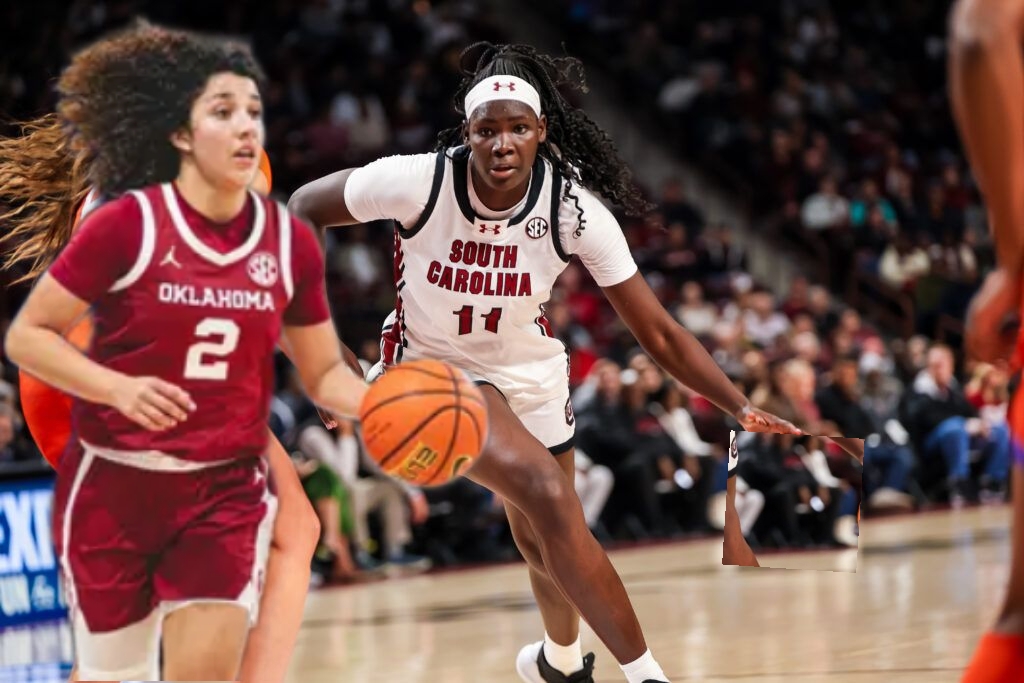
The Sooners feature two standout performers who pose significant challenges for South Carolina in Thursday evening’s matchup.
First-year guard Aaliyah Chavez has garnered national recognition for her outstanding inaugural season performance. As the third-ranked prospect in her recruiting class, she tops Oklahoma’s scoring chart with 18.8 points nightly while ranking second on the squad with 3.1 assists per contest.
Chavez epitomizes an aggressive offensive approach, hoisting 17.2 shots per game while converting 39% of those attempts. Her three-point shooting reflects similar boldness—she fires up 8.6 long-range shots per outing, connecting on 33.8% of them.
While Okot has developed significantly since last season, she won’t be tasked with defending Beers single-handedly. The Gamecocks have previously succeeded against Beers by employing multiple defenders and varying defensive schemes. During last year’s SEC Tournament, reserve player Maryam Dauda provided crucial minutes off the bench, effectively outperforming Beers. South Carolina plans to utilize Edwards, Okot, Dauda, Tac, and rookie Alicia Tournebize in this defensive effort.
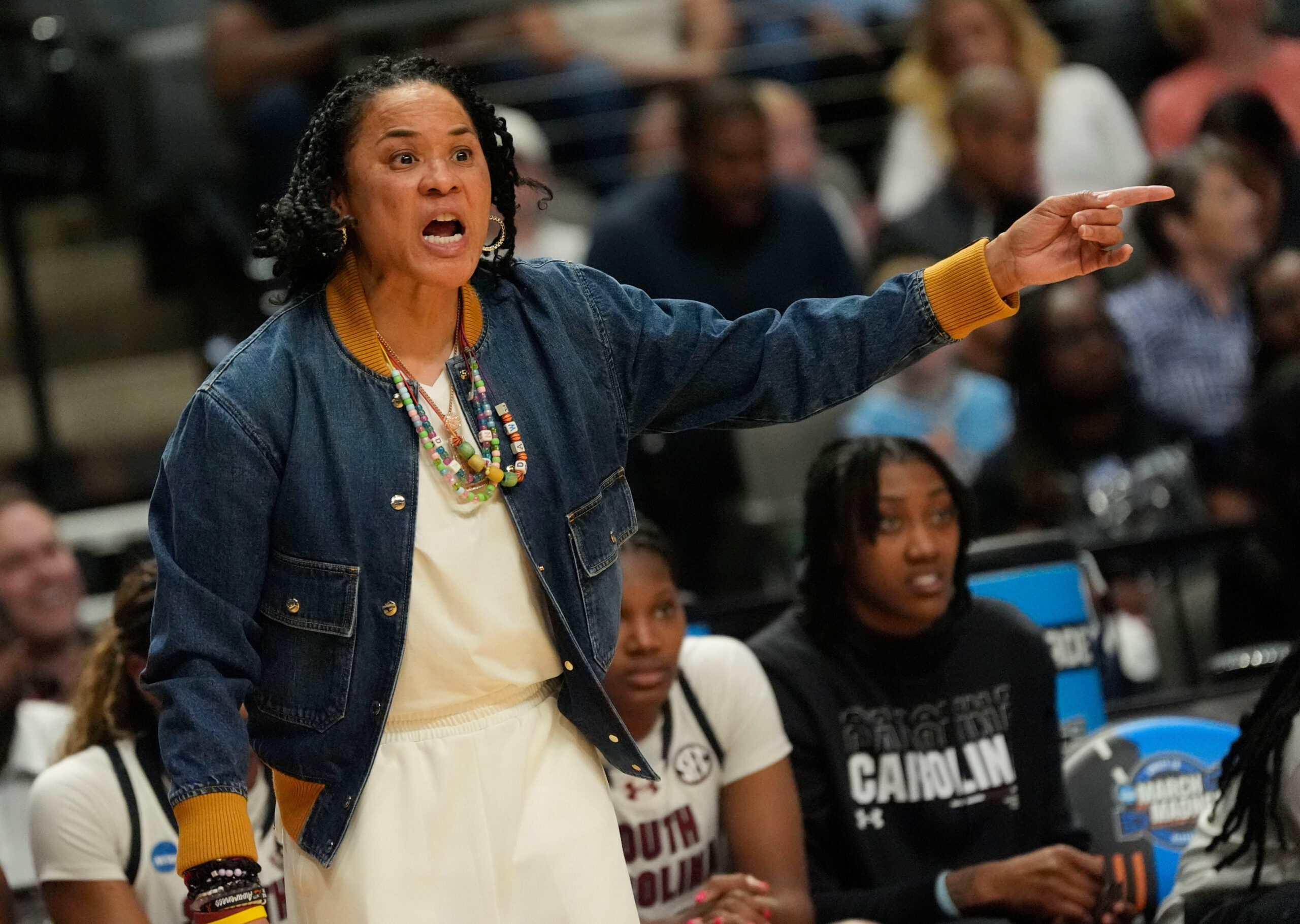
“We’ve got five of them, five of them will play at some point,” Staley said. “At some point, the five of them will be needed. I think Beers is a handful that we’ve got to just show her different looks, and we’ve got five different looks to throw at her.”
“People who like her, who are scorers, they’re going to get shots off, they’re going to hit shots,” South Carolina forward Joyce Edwards said Wednesday. “We just, again, [have to] disrupt her. I feel like we have a game plan, and we can execute to minimize her scoring game.”
Oklahoma’s veteran forward Raegan Beers presents another significant challenge for South Carolina.
Beers consistently produces double-figure performances in both scoring (16.7 points nightly) and rebounding (11.2 boards per game, leading the SEC). Her previous encounters with South Carolina have yielded inconsistent outcomes across three meetings.
During her time with Oregon State, she contributed 16 points in a tournament defeat to the Gamecocks in 2024. In last season’s regular-season clash, Beers tallied 23 points despite Oklahoma suffering a devastating 41-point defeat.
The Gamecocks effectively neutralized Beers during last year’s conference tournament, holding her to merely seven points on 2-of-10 shooting. Dauda’s bench contributions proved instrumental in stifling Beers’ offensive impact during that postseason encounter. Staley anticipates Dauda and her fellow frontcourt players will deliver comparable defensive performances Thursday.
“We got five of them, five of them will play at some point. At some point five of them will be needed,” Staley said Wednesday. “Beers is a handful that we got to just show her different looks, and we got five different looks to throw at her.”
Addressing Free Throw Deficiencies
South Carolina has compiled numerous positive achievements through their opening 20 contests.
Their offensive production ranks among the nation’s elite at 88.7 points per outing (fifth nationally), while their defensive efficiency exceeds even that standard by limiting opponents to merely 32.4% shooting (third nationally).
However, opportunities for enhancement remain, particularly regarding their charity stripe performance this season.
Currently sitting at 231st nationally with a 69.1% conversion rate from the line, the Gamecocks have endured prolonged struggles in this area. Historical data reveals South Carolina has surpassed the 70% threshold only four times since the 2012-13 campaign.
These current difficulties prove especially troubling given last season’s progress at the foul line. The Gamecocks converted 76% of their free throws in 2024-25—their strongest performance since achieving 73% during the 2018-19 season.
Staley acknowledged Wednesday that her squad faces challenges from the stripe, noting the team’s active efforts to overcome this slump, recognizing how crucial every point becomes during competitive conference play.
“I think just as much as you get in the rut, you can get yourself out of it,” Staley said. “You got to make them. Got to make them to get out of it. I know they’re not intentionally missing them, but it’s a rut that we’ll try to fight to get out. Because we don’t want to lose a basketball game depending on having to make free throws.”
Evaluating the Sooners
Despite South Carolina’s dominant victories over Oklahoma in both previous season meetings, Edwards dismissed those results as irrelevant.
“They’ve got new players. They’re essentially a new team,” Edwards said. “Some people aren’t taking as many shots, some people are taking more shots. So we don’t really look at last year because they’re a whole new team.”
Verhulst’s shot attempts have decreased by nearly two per game this year, with her scoring output declining from 14.9 to 10.9 points nightly. While capable of explosive performances—evidenced by her 21-point output versus LSU—her overall effectiveness has diminished. She’s connecting on merely 38.9% from the field and 29.7% from distance.
Despite attempting one additional shot per contest compared to last season, Beers has experienced declines in both scoring and shooting accuracy. Oklahoma’s primary challenge in tight contests has been successfully feeding Beers in favorable positions.
The Sooners enter Thursday having dropped three consecutive contests, with their last victory occurring January 4 versus Mississippi State—seemingly ages ago. Each defeat has proven more discouraging than its predecessor: a 74-69 home setback to Ole Miss, followed by a 63-57 loss at Kentucky (themselves struggling), and most recently, a 91-72 home blowout against LSU despite full week’s preparation.
“Whether they won five straight, three straight, lost, it’s a dangerous game, and we don’t think going in just because they lost three that it’s an automatic for us,” Staley said. “We know this league. We know this league, and we know the strength of it, we know the weaknesses of it, which there aren’t very many of them. So to go on the road, to win, it’s a hard feat no matter who you’re playing, and you don’t take Oklahoma lightly.”
Prior to this downturn, Oklahoma hadn’t suffered three consecutive defeats since December 2023, nor three straight conference losses since February 2022 while competing in the Big 12. The Sooners haven’t endured four consecutive setbacks since the 2019-20 campaign, when they experienced separate four-game and eight-game losing stretches.
Thursday’s contest will feature a white-out promotion as Oklahoma seeks to reverse their current slide.