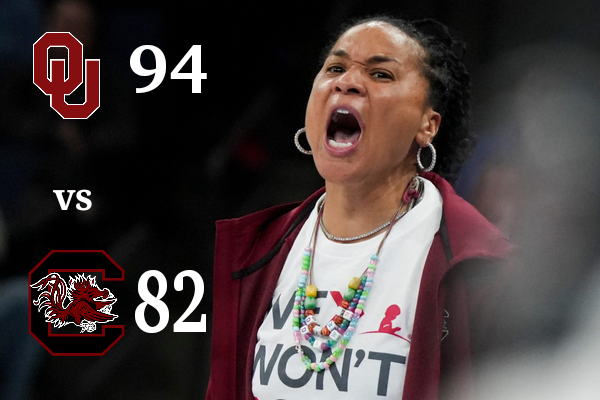
South Carolina’s unblemished Southeastern Conference record came to a stunning halt Thursday night as shooting woes plagued the Gamecocks in a 94-82 overtime defeat at Oklahoma, according to On3.
The Collapse and Comeback
The narrative appeared written with three minutes remaining in regulation. Oklahoma commanded a 73-67 advantage while South Carolina endured a frigid stretch, converting just one of their previous 13 field goal attempts. The Gamecocks seemed destined for defeat as their offensive execution crumbled down the stretch.
However, South Carolina’s defensive identity emerged when it mattered most. The Gamecocks intensified their pressure, forcing Oklahoma into critical errors that sparked a dramatic comeback sequence.
Point guard Raven Johnson ignited the rally by knocking down a jumper following a defensive stop. Moments later, her defensive instincts created another opportunity—she generated a turnover that resulted in an uncontested layup for Ta’Niya Latson, suddenly cutting the deficit to manageable proportions.
Following several scoreless possessions by both teams, Johnson delivered again with a theft that she converted into a game-tying layup, completing South Carolina’s improbable comeback from six points down in the final three minutes.
The Gamecocks seized their first lead since the early stages when Joyce Edwards calmly converted both free throws after drawing a foul, putting South Carolina ahead in the waning moments.
South Carolina’s defense forced one final stop, compelling Sahara Williams into a missed layup attempt. But Oklahoma’s Raegan Beers crashed the offensive glass for the putback score, knotting the game and forcing the extra period.
Overtime Meltdown
The additional five minutes proved catastrophic for South Carolina as their shooting struggles intensified while Oklahoma freshman sensation Aaliyah Chavez delivered a performance for the ages.
Chavez erupted for 15 of her game-high 26 points during overtime alone, systematically dismantling South Carolina’s defensive schemes. The decisive factor came in defensive matchups—Raven Johnson had capably defended Chavez throughout regulation, but the overtime period saw Tessa Johnson assigned to the Oklahoma star. The height differential proved decisive as Chavez repeatedly executed her signature step-back three-pointers over the shorter defender, who lacked the length to effectively contest the shots.
Oklahoma achieved offensive perfection in the extra session, converting all seven field goal attempts, including a flawless 4-for-4 performance from beyond the arc. Conversely, South Carolina managed just two baskets on nine attempts, a continuation of their shooting struggles that ultimately determined the outcome.
Early Foul Trouble Disrupts Rhythm
The game’s trajectory shifted early when Tessa Johnson, who exploded for eight points in the opening three minutes, picked up two quick fouls that relegated her to the bench. Her absence proved consequential—without her perimeter shooting threat, South Carolina’s offensive flow stagnated, unable to establish the spacing and rhythm that typically characterizes their attack.
The Gamecocks did manufacture one sustained run during the second quarter, assembling a 10-0 scoring surge to establish an eight-point cushion. Yet this proved to be South Carolina’s lone period of sustained excellence, as inconsistent execution plagued them throughout the remainder of regulation and into overtime.
Stars Fail to Shine
Perhaps most concerning for South Carolina was the uncharacteristic offensive disappearance of their primary scoring options. Joyce Edwards, the team’s leading scorer averaging 20.2 points per game, managed just 12 points on an abysmal 3-for-12 shooting performance. Ta’Niya Latson, South Carolina’s second offensive weapon at 16.0 points per game, endured an even more frustrating evening with only six points on 1-for-10 shooting.
Even third-leading scorer Madina Okot couldn’t provide offensive relief, though her struggles came in limited action—just 17 minutes on the floor.
Analysis
This defeat exposes several vulnerabilities in South Carolina’s championship aspirations. The Gamecocks’ overdependence on their top scorers became painfully evident when Edwards and Latson simultaneously struggled—the supporting cast lacked sufficient firepower to compensate. The team’s persistent shooting inconsistency, which surfaced at the worst possible moment, raises questions about their ability to win grinding SEC contests when shots aren’t falling.
However, South Carolina demonstrated championship resilience by erasing a late six-point deficit through defensive intensity and clutch plays. Raven Johnson’s two-way excellence—scoring, playmaking, and creating turnovers—showcased the type of leadership necessary in hostile road environments.
The overtime period revealed a critical defensive vulnerability: when forced into unfavorable matchup situations, South Carolina lacked the depth or adjustment capability to neutralize an elite scorer like Chavez. The coaching staff’s inability to provide additional defensive help or switch schemes as Chavez torched Tessa Johnson repeatedly suggests adjustments will be necessary moving forward.
This loss serves as a valuable reality check for the Gamecocks—road SEC games demand consistent execution and depth scoring, neither of which materialized in Norman. How South Carolina responds to this adversity will define whether this represents a momentary stumble or a concerning trend heading into the heart of conference play.