
How South Carolina’s Projected Second Unit Could Become a Major Weapon in 2026-27
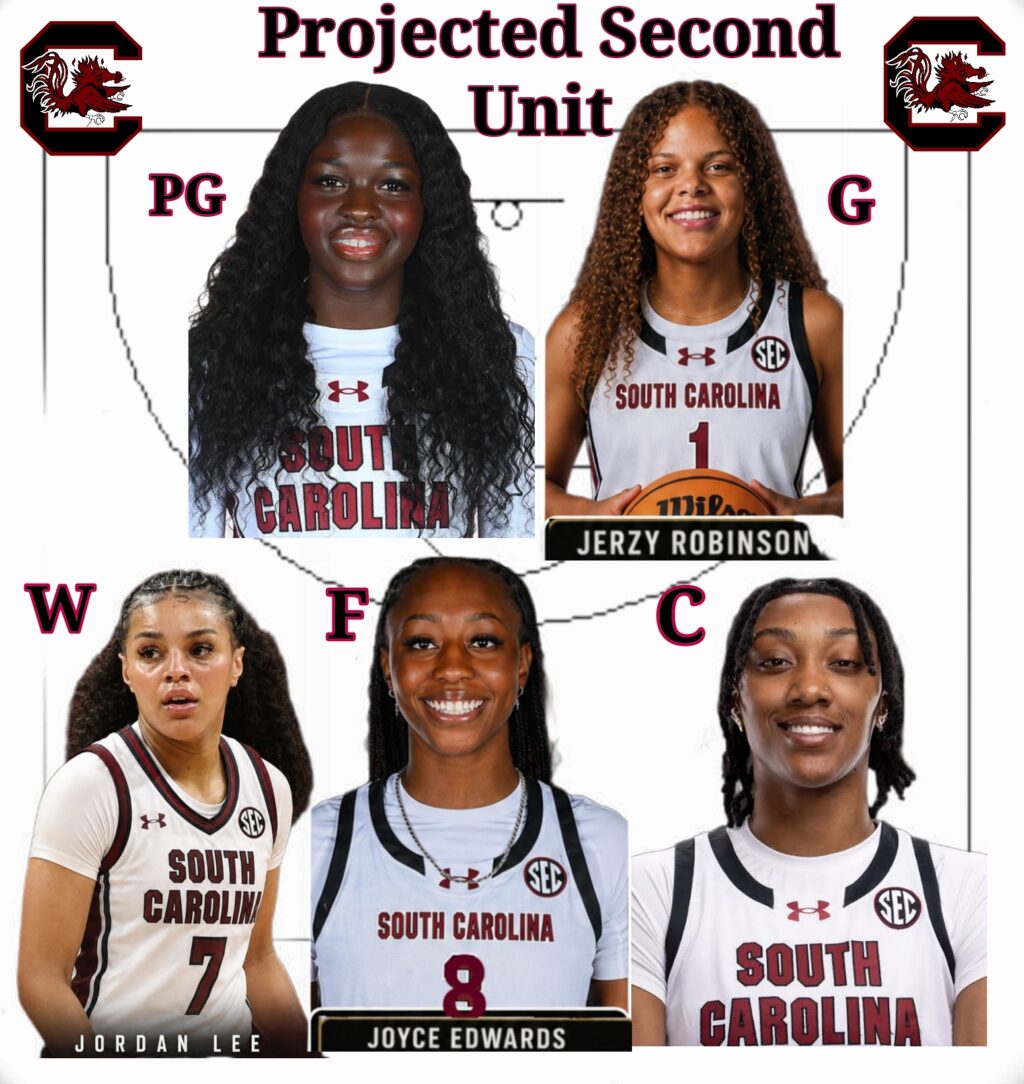
South Carolina’s 2026-27 roster may have something that is often more difficult to build than a talented starting five: a second unit capable of changing the game rather than simply surviving the minutes without the starters.
On paper, the projected reserve group is intriguing:
- PG — Agot Makeer, So., 6-foot-2
- G — Jerzy Robinson, Fr., 6-foot-2
- W — Jordan Lee, Jr., 6-foot-0
- F — Joyce Edwards, Jr., 6-foot-3
- C — Ashlyn Watkins, Sr., 6-foot-3
The obvious question is whether Dawn Staley would actually deploy all five simultaneously. There is considerable risk in removing multiple experienced players at once, particularly the team’s primary point-guard option. But if Staley can make this group work — even for short stretches — it could become one of the most fascinating tactical developments of the upcoming season.
The key isn’t simply that the five players are talented.
It’s that their skill sets potentially complement one another extremely well.
A second unit that doesn’t look like a traditional bench
The biggest advantage of this projected group is its size.
A 6-foot-2 point guard in Makeer, a 6-foot-2 Robinson on the perimeter, a 6-foot Lee on the wing, a 6-foot-3 Edwards at forward and a 6-foot-3 Watkins at center would give South Carolina unusual positional size for a bench group.
That creates immediate possibilities defensively.
Instead of Staley having to sacrifice size when her starters leave the floor, this group could actually maintain — or potentially increase — the physical pressure South Carolina wants to impose.
The lineup could switch assignments, pressure passing lanes and create difficult matchups without having to rely exclusively on half-court defense.
And that matters because South Carolina’s best basketball has traditionally been built around turning defense into offense.
The second unit doesn’t necessarily have to score 20 points in five minutes to be effective. It could change the game’s tempo.
Makeer could be the key to everything
Perhaps the most important player in this particular configuration is Agot Makeer.
At 6-foot-2, Makeer has the physical profile to defend multiple perimeter positions while also possessing the size to see over smaller guards.
But her most important responsibility would be simple:
Can she organize the offense?
That’s where this proposed second unit carries its biggest risk.
If the first substitution removes the team’s most trusted senior point guard, South Carolina cannot afford for the offense to become disorganized.
Makeer’s development as a ball handler and decision-maker therefore becomes critical.
If she can consistently bring the ball up, initiate the offense, recognize defensive coverages and get Edwards and Watkins touches in advantageous positions, the second unit becomes much more dangerous.
And there is another benefit.
Makeer wouldn’t have to carry the scoring burden.
With Edwards and Watkins occupying the frontcourt and Robinson and Lee providing perimeter options, Makeer’s job could be to control the game rather than dominate it.
That’s a much more manageable assignment for a young point guard.
Jerzy Robinson gives the unit a potentially explosive scorer
Robinson is where this second unit could become particularly dangerous.
A freshman entering a rotation this talented would normally be expected to learn through limited opportunities. But her presence gives Staley another player capable of attacking defenses.
At 6-foot-2, Robinson also doesn’t fit the traditional small-guard mold.
That could allow South Carolina to create mismatches on both ends.
If a smaller guard defends her, Robinson can potentially use her size to attack. If a bigger player is assigned to her, South Carolina could exploit that matchup by putting the ball in her hands and forcing the defense to move.
More importantly, Robinson doesn’t necessarily have to become a primary scorer immediately.
She could thrive as a secondary offensive weapon.
Imagine Edwards drawing two defenders inside, Watkins occupying the paint and Lee spacing the floor. Robinson could receive the ball against a defense already tilted toward the Gamecocks’ frontcourt.
Those are precisely the circumstances in which young offensive players can gain confidence quickly.
Jordan Lee could be the stabilizer
Jordan Lee might be the least flashy piece of the projected group, but that doesn’t make her less important.
In fact, she could be the connective tissue.
The transfer from Texas brings experience into a unit that otherwise contains considerable youth. Her ability to operate on the wing gives South Carolina another ball handler without forcing everything through Makeer.
That’s important because second units often become predictable.
If the point guard controls every possession, opponents can pressure the ball and disrupt the offense before it develops.
Lee gives Staley another option.
She can potentially attack closeouts, move the ball, space the floor and defend multiple perimeter positions.
That versatility allows South Carolina to play positionless basketball without becoming positionless offensively.
Edwards could be the offensive centerpiece
Then there is Joyce Edwards.
If this really becomes South Carolina’s primary second unit, Edwards would arguably become its offensive centerpiece.
That’s an enormous advantage.
Most teams’ second units lose offensive efficiency because their best scorer leaves the floor.
South Carolina potentially wouldn’t have that problem.
Edwards can operate around the perimeter, attack mismatches and punish smaller defenders inside. Her 6-foot-3 frame also gives the Gamecocks another physical presence alongside Watkins.
The most interesting possibility would be using Edwards as the team’s hub rather than simply its scorer.
Instead of running every possession through a traditional point guard, South Carolina could allow Edwards to initiate offense from the elbow or high post.
That would make the unit considerably harder to defend.
Edwards could receive the ball, face up, attack the basket, hit cutters or kick the ball to Robinson and Lee.
Suddenly, Makeer doesn’t have to create every possession.
That’s potentially the solution to the lineup’s biggest weakness.
Watkins could completely change the defensive identity
Ashlyn Watkins is perhaps the most intriguing player in the group because of what she can provide that few teams can replicate.
She gives South Carolina an experienced defensive anchor coming off the bench.
That means the Gamecocks could theoretically replace their starting center with another elite-level interior defender without experiencing a dramatic defensive drop-off.
Watkins’ presence also frees Edwards.
If Edwards plays alongside a true defensive five, she doesn’t have to constantly worry about protecting the rim.
She can operate more aggressively on the perimeter and pursue rebounds.
Meanwhile, Watkins can patrol the paint, contest shots and clean up mistakes.
That could make this group exceptionally difficult to score against.
The rebounding potential is enormous
One of the most underrated aspects of this projected unit is its collective size.
Makeer, Robinson, Lee, Edwards and Watkins are all capable of competing physically on the glass.
That creates an opportunity for South Carolina to turn defensive possessions into transition opportunities.
Consider the potential sequence:
Watkins grabs the rebound → Makeer immediately pushes → Robinson and Lee sprint the wings → Edwards runs the middle.
That’s five players capable of getting down the floor.
Instead of waiting for the offense to develop in the half court, the Gamecocks could attack before the opponent establishes its defense.
That is exactly the type of basketball that can make a reserve group feel like an entirely different team.
The biggest concern: removing too much experience at once
There is, however, a legitimate reason to question the strategy.
Taking two seniors out immediately — particularly Watkins and the veteran trusted with point-guard responsibilities elsewhere in the rotation — could create unnecessary instability.
This is where Staley’s substitution patterns become critical.
A second unit is only effective when someone can control it.
South Carolina cannot simply put five reserves on the floor and assume their individual talent will automatically produce coherent basketball.
Someone has to organize the group.
Someone has to make the right pass.
Someone has to slow the game down when necessary.
And someone has to recognize when the opponent is making a run.
That is why Makeer’s development becomes so important.
But there is a major upside to the gamble
The reason this approach is worth considering is that South Carolina has historically used its bench as an energy weapon.
There is a long line of Gamecock reserves who entered games and immediately changed the tone.
A’ja Wilson and Alaina Coates helped establish that mentality in earlier years. Later, players such as Lele Grissett and Tessa Johnson provided valuable sparks, while MiLaysia Fulwiley became one of the most dynamic examples of a reserve capable of dramatically changing the pace of a game.
The philosophy is clear:
The bench shouldn’t merely preserve the lead. It should extend it.
This projected group has the talent to potentially continue that tradition.
The lineup could create a fascinating two-wave attack
The greatest strategic advantage might actually come from what happens after this unit enters the game.
If Staley holds experienced players such as Raven Johnson and Chloe Kitts back initially, she isn’t necessarily weakening her team.
She could be creating a second wave.
Imagine the first group pushing the opponent for several minutes before Makeer, Robinson, Lee, Edwards and Watkins enter.
The opponent might initially think it has survived South Carolina’s starters.
Then it faces a completely different five-player group with fresh legs, size and defensive intensity.
And later, Staley can reintroduce her veterans against an opponent that has already been forced to deal with two different waves of pressure.
That could be particularly valuable against teams with thin rotations.
The Edwards-Watkins combination could be especially important
One matchup worth watching is Edwards alongside Watkins.
The two could complement one another exceptionally well.
Watkins provides interior defense, rebounding and rim protection.
Edwards can stretch the floor and create mismatches.
That forces opponents to make difficult decisions.
If they put a smaller defender on Watkins, South Carolina can punish the mismatch inside.
If they use a bigger defender on Edwards, she can potentially attack that player away from the basket.
And if the defense sends help toward either player, Robinson and Lee become available on the perimeter.
That’s the basic foundation of a balanced five-player attack.
Robinson and Lee could make the perimeter difficult to target
Another potential strength is defensive versatility.
A backcourt consisting of Makeer and Robinson would be physically imposing, while Lee gives Staley another sizable perimeter defender.
South Carolina could potentially switch assignments without creating obvious mismatches.
That matters against teams that rely heavily on pick-and-roll basketball.
Instead of automatically fighting through every screen, the Gamecocks could switch certain actions and use their length to recover.
For a young lineup, that kind of defensive flexibility could help simplify the game.
The real test will be chemistry, not talent
There is very little doubt about the individual talent in this group.
The bigger question is whether the five players can function as one unit.
Makeer must understand when to attack and when to distribute.
Robinson has to learn the pace of college basketball.
Lee must provide stability.
Edwards needs to balance scoring with playmaking.
Watkins has to anchor everything defensively.
If those responsibilities become clearly defined, the group could become extremely effective.
If everyone tries to prove something individually, the unit could struggle.
That’s why Staley’s coaching will be just as important as the players’ ability.
The biggest question for 2026-27
Ultimately, this projected second unit presents one of the most interesting strategic questions surrounding South Carolina entering the new season.
Can Dawn Staley turn five talented reserves into a genuine weapon rather than simply a collection of backups?
The answer could have significant implications for the Gamecocks.
If Makeer can handle the point, Robinson can provide instant offense, Lee can stabilize the perimeter, Edwards can become the offensive hub and Watkins can control the interior, South Carolina could possess something every championship contender wants:
a bench that doesn’t give opponents a chance to breathe.
The risk is obvious. Removing too much senior leadership simultaneously could produce turnovers, stagnant possessions or defensive communication problems.
But the reward may be even greater.
Instead of relying on one or two reserves to provide an occasional spark, Staley could potentially deploy an entire five-player wave designed around size, defense, transition basketball and offensive versatility.
And if that unit develops chemistry early, the distinction between South Carolina’s “starters” and “reserves” may become increasingly meaningless.
That could be the real secret to making the 2026-27 Gamecocks so difficult to beat.
About The Author