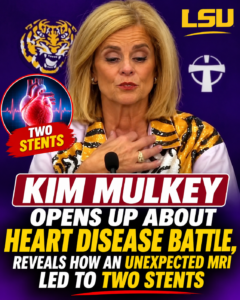
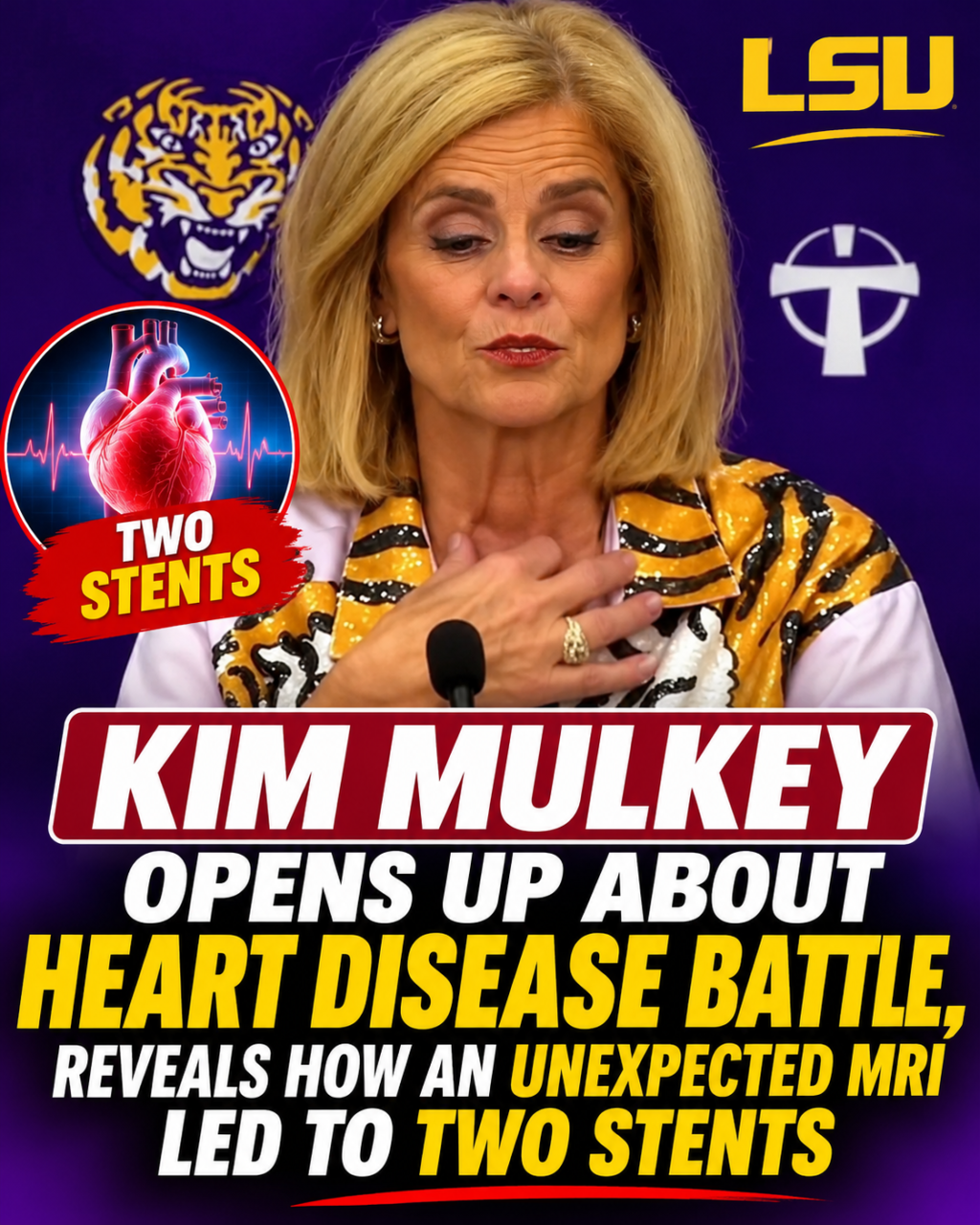
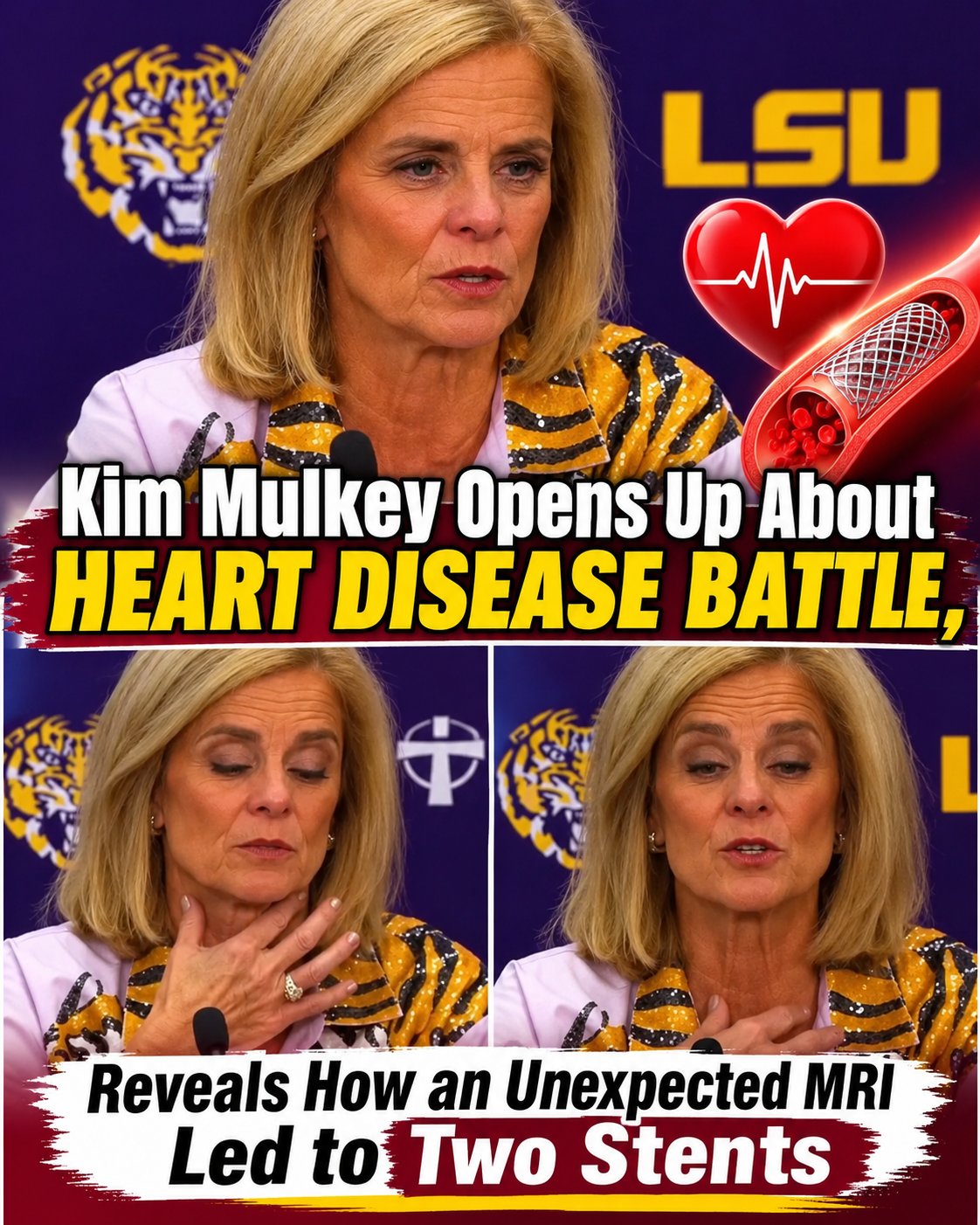
Kim Mulkey Opens Up About Heart Disease Battle, Reveals How an Unexpected MRI Led to Two Stents
Women’s Basketball | LSU | Health Update
LSU women’s basketball coach Kim Mulkey has shared a deeply personal health experience, revealing how an unexpected medical discovery eventually led to the placement of two heart stents. Her story is a powerful reminder that heart disease does not always come with obvious warning signs, even for people who appear healthy, active and energetic.
Known for her competitive personality, championship pedigree and demanding presence on the sidelines, Mulkey has spent much of her life in the public eye as one of college basketball’s most recognizable coaches. However, her latest revelation shifts attention away from basketball and toward a health issue that affects millions of women.
Her central message was simple but important: You cannot determine someone’s heart health by looking at them.
An Unexpected MRI That Changed Everything
Mulkey explained that her discovery began with what appeared to be an ordinary medical appointment.
Following LSU’s national championship victory, she visited a neurosurgeon because of a problem involving the tip of her finger. She suspected carpal tunnel syndrome and wanted to determine the severity of the condition.
What happened next was largely accidental.
According to Mulkey, the MRI machine was available as she was leaving the appointment. Seeing an opportunity to undergo the scan, she jokingly asked whether she could use it, mentioning that she had good insurance and was willing to pay for the examination.
She initially believed the scan would simply help evaluate her existing medical concern.
However, the results revealed something far more serious.
After receiving a call informing her that the scan looked good regarding her original issue, Mulkey asked to see the results. That was when the medical team explained that they had identified another concern.
The unexpected discovery was plaque buildup in her carotid arteries, which prompted doctors to recommend that she consult a cardiologist.
Mulkey recalled her confusion when she was told she needed to see a heart specialist.
“I said, ‘For this?'”
The discovery was particularly surprising because she had not initially gone to the hospital with a heart-related complaint. What started as an appointment for a finger problem unexpectedly opened the door to a potentially life-changing cardiovascular diagnosis.
Two Stents Later: Why Mulkey’s Revelation Matters
Perhaps the most striking part of Mulkey’s account was her confirmation that the medical discovery eventually led to the placement of two stents.
She concluded her explanation with the words:
“And so, yeah—two stents later, I’m still alive and kicking.”
That statement puts the seriousness of her experience into perspective.
Stents are small medical devices used to help keep narrowed or blocked blood vessels open, typically in the arteries. Their placement is often part of treatment for significant coronary artery disease.
However, Mulkey does not specify the exact arteries in which her two stents were placed, when the procedures occurred, or the precise diagnosis that led to them. It would therefore be inaccurate to assume that the carotid plaque discovered during the MRI directly resulted in both stent procedures.
What is clear is that the discovery prompted further cardiovascular evaluation and that she subsequently underwent treatment involving two stents.
For someone whose professional life involves constant travel, intense competition, public appearances and the pressures of leading an elite basketball program, the experience offers a sobering reminder that health concerns can exist beneath an outward appearance of strength.
‘Do I Look Like a Heart Patient?’ Her Message to Women
The most important part of Mulkey’s revelation was not necessarily the medical procedure but the lesson she wants other women to take from her experience.
She repeatedly challenged the assumption that heart disease has a particular appearance.
“Do I look like a heart patient? Do I look like somebody that would have heart disease? You never know.”
That question captures one of the biggest challenges surrounding cardiovascular health: people can feel healthy and appear physically fit while still having underlying risk factors or developing cardiovascular disease.
Heart disease is not exclusively a condition affecting older people, individuals who are visibly overweight or those who already have obvious health problems.
Women, in particular, should take cardiovascular health seriously. Symptoms can sometimes be different from the familiar chest-pain presentation many people associate with heart attacks. Unusual fatigue, shortness of breath, nausea, dizziness and discomfort in the back, jaw or arms can also be warning signs.
Mulkey’s experience reinforces the importance of paying attention to medical advice, undergoing appropriate screenings and following up when doctors identify something unusual.
Her story should not be interpreted as a recommendation for everyone to undergo an MRI. Rather, it highlights the importance of appropriate medical evaluation and not dismissing unexpected findings.
Regular Medical Checks Have Become Part of Her Routine
Mulkey also explained that the discovery changed how seriously she approaches her health.
She revealed that she joined her mother in getting checked regularly after learning about the plaque in her carotid arteries.
That detail is particularly significant because it demonstrates how one unexpected medical finding can change a person’s approach to preventive healthcare.
Rather than treating the discovery as an isolated incident, Mulkey made regular medical evaluations part of her routine.
For women who often prioritize family responsibilities, careers and other commitments ahead of their personal well-being, her message carries additional importance.
Knowing your blood pressure, cholesterol levels, blood sugar and other cardiovascular risk factors can help healthcare professionals identify potential problems and recommend appropriate preventive measures.
A Health Message Bigger Than Basketball
Kim Mulkey’s revelation is significant for reasons that extend well beyond LSU women’s basketball.
She is a high-profile coach whose public image is closely associated with toughness, confidence and an unwavering competitive spirit. Her willingness to discuss a personal health experience offers a different perspective on what strength means.
Being strong does not make someone immune to heart disease. Being active does not automatically guarantee cardiovascular health, and looking healthy does not mean everything is functioning properly internally.
There is also an important distinction between discovering a potential health problem and receiving a definitive diagnosis. Mulkey’s account demonstrates why follow-up examinations matter, particularly when unexpected findings appear during medical testing.
Her decision to speak publicly could encourage other women to take their health more seriously, ask questions during medical appointments and avoid assuming that cardiovascular problems only affect other people.
Importantly, Mulkey has not disclosed a new cardiac emergency. Her comments are a personal account of a previous discovery, subsequent treatment involving two stents and her ongoing commitment to regular checkups. There is no indication that she is currently stepping away from coaching or experiencing a new heart-related complication.
WATCH VIDEO👇
Final Takeaway
Kim Mulkey has built a remarkable basketball career through determination, resilience and an ability to overcome challenges. But her latest personal revelation delivers a lesson that no championship trophy can replace.
An ordinary medical appointment, an unexpected MRI and a discovery she never anticipated ultimately changed how she viewed her health.
Her words deserve to be remembered:
“Do I look like a heart patient? Do I look like somebody that would have heart disease? You never know.”
For Mulkey, the experience resulted in two stents and a renewed commitment to regular medical checks. For the women listening to her story, the message is clear: do not wait until something feels seriously wrong before taking your heart health seriously.
Some things are bigger than basketball. ❤️
About The Author