Option B: If Chloe Kitts needs time, Dawn Staley’s contingency plan might just be the most dominant lineup in the SEC — And the “Tournebize Era” Is Already Here
Why Alicia Tournebize Could Be South Carolina’s Secret Weapon
There is a version of the 2026-27 South Carolina Gamecocks season where the story isn’t about who was expected to start — it’s about who earned the right to. Option B is that story. It is the lineup that puts Alicia Tournebize at the center of everything, shifts an All-American into a new role, and forces every team in the SEC to solve a problem they have never seen before.
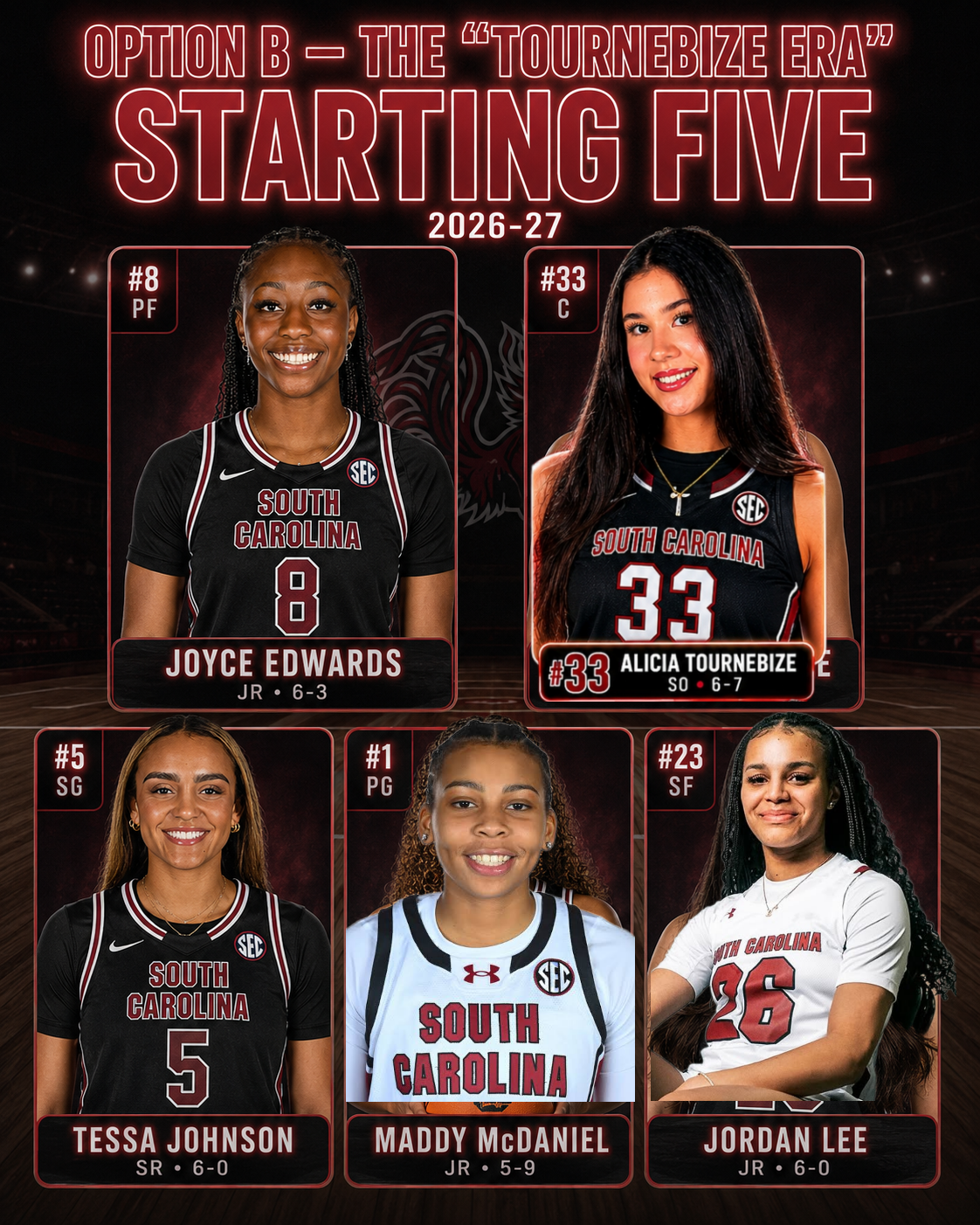
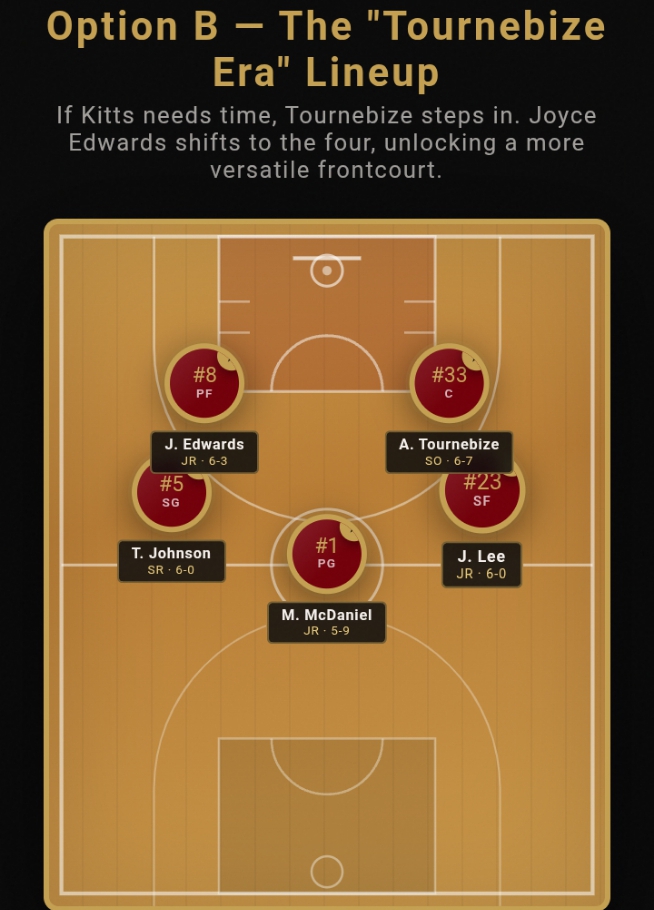
Here is the full projected starting five:
PG — Maddy McDaniel | JR · 5-9
SG — Tessa Johnson | SR · 6-0
SF — Jordan Lee | JR · 6-0
PF — Joyce Edwards | JR · 6-3
C — Alicia Tournebize | SO · 6-7
Breaking Down the Lineup
Maddy McDaniel — The Constant
Regardless of which starting lineup Dawn Staley ultimately deploys, one thing never changes — Maddy McDaniel is running this offense. The junior point guard has earned the trust of her coaching staff to the point where South Carolina passed entirely on adding a transfer point guard competitor this offseason. That level of institutional confidence is rare, and McDaniel’s ability to manage pace, distribute the ball, and keep a rotation of talented players engaged makes her the irreplaceable foundation of every lineup option on the board.
In the Option B configuration specifically, McDaniel’s role becomes even more critical. With a starting lineup that skews toward length and frontcourt dominance, she is the primary creator and decision-maker — the player responsible for putting Tournebize, Edwards, and Lee in the right positions to succeed on every possession.
Tessa Johnson — The Senior Stabilizer
Johnson’s presence at the two is about far more than scoring. At 6-foot and in her senior year, she is one of the most experienced players on this roster — a player who has been in big moments, absorbed big coaching corrections, and come out the other side as one of the more reliable perimeter contributors in the program. Johnson and McDaniel showed the ability to function interchangeably as ball-handlers last season when needed, giving this backcourt genuine positional flexibility that helps mask any developing lineup’s early-season rough edges.
She is also a critical defensive communicator — the kind of senior presence that keeps a young center like Tournebize properly positioned on the back line of South Carolina’s defensive schemes.
Jordan Lee — The Underrated Piece
Jordan Lee at the three is arguably the most underappreciated aspect of this entire lineup projection. At 6-foot and entering her junior year, Lee brings a calm, consistent professionalism to the wing spot that complements the explosive pieces around her perfectly. She has never been a primary ball-handler, and slotting her into the starting small forward role leans into her strengths — off-ball movement, spot-up shooting, and the kind of cerebral defensive awareness that doesn’t always show up in box scores but absolutely shows up in wins.
Lee coming off the bench in a Johnson or Makeer-led backup unit made strong organizational sense in previous rotation projections, but with Tournebize needing experienced floor spacing around her in the post, Lee’s shooting range and court IQ at the three make her an ideal fit as a starter in this configuration.
Joyce Edwards — Unleashed at the Four
Here is where Option B becomes genuinely dangerous for the rest of the SEC.
Moving Joyce Edwards from her natural center position to the power forward spot is not a demotion — it is an upgrade in terms of what she unlocks for this team. At 6-3 with All-American credentials, Edwards is one of the most versatile frontcourt players in women’s college basketball. The coaching analysis from the projected rotation says it plainly: “Moving Joyce Edwards to the four unleashes her versatility — she proved she can thrive in that role during big games last season.”
Those big games matter. Against TCU and UConn in particular, Edwards demonstrated the footwork, athleticism, and basketball IQ to function not just adequately but effectively as the primary four-man in small-ball and matchup lineups. Opposing power forwards will be completely outmatched by her skill level, and her ability to step away from the basket and operate as a connector gives Tournebize the room she needs to operate without a body constantly in the paint creating traffic.
On the defensive end, Edwards at the four is a nightmare assignment for any opponent. She has the length to contest perimeter jumpers and the physicality to hold her own in the post — a genuinely two-way defender who makes this lineup nearly impossible to attack in any conventional way.
Her international pedigree further validates the projection. This past summer, Edwards won a gold medal with Team USA at the 2026 FIBA 3×3 Women’s World Cup, where she was one of the team’s most consistent contributors. That experience — playing under pressure, against elite competition, in a format that demands both versatility and physical toughness — will only accelerate her development heading into the college season.
Alicia Tournebize — The Game Changer at Center
This is the position that defines Option B entirely, and the one with the most riding on a single player’s offseason development.
As the coaching analysis states directly: “Tournebize at 6-7 gives South Carolina a dominant paint presence that stretches opposing defenses.”
At 6-7, Tournebize is simply a different problem than any center South Carolina has deployed in recent memory. Her frame alone — a full four inches taller than the next tallest starter in this lineup — forces opposing defenses to completely recalibrate. Bigs who are accustomed to operating freely on the baseline suddenly have a skyscraper altering their shot angles. Guards driving the lane suddenly have to contend with a presence that can block shots and rebound at a rate that changes the entire complexion of a game.
As a freshman last season, Tournebize showed undeniable promise but was limited by the one thing that a summer in South Carolina’s renowned strength and conditioning program can actually fix — physical strength. She simply did not yet have the body to consistently absorb contact in the post against SEC-caliber competition. The coaching analysis is honest about the core risk: “This lineup is only as strong as Tournebize’s conditioning development. If her offseason strength gains haven’t arrived, post defense becomes a vulnerability at the highest level of SEC play.”
That is the make-or-break question for Option B. If Tournebize’s body has caught up to her talent — and every indication from the offseason program suggests it has been a priority — then this lineup doesn’t just work. It dominates.
The Kitts Factor: Contingency That Becomes Competition
The trigger for Option B has always been Chloe Kitts’ ACL recovery timeline. If Kitts is fully healthy and ready to start from day one, Option A — the proven core lineup — becomes the default. But Option B was never designed as merely a backup plan. It is a genuine alternative starting configuration that could conceivably be better than the conventional lineup depending on the matchup.
Think about what Dawn Staley now has available in this scenario: Kitts — a redshirt senior All-American — coming off the bench as the first frontcourt reserve. That is not a consolation prize. That is the most dangerous bench weapon in the entire country. A player of Kitts’ caliber, entering games fresh against tired post defenders who have spent 15 minutes trying to guard Tournebize and Edwards, is a matchup that late-game opponents simply cannot solve.
This is what championship roster depth looks like in practice. The contingency plan is so talented that it creates genuine lineup competition — and that competition makes the entire program better.
Why This Lineup Could Work All Season
The Option B starting five averages 6-foot-2 in height across all five positions — a statistic that tells you everything about the defensive potential of this unit. Length, versatility, and athleticism at every spot from the point guard to the center creates a defensive identity that is uniquely difficult to prepare for.
On offense, the spacing logic is sound. Tournebize’s presence in the paint draws defensive attention and opens the floor for McDaniel’s pick-and-roll game, Lee’s corner shooting, and Johnson’s mid-range efficiency. Edwards at the four provides a secondary post option and a relentless offensive rebounding presence that turns missed shots into second-chance opportunities at a high rate.
The risk is real and must be acknowledged. Tournebize has to deliver on the physical development front. But the upside — a 6-7 sophomore who has already spent a full year learning Dawn Staley’s system operating alongside two All-Americans and two experienced guards — is the kind of upside that wins championships in March.
The Bottom Line
Option B is not the contingency plan people think it is. It is a legitimate championship configuration that asks one sophomore to take a leap — and surrounds that sophomore with everything she needs to make that leap confidently.
If Alicia Tournebize has done the work this offseason, the “Tournebize Era” at South Carolina isn’t just a catchy label. It is the beginning of a dominant chapter in Gamecock basketball history.
Dawn Staley has never been afraid to play the best lineup, regardless of expectations. In 2026-27, that lineup just might start with the tallest player on the roster. 🐔
About The Author