Rebuilding South Carolina’s Rotation From Scratch After McDaniel’s Exit
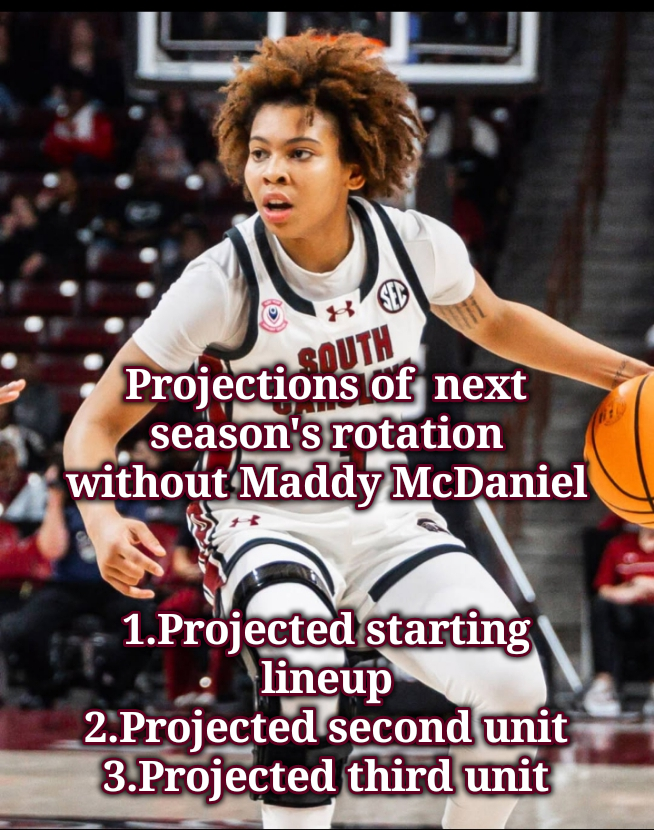
South Carolina confirmed last week that Maddy McDaniel will not be returning to the team this season — news that forces a complete rebuild of how the Gamecocks’ rotation projects to look, rather than a simple tweak to an existing plan.
Why this projection starts over completely
Earlier roster projections built throughout the spring worked incrementally, updating a previous version each time a new player joined the program. This time, that approach doesn’t work. McDaniel was one of the only true constants across every prior version of the projected lineup, anchoring the point guard spot in each iteration. Her departure doesn’t just create a single positional vacancy — it forces a full reconsideration of how the rest of the roster fits together, given how much of the previous structure was built around her running the offense.
A shift toward positionless basketball
Rather than continuing to project traditional starter-and-backup depth charts at each position, this year’s roster realities call for something more fluid. Both necessity and the roster’s actual strengths point toward positionless basketball, meaning the more useful exercise now is projecting full lineup groupings — a starting five, a second unit that enters after the first wave of substitutions, and a third unit that typically sees action around quarter breaks — rather than rigid position-by-position depth.
With no true, natural point guard on the roster, South Carolina will likely need to keep multiple ball-handlers on the floor simultaneously to avoid overloading any single player. That points toward using at least two players from a group of four: Tessa Johnson, Agot Makeer, Jerzy Robinson and Chloe Kitts. Jordan Lee is notably left out of that primary ball-handling group, since she was never used in that role at Texas — though with a full three months before the season, there’s still time for her to work her way into that conversation.
Projected starting lineup
- Point guard: Tessa Johnson (SR, 6-0)
- Guard: Jordan Lee (JR, 6-0)
- Wing: Agot Makeer (SO, 6-2)
- Forward: Chloe Kitts (R-SR, 6-3)
- Post: Joyce Edwards (JR, 6-3)
On the surface, this grouping is fairly straightforward — arguably South Carolina’s five most talented and experienced available players, arranged in a lineup that fits together naturally. But there’s a case for deviating from it, too. Historically, Dawn Staley has preferred keeping a significant scoring or physical punch in reserve rather than simply starting her five best individual players. That could mean swapping Kitts for Ashlyn Watkins to add size and defensive presence, or swapping Lee for Robinson — a move that would theoretically ease pressure on the freshman by surrounding her with veterans while also preserving a proven scorer for the bench unit.
Projected second unit
- Point guard: Agot Makeer (SO, 6-2)
- Guard: Jerzy Robinson (FR, 6-2)
- Wing: Jordan Lee (JR, 6-0)
- Forward: Joyce Edwards (JR, 6-3)
- Post: Ashlyn Watkins (SR, 6-3)
This grouping essentially plugs in the top reserves behind the starting lineup — Watkins up front, Robinson in the backcourt — while intentionally holding Johnson and Kitts back so they’re available deeper into the bench rotation. The tradeoff worth questioning here is significant, though: pulling two seniors, including the one player trusted to run point guard duties, at the very first substitution is a real risk. This is traditionally the exact unit Staley has counted on to provide an energy spark off the bench — the role filled in past seasons by names like A’ja Wilson and Alaina Coates in 2015, Lele Grissett in 2020, and Tessa Johnson and MiLaysia Fulwiley in 2024. Whether this particular group can replicate that same spark remains a genuine open question.
Projected third unit
- Point guard: Jerzy Robinson (FR, 6-2)
- Guard: Tessa Johnson (SR, 6-0)
- Wing: Chloe Kitts (R-SR, 6-3)
- Forward: Oliviyah Edwards (FR, 6-3)
- Post: Alicia Tournebize (SO, 6-7)
Positional labels matter less here than the overall concept. This grouping lets Robinson run the offense with two experienced safety nets in Johnson and Kitts alongside her, while getting minutes to two freshmen frontcourt pieces in Oliviyah Edwards and Tournebize who need game reps but haven’t yet fully earned complete trust. Going bigger with this unit could also help create mismatches and offset the relative inexperience of the group as a whole. That said, the noticeable absences here — Adhel Tac, Ayla McDowell, Kelsi Andrews, Kaeli Wynn and Justine Loubens — are worth flagging. If healthy, Tac represents South Carolina’s only true, traditional post player, and she could realistically take minutes away from Tournebize depending on matchup. McDowell, Wynn and Loubens all bring shooting ability that could offer valuable floor spacing this group currently lacks.
Remaining reserves (garbage-time lineup)
- Point guard: Jordan Lee (JR, 6-0), Jerzy Robinson (FR, 6-2)
- Guard: Ayla McDowell (SO, 6-1)
- Wing: Kaeli Wynn (FR, 6-2), Justine Loubens (FR, 6-1)
- Forward: Oliviyah Edwards (FR, 6-3), Alicia Tournebize (SO, 6-7)
- Post: Adhel Tac (R-JR, 6-5), Kelsi Andrews (FR, 6-3)
This final group is largely a matter of process of elimination — essentially the rest of the available roster. Getting Lee some point guard reps here, even in low-stakes minutes, would be a reasonable way to prepare for an emergency scenario later in the season, and continuing to develop Robinson’s game remains valuable regardless of matchup. The larger philosophical question is whether South Carolina prioritizes game experience for its younger players over more minutes for Tac — and there’s a reasonable argument that Lee shouldn’t be logging 30-plus minutes in a comfortable 50-point blowout in December, regardless of how deep the bench goes.
The bigger picture
Taken together, this full reconstruction reflects just how significant McDaniel’s absence actually is — not merely a single roster hole, but a structural shift that touches all three lineup tiers and forces South Carolina toward a genuinely different offensive philosophy built around shared ball-handling rather than a single primary floor general.
About The Author