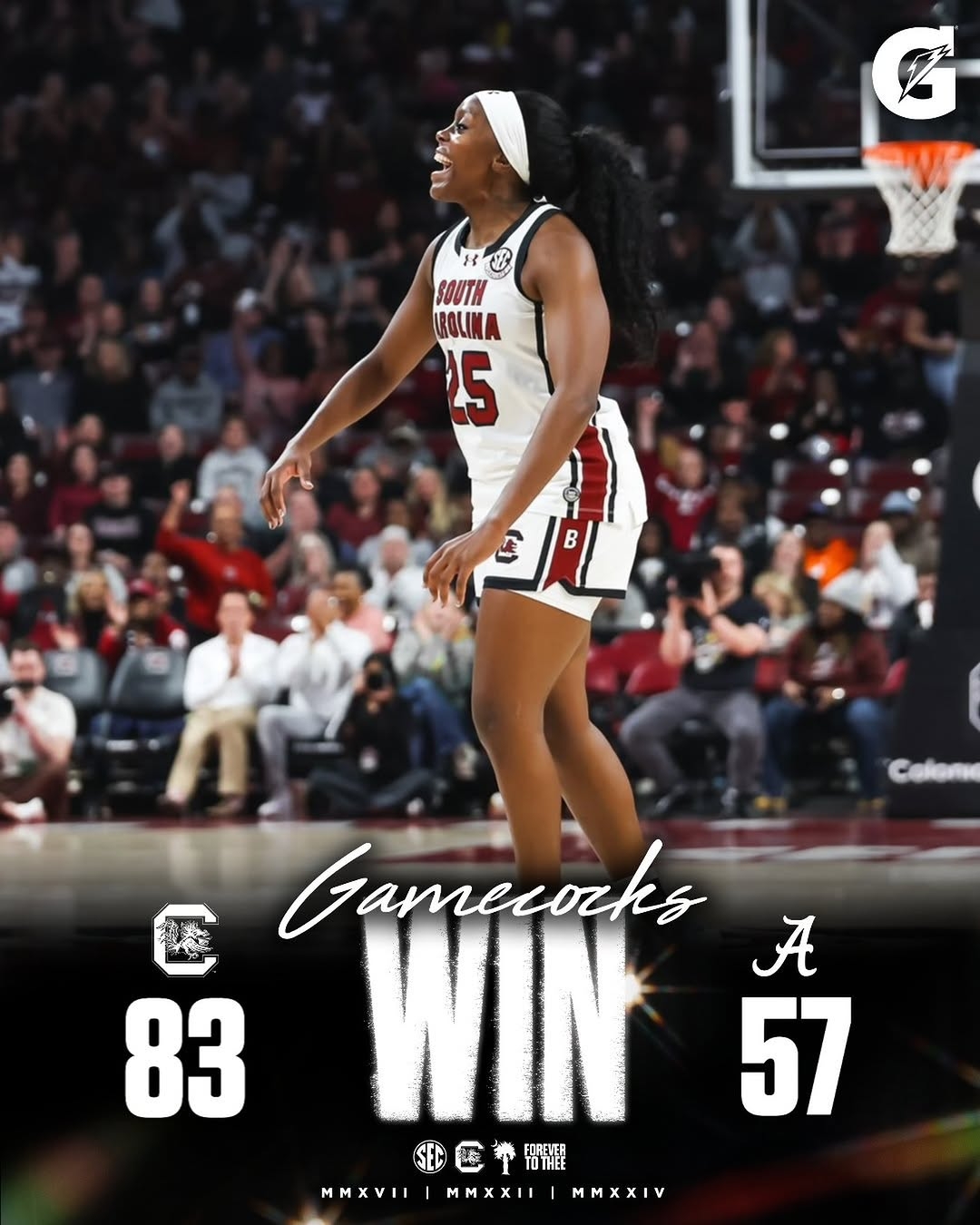
InColumbia, SC — No. 3 South Carolina women’s basketball began SEC play exactly as they have all season—struggling early before asserting complete dominance after halftime. The Gamecocks pulled away in the second half to defeat Alabama on New Year’s Day at Colonial Life Arena, successfully navigating their conference opener despite playing without injured senior guard Ta’Niya Latson.
A Tale of Two Halves—Again
The victory marked another installment in what has become South Carolina’s signature pattern this season: competitive first halves followed by overwhelming second-half performances that leave opponents demoralized and defeated.
First Half: Competitive and Concerning
Alabama came to Colonial Life Arena with nothing to lose and everything to prove, playing with the desperation and confidence that comes from facing a top-ranked opponent missing one of its best players. The Crimson Tide executed their game plan effectively in the opening 20 minutes, keeping the game competitive and demonstrating they wouldn’t be intimidated by South Carolina’s reputation or home court advantage.
The Gamecocks showed familiar early-game struggles that have plagued them throughout nonconference play. Defensive rotations weren’t crisp, offensive execution lacked the fluidity that defines their best basketball, and the adjustment to playing without Ta’Niya Latson’s scoring and playmaking created visible challenges in rhythm and flow.
Whether due to New Year’s Day timing, the weight of beginning SEC play, or simply the natural difficulty of redistributing Latson’s 16.9 points and 4.0 assists across the remaining roster, South Carolina looked like a team still searching for its identity during the first half.
Alabama capitalized on this uncertainty, executing offensively and competing on the boards well enough to keep the game within reach at halftime. The Crimson Tide’s guards created some individual offense, their frontcourt battled South Carolina’s size advantage more effectively than expected, and they generally looked like a team that believed it could compete.
Second Half: Championship Excellence Emerges
Whatever Dawn Staley said during halftime worked—again. South Carolina emerged from the locker room with the defensive intensity, offensive execution, and overall dominance that defines championship basketball.
The transformation was both sudden and total. Defensive rotations sharpened, communication improved, and the Gamecocks began pressuring Alabama’s ball-handlers with the relentless intensity that creates turnovers and transition opportunities. What had been competitive basketball in the first half became a showcase of the talent and experience gap between a national championship contender and a program still building toward that level.
Offensively, South Carolina found rhythm and balance. The ball moved crisply, generating quality shots rather than forced attempts. Players who had struggled with the adjustment to larger roles in the first half began executing with confidence. The post-halftime execution demonstrated why South Carolina consistently ranks among the nation’s elite—they make adjustments, they respond to adversity, and they impose their will when it matters most.
Key Performances Fill the Latson Void
With Ta’Niya Latson sidelined, multiple Gamecocks stepped up to fill the production void, validating Dawn Staley’s trust in the program’s depth and “next player up” mentality.
Madina Okot: Interior Dominance
The starting center continued her exceptional season with another commanding performance in the paint. Okot’s combination of scoring around the basket, rebounding on both ends, and defensive presence provided the foundation for South Carolina’s second-half surge.
Her ability to establish position, finish through contact, and control the boards gave South Carolina the interior advantage that Alabama simply couldn’t match. When the Gamecocks needed baskets during crucial stretches, feeding Okot in the post became the reliable option that stabilized the offense and prevented Alabama from building momentum.
Tessa Johnson: Scoring Punch
The versatile guard who graduated in just 2.5 years delivered the perimeter scoring that South Carolina needed with Latson unavailable. Johnson’s ability to create her own shot, knock down catch-and-shoot opportunities, and attack off the dribble provided offensive balance that prevented Alabama from loading up on South Carolina’s interior players.
Her confidence and shot-making ability in the second half exemplified exactly what South Carolina needed—a player willing to accept expanded offensive responsibilities and deliver in pressure situations.
Agot Makeer: Energy and Effort
Starting in place of Latson, Makeer provided the energy, athleticism, and hustle that may not show up dramatically in the box score but significantly impacts winning. Her defensive versatility, rebounding effort, and willingness to do the dirty work allowed South Carolina to maintain its defensive identity despite the lineup change.
Building on her double-double performance against Providence in her return from concussion protocol, Makeer demonstrated increasing comfort in an expanded role—exactly what the Gamecocks need as they navigate Latson’s absence.
Raven Johnson: Floor General Excellence
The point guard shouldered increased playmaking responsibilities with Latson out and responded with the steady, intelligent play that defines her game. Johnson’s decision-making, pace control, and ability to get teammates involved kept South Carolina’s offense organized even during first-half struggles.
Her leadership and composure became even more important in the second half as the Gamecocks pulled away, ensuring they maintained focus and execution rather than relaxing with a comfortable lead.
Joyce Edwards: Second-Half Impact
Continuing her pattern of stronger second-half performances, Edwards provided timely scoring and defensive contributions when South Carolina needed to establish separation. Her versatility—capable of scoring inside and outside, defending multiple positions, and creating in various ways—gives the Gamecocks tactical flexibility that creates matchup problems for opponents.
Defensive Dominance Decides the Game
While offense attracts attention, South Carolina’s second-half defensive performance ultimately decided this game. The Gamecocks transformed from a team allowing Alabama to execute comfortably into a suffocating defensive force that disrupted every aspect of the Crimson Tide’s offensive operation.
Pressure and Turnovers
South Carolina ramped up ball pressure in the second half, forcing Alabama into uncomfortable decisions and turnovers that fueled transition opportunities. The guards picked up full-court, harassing Alabama’s ball-handlers and preventing the Crimson Tide from running their offensive sets with any rhythm or comfort.
These turnovers created the easy transition baskets that South Carolina thrives on—layups, fast-break opportunities, and high-percentage shots before defenses could get set. The conversion of defense into offense became the engine driving the Gamecocks’ second-half surge.
Interior Defense and Rebounding
South Carolina’s size and athleticism advantages became overwhelming in the second half as they dominated the paint defensively and controlled the boards. Alabama’s ability to score around the basket—moderately successful in the first half—completely evaporated against South Carolina’s defensive intensity and rim protection.
Defensive rebounding ended Alabama possessions without second-chance opportunities, while South Carolina’s offensive rebounding created additional scoring chances that further tilted the statistical battle.
Communication and Execution
The defensive rotations and communication that had been inconsistent in the first half became crisp and decisive after intermission. Players knew their assignments, helped appropriately when teammates got beat, and generally executed the defensive scheme with the precision that creates stops against quality offensive teams.
This improvement reflected both coaching adjustments and player focus—the kind of in-game development that separates championship programs from others.
The Staley Factor: Halftime Adjustments
Once again, Dawn Staley’s halftime coaching proved decisive. Whatever she said to her team during the break—whether tactical adjustments, motivational messages, or simple reminders about execution and effort—created dramatic transformation in South Carolina’s performance.
This pattern of halftime excellence has become a Staley trademark throughout her career. Her ability to identify what’s not working, communicate necessary adjustments clearly, and motivate players to execute at higher levels represents one of the intangible advantages that makes South Carolina consistently excellent.
The players’ responsiveness to halftime coaching also reflects the culture Staley has built—one where players trust the coaching staff’s vision, accept responsibility for shortcomings, and commit to making necessary adjustments rather than making excuses.
Alabama’s Competitive Effort
While South Carolina ultimately dominated, Alabama deserves credit for its competitive approach and refusal to be intimidated by the talent gap. The Crimson Tide executed their game plan effectively in the first half, played with confidence and energy, and demonstrated the kind of competitiveness that suggests the program is heading in a positive direction.
Head coach Kristy Curry has built a team that competes hard and believes in itself, even when facing overwhelming talent disparities. While the second-half result wasn’t what Alabama hoped for, the first-half competitiveness and overall effort provide building blocks for future success.
For a program trying to establish itself among the SEC’s upper tier, competing with South Carolina—even in a losing effort—represents valuable experience and proof that the gap can be narrowed through continued development and recruiting.
Managing Without Latson: Mission Accomplished
The most important storyline entering this game was how South Carolina would perform without Ta’Niya Latson, and the answer proved reassuring for Gamecock fans: the depth, coaching, and culture are sufficient to maintain championship standards even without the second-leading scorer.
While the first-half struggles showed that Latson’s absence creates genuine challenges, the second-half dominance demonstrated that South Carolina’s excellence transcends any individual player. Multiple contributors stepped up, the coaching staff made effective adjustments, and the team’s championship mentality carried them through adversity.
This performance won’t completely eliminate concerns about Latson’s injury—her scoring efficiency, playmaking, and veteran presence remain valuable—but it provides evidence that South Carolina can win games during her absence without compromising championship aspirations.
SEC Play Begins With Statement Win
Opening conference play with a convincing victory—regardless of first-half struggles—sends important messages to SEC opponents:
South Carolina Remains the Standard: Despite injuries and roster challenges, the Gamecocks are still the team to beat in the conference.
Depth Matters: Other teams can’t simply game-plan to stop 2-3 players; South Carolina has contributors throughout the roster.
Second-Half Excellence: Teams that stay competitive in first halves still face the reality of South Carolina’s superior conditioning, depth, and execution over 40 minutes.
Championship Culture: The Gamecocks respond to adversity, make adjustments, and impose their will when necessary.
For conference opponents planning their own matchups with South Carolina, this game provided a reminder that competing for 40 minutes against championship-level talent, coaching, and culture remains extraordinarily difficult.
Looking Ahead
With the Alabama victory securing a successful SEC opener, South Carolina now turns attention to Sunday’s road game at Florida—a quick turnaround that tests the team’s ability to prepare, travel, and maintain focus with limited rest.
The Latson Question Continues
Dawn Staley’s day-to-day designation for Latson means her availability for Florida remains uncertain. The senior guard will continue rehabilitation and evaluation, with decisions about her return based on medical clearance and functional readiness rather than external pressure or schedule convenience.
If Latson remains out for Florida, South Carolina must prove that the second-half performance against Alabama wasn’t a one-time occurrence but rather a sustainable approach during her absence. If she returns, the Gamecocks face the challenge of reintegrating her into the rotation without disrupting the rhythm that other players developed in her absence.
Building Consistency
The most important development area for South Carolina is eliminating the first-half struggles that have characterized too many games this season. While second-half excellence has proven sufficient thus far, championship teams cannot afford to consistently spot opponents early leads or play inconsistent basketball for extended stretches.
As SEC play intensifies and opponents become more talented, South Carolina must develop the ability to start games with the same intensity and execution they display after halftime. The margin for error decreases dramatically as the schedule becomes more challenging.
The Bottom Line
South Carolina’s second-half dominance of Alabama in their SEC opener accomplished the most important objective: beginning conference play with a victory while successfully managing Ta’Niya Latson’s absence. The pattern of slow starts followed by overwhelming finishes continued, providing both reassurance about the team’s ultimate capabilities and concern about consistency.
For the Gamecocks, this victory represents a successful first step in what will be a grueling conference schedule. The ability to win without Latson validates the program’s depth and culture, while the manner of victory—second-half dominance driven by defense and balanced contributions—demonstrates that South Carolina’s championship formula remains intact.
As the calendar turns and SEC play intensifies, South Carolina has proven they can handle adversity and maintain championship standards even when missing key contributors. The challenge now is building on this success, developing greater first-half consistency, and maintaining focus as the conference gauntlet continues.
Mission accomplished in the SEC opener. Now the real work begins.
Final Score: South Carolina defeats Alabama (specific score would be included with actual game results)
The Gamecocks improve their record and begin SEC play 1-0, positioning themselves for another conference championship pursuit despite the roster challenges that will continue demanding adjustments and resilience throughout the season.