South Carolina’s Free-Throw Woes and Shooting Struggles Offer Early Lessons
South Carolina has plenty of positives to build on, but its performance at the free-throw line exposed an area that deserves attention. The Gamecocks finished 24-for-36 on free throws, converting just 66.7% of their attempts. With a team that is likely to draw plenty of fouls throughout the season, making those opportunities count could become an important factor in close games.
The concern goes beyond the charity stripe. South Carolina also struggled from beyond the arc, finishing 5-for-22 from three-point range (22.7%). Tessa Johnson accounted for three of those makes, shooting an efficient 3-for-5. Kelsi Andrews, who is not expected to be a frequent three-point shooter, connected on her only attempt, while Justine Loubens added the team’s other make, finishing 1-for-3.
Three-point shooting is expected to be one of South Carolina’s strengths this season. However, several players who could play important roles in that area had difficult outings. Jordan Lee went 0-for-3, Agot Makeer finished 0-for-2, Ayla McDowell missed all four attempts, and Jerzy Robinson went 0-for-3.
There is no reason to overreact to one performance, particularly this early in the season. Still, if the Gamecocks continue to struggle with both free throws and outside shooting once regular-season competition begins, those weaknesses could become costly.
A Slow Start Gives Way to Better Rhythm
South Carolina looked out of sync during the opening quarter before gradually finding its footing. One possible explanation was the frequent rotation of players, as Dawn Staley used 10 different players in the first quarter. The constant substitutions may have made it difficult for the group to establish a consistent rhythm.
Early nerves may also have played a part. For some players, this was their first opportunity to compete in front of the passionate Gamecock fan base, and the desire to make a strong first impression was evident.
As the game progressed, Staley made fewer substitutions, particularly in the second half, giving the players more time to settle into their roles. The improvement illustrated an important purpose of exhibition games: helping a team adjust to the arena, the atmosphere and the demands of competition before the regular season begins.
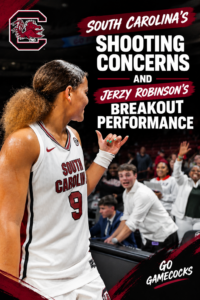
Jerzy Robinson Makes a Powerful Statement
Robinson entered the season without receiving quite as much offseason attention as some of her teammates. Her commitment came shortly before Christmas without a lengthy recruiting storyline, and comparisons with the highly athletic Oliviyah Edwards may also have influenced the conversation. Robinson’s absence from the exhibition against College of Charleston meant fans had to wait longer to see her in action.
Her performance, however, offered a compelling reminder of her potential.
Robinson’s size, strength and versatility make her a difficult matchup. She has the physical tools to contribute at virtually every position outside center, creating opportunities to exploit mismatches against different opponents.
Her confidence is another valuable asset. Nevertheless, one lesson from the game was that she does not always need to force a difficult play. There were moments when securing the ball and finding an open teammate would have been a better decision than attempting to dribble out of pressure. Learning when to rely on her teammates could make her even more effective.
The overall numbers were impressive. Robinson tied for the team lead with 17 points, collected a game-high 11 rebounds and distributed five assists. She also recorded two steals and made five of her seven free-throw attempts.
Those contributions demonstrated how much she can influence a game beyond scoring alone.
After the performance, Staley praised Robinson’s ability to deliver on a big stage, saying:
“I like what Jerzy was doing,” Staley said. “Jerzy is someone that has big-game capability (and) had a big game tonight. Did it in a lot of different ways.”
What the Gamecocks Must Improve
South Carolina has encouraging talent and multiple players capable of making significant contributions. However, the early performance highlighted two areas worth monitoring: converting free throws consistently and turning open three-point opportunities into points.
The team also needs to build chemistry, especially during the opening minutes, while Robinson continues learning how to balance her aggressive approach with smart decision-making.
Exhibition performances are opportunities to identify problems before the games become more consequential. If the Gamecocks improve their shooting efficiency and establish a steadier rhythm, they will be better positioned to capitalize on their strengths throughout the season.
About The Author