
Why This Projected Starting Five Could Be South Carolina’s Best Answer to a Difficult Offseason
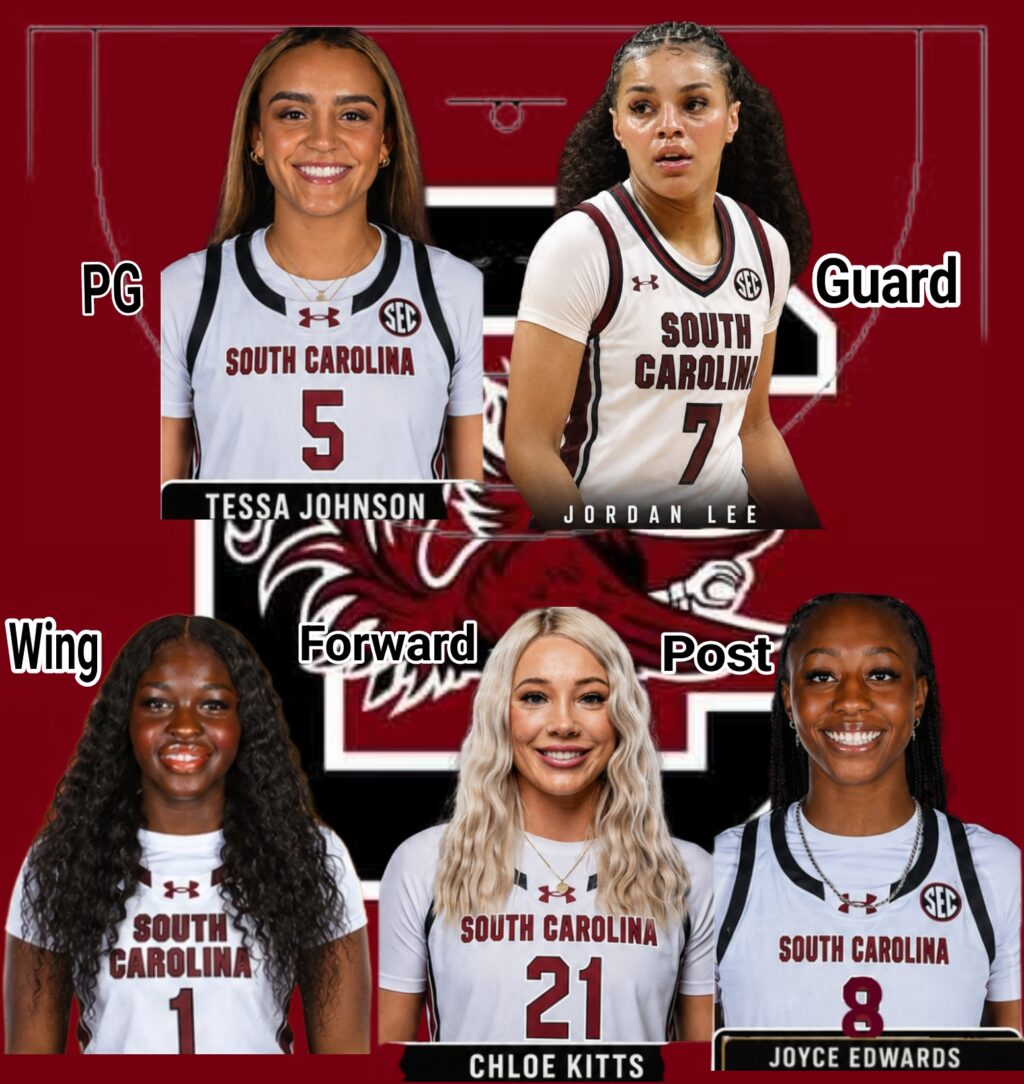
Losing your presumptive starting point guard midseason would sink most programs’ championship hopes. For South Carolina, it’s instead forced a lineup solution that, on closer inspection, may actually fit together better than the group it replaces. Here’s a deeper look at why Tessa Johnson, Jordan Lee, Agot Makeer, Chloe Kitts and Joyce Edwards could form a genuinely effective starting five in 2026-27.
A point guard who’s been building toward this for years
Tessa Johnson running the point isn’t a reach — it’s the culmination of a deliberate, multi-year plan. She arrived at South Carolina as a legitimate high school floor general, then spent three seasons intentionally reshaping her game into elite three-point shooting while quietly banking point guard reps during blowout fourth quarters and a real midseason audition last year when McDaniel missed time. What makes her particularly effective in this role now isn’t just experience — it’s that she brings something most primary ball-handlers don’t: elite outside shooting. A point guard who can genuinely space the floor from three removes an entire layer of defensive strategy opposing teams typically use against ball-dominant lead guards, since sagging off her to protect the paint simply isn’t a viable option.
Jordan Lee provides secondary shot creation without positional rigidity
Pairing Johnson with Jordan Lee at the “guard” spot, rather than a true second ball-handler, reflects the broader positionless approach this roster likely needs. Lee wasn’t asked to run offense at Texas, but that’s precisely the point — she can operate as a scoring guard alongside Johnson, reducing the burden on any single player to be the offense’s engine. In a backcourt without a traditional, high-usage point guard, distributing playmaking responsibility across multiple capable ball-handlers (Johnson, Makeer, and eventually Robinson off the bench) is a more sustainable model than hoping one player replicates what McDaniel or Raven Johnson provided in years past.
Makeer as the connective tissue at the wing
Agot Makeer’s placement at wing may be the most quietly important piece of this lineup. Her defensive versatility — evidenced by her ability to cross-match onto opposing point guards during last year’s NCAA Tournament — gives Staley a wing capable of guarding multiple positions, which matters enormously in a starting group that’s otherwise a bit undersized at the traditional forward and post spots. Offensively, her own point guard background in high school means she can function as a release valve or secondary initiator, adding further flexibility to an already fluid backcourt-to-wing pipeline.
Kitts brings the physicality this group otherwise lacks
Chloe Kitts’ inclusion addresses a real structural need. With Johnson (6-0), Lee (6-0) and Makeer (6-2) forming a relatively compact perimeter trio, Kitts’ 6-3 frame and physical style provide rebounding presence and interior toughness that keeps this lineup from being overly finesse-oriented. Her ability as a lead passer in high school also means she can function as a point forward in a pinch — exactly the kind of positional overlap this roster seems built to leverage, where multiple players can initiate offense depending on the possession and matchup.
Edwards anchors the frontcourt with size and scoring touch
Joyce Edwards rounds out the group as the traditional post presence, and her role here is arguably the most conventional of the five — but that stability matters. With four positionally flexible, multi-skilled players surrounding her, Edwards can focus on what she does best: scoring and rebounding around the rim, without needing to stretch her game into unfamiliar territory. That kind of clear, defined role for a post player often produces the most consistent production, since she isn’t being pulled in multiple directions offensively.
Why the fit works better than it might first appear
What makes this specific combination promising isn’t any single player’s individual talent — it’s the way their skill sets interlock. Johnson’s shooting stretches defenses vertically from the point guard spot, an uncommon luxury. Lee adds scoring punch without needing the ball in her hands constantly. Makeer’s defensive versatility covers for what could otherwise be a size disadvantage on the perimeter. Kitts provides the physical toughness and secondary playmaking to prevent the lineup from being one-dimensional. And Edwards gives the group a stable, high-volume scoring option inside that doesn’t require significant offensive redesign.
This is, in effect, a lineup built around distributed responsibility rather than a single dominant hierarchy — five players who can each handle the ball, defend multiple spots, and score in different ways, which is precisely the kind of adaptability a team needs when it no longer has one clear point guard to lean on.
The case for holding this group back — and why it might not matter
The argument for deviating from this exact five isn’t about talent; it’s about bench identity. Staley has historically preferred a formidable second unit capable of providing an immediate spark — the model that’s worked in seasons featuring names like A’ja Wilson, Alaina Coates, Lele Grissett, and more recently Tessa Johnson herself coming off the bench. Swapping Kitts for Ashlyn Watkins would add even more size and defensive rigidity to the starting group while preserving scoring punch for the second unit. Swapping Lee for Jerzy Robinson, meanwhile, would ease the freshman into a veteran-heavy lineup while keeping a proven scorer in reserve.
Either adjustment has real merit. But the strength of the base five-man group described above is that it doesn’t actually depend on staying static. Because so many of these players — Johnson, Makeer, Kitts — can slide between roles depending on matchup, Staley retains real flexibility to make exactly these kinds of substitutions without disrupting the underlying philosophy. The system is built to accommodate change, which may end up being its greatest strength heading into a season defined by uncertainty at the top of the depth chart.
The bottom line
This projected starting lineup isn’t a lineup built around one dominant star carrying the offense — it’s a lineup built around shared responsibility, defensive versatility, and positional fluidity, which happens to be exactly the model South Carolina needs after losing its presumptive point guard. If Johnson’s shooting continues opening up driving lanes, if Makeer’s defensive versatility neutralizes size disadvantages, and if Kitts and Edwards provide the physical toughness this group needs on the boards, this five-man unit could prove not just serviceable, but genuinely effective — a lineup whose adaptability may end up being more valuable to a championship push than raw individual star power alone.
About The Author