South Carolina Executed a Perfect Game Plan — And Kentucky Never Had a Chance

GREENVILLE, S.C. — It wasn’t just a win. It was a masterclass in tournament preparation, physical conditioning, and strategic execution. South Carolina didn’t simply beat Kentucky on Friday. The Gamecocks implemented a game plan specifically designed to exploit every vulnerability the Wildcats carried into Bon Secours Wellness Arena — and it worked from the opening tip.
The final score was 87-64. But the margin tells only part of the story.
The Strategy Was Simple. The Execution Was Surgical.
Dawn Staley’s staff had identified the blueprint before Friday’s quarterfinal even began. Kentucky was playing its third game in three days and its fourth in six — a grueling schedule that had already left significant physical wear on a roster that goes only six or seven players deep. The answer was obvious: play fast, push tempo, and make the fatigue that was already present become overwhelming as early as possible.
South Carolina executed that plan with precision. While the Gamecocks were officially credited with just 15 fast break points — a number that undersells how much the pace affected the outcome — the deeper statistics reveal the true damage inflicted. South Carolina attempted one more field goal than Kentucky and an extraordinary 19 more free throws. They converted 25 points off 19 Kentucky turnovers. The combination of relentless pressure, superior conditioning, and disciplined aggression forced the Wildcats into mistake after mistake while the Gamecocks cashed in at the free throw line again and again.
This is what modern, high-level tournament basketball looks like when it is executed correctly — not just outscoring an opponent, but systematically dismantling their ability to compete through intelligent game planning and physical superiority.
Kentucky Blinked First — Then Never Recovered
The Wildcats actually drew first blood, taking a 3-0 lead just 62 seconds into the game. It was the last time they led. South Carolina responded with a 9-0 run that set the tone for everything that followed, taking control of the game and never relinquishing it. The Gamecocks led 22-16 after the first quarter and pushed the margin to double digits early in the second — at which point the outcome was effectively decided.
For a Kentucky team that needed a fast start to have any chance of maintaining competitive tension, falling behind by double digits in the second quarter was a fatal blow. There was no reserve energy to mount a sustained comeback. There was no depth to absorb foul trouble or rest starters. Once the lead grew, it kept growing.
Tessa Johnson’s Breakthrough: Exactly What South Carolina Needed
If there was a single performance within the performance that defined Friday’s game, it belonged to Tessa Johnson. The SEC’s leading three-point shooter had been mired in one of the most concerning slumps of her season — connecting on just 4 of 21 attempts from beyond the arc across her previous three games. The cold stretch had been a legitimate concern heading into the tournament, a potential vulnerability in an otherwise complete South Carolina team.
On Friday, she answered every question at once.
Johnson scored 10 consecutive points during an 11-0 Gamecock run that didn’t just extend the lead — it broke the game open entirely and ended whatever competitive hope Kentucky had brought into the second half. She finished 3-for-4 from three and scored 15 points, the kind of efficient, timely performance that tournament runs are built on. The slump is over. The shooter is back.
Dawn Staley had urged Johnson all week to keep shooting, to get to the free throw line, to mix up her game and let the rhythm return naturally. The trust Staley placed in her shooter was repaid in full on Friday, at the exact moment the game demanded it most.
Joyce Edwards: A Statement Performance
Kentucky had held Joyce Edwards to a season-low nine points in their regular season meeting just days earlier. If that performance left any doubt about Edwards’ competitive response mechanism, Friday removed it entirely.
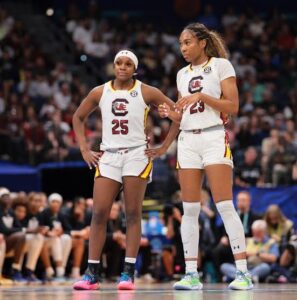
She sprinted the floor on every possession. She attacked relentlessly. She finished as the game’s leading scorer with 21 points on 8-of-12 shooting, adding four rebounds and locking down Kentucky star Clara Strack on the defensive end. The body language was unmistakable from the opening minutes — this was a player with something to prove, and she proved it comprehensively.
Edwards’ performance encapsulates something important about the culture Staley has built at South Carolina. A season-low scoring performance one week becomes a game-high scoring performance the next. The program doesn’t allow players to dwell in disappointment — it channels it.
The Okot-Strack Rematch: A Story of Conditioning
The most anticipated individual battle of Friday’s game was the rematch between South Carolina’s Madina Okot and Kentucky’s Clara Strack — two players who had put on an extraordinary show in Lexington just days earlier. Round two told a different story, and the reason was written on Strack’s face by the end of the first half.
Okot was dominant from the opening whistle, recording a double-double before halftime and finishing with 12 points, 13 rebounds, three steals, two assists, and a block in just 23 minutes. The efficiency of that line — that level of production in under 24 minutes — speaks to how completely Okot imposed herself on the game.
Strack, meanwhile, was visibly gasping for air by the end of the first half. The cumulative toll of three games in three days had caught up to her in real time, and what had been a fiercely competitive post battle in Lexington became a mismatch of physical reserves on Friday. She still finished with 11 points and five rebounds in 23 minutes — numbers that reflect genuine toughness and competitive pride — but the player who nearly willed Kentucky to an upset days earlier was running on empty.
It was not a failure of talent or effort. It was the inevitable consequence of an unsustainable schedule meeting a team specifically designed to exploit it.
Amelia Hassett provided Kentucky’s brightest individual moment, finishing with 15 points on a perfect 5-for-5 performance from three-point range — a shooting display that, in a different game under different circumstances, would have been the headline. On Friday, it was a footnote.
The Luxury of Depth — and Rest
South Carolina led by 23 heading into the fourth quarter, and Staley was able to do something she has rarely had the luxury of doing this season — rest her key players. In a tournament that demands four games across five days to claim a championship, preserving the legs of starters in a blowout quarterfinal is not just a kindness. It is a strategic decision with compounding value.
The Gamecocks who will matter most in the semifinals on Saturday will be fresher because of Friday’s outcome. That is not an accident. It is the downstream benefit of a game plan that was designed to create a blowout — and delivered one on schedule.
The Bigger Picture
South Carolina’s 87-64 victory over Kentucky was not simply a comfortable win for a top seed over a tired opponent. It was a statement about the kind of team the Gamecocks are — prepared, physical, deep, and capable of executing a specific strategic vision against a specific opponent with precision and efficiency.
Tessa Johnson’s slump is over. Joyce Edwards has delivered her answer. Madina Okot is playing some of the best basketball of her career. And Dawn Staley’s program is exactly where it has positioned itself to be — moving deeper into the SEC Tournament with fresh legs, growing momentum, and a game plan that has already proven it can work.
The semifinals await on Saturday. South Carolina is ready.
Source: on3
About The Author