The Man Behind the Screens: How Hudson Jacobs Became South Carolina Women’s Basketball’s Most Valuable Unsung Hero

COLUMBIA, S.C. — It started with a broken TV.
Dawn Staley couldn’t get her television to play a movie she’d been given early access to screen. So she did what she’s done for the better part of 15 years whenever technology becomes an obstacle — she called Hudson Jacobs.
That first call, made after Staley’s third season at South Carolina, was about a streaming problem. Every call since has been about winning.
The Origin Story Nobody Talks About
Jacobs didn’t arrive at South Carolina through a conventional pipeline. He was a multisport athlete whose playing career was derailed by injuries — the kind of backstory that could have led anywhere. Instead, it led him toward the analytical side of the game, first as a manager doing video work under Hall of Fame coach Kay Yow at NC State, then briefly with Charlotte’s men’s and women’s basketball programs.
He had exactly one season of full-time video experience when Staley reached out after someone floated his name at an AAU tournament. She had a video position to fill, and a program still searching for its first NCAA Tournament appearance. Jacobs interviewed. He got the job. And since August 2011, he hasn’t left.
“Hudson is our unsung hero,” Staley said. “Great, great, great, great guy.”
That four-part emphasis isn’t filler. It’s Staley’s way of communicating something that statistics can’t fully capture — that Jacobs is woven into the fabric of everything South Carolina has built. The 10 SEC regular-season titles. The nine 30-win seasons. The seven Final Fours. The five Coach of the Year honors. The three national championships. All of it came after that first call.
What Happens in the Lab
In the corner of Carolina Coliseum, where the Gamecocks practice, sits what Jacobs’ colleagues have come to think of as his lab. Two tables pushed together. A setup described by those who’ve seen it as something resembling a DJ booth. Screens on the wall. Players and coaches pulling up chairs.
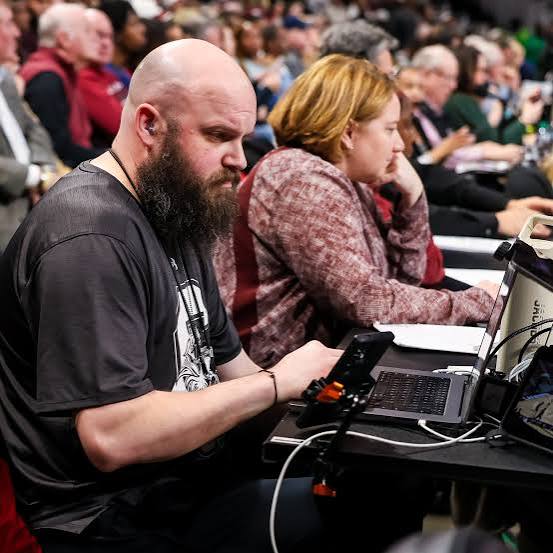
What happens in that room is the analytical backbone of South Carolina’s preparation. Jacobs is responsible for opponent scouting reports, practice film, game film, statistical breakdowns — the full intelligence package that allows Staley and her staff to walk into every game with a picture of their opponent that is as complete as possible.
But framing Jacobs as a button-pusher or a video technician misses the point entirely. His value isn’t in the mechanics of cutting film. It’s in the judgment he brings to what he sees.
“He’s an extra set of eyes,” said point guard Maddy McDaniel. “He sees things we don’t see. He does a lot for us and definitely gives us an advantage since he knows a lot about the game. He just sees a lot more than other video guys.”
That distinction — seeing more than other video guys — is what separates a capable coordinator from an invaluable one. Jacobs doesn’t just deliver information. He interprets it, contextualizes it, and translates it into something coaches and players can act on.
“He is the connector of all things basketball to our coaches and our players,” Staley said. “Not just coaches. Everybody asks Hudson for his expertise and he comes through every single time.”
The Challenge: A New Dimension of Trust
This season brought a new responsibility that put Jacobs’ judgment on display in real time, in front of thousands of people, with the outcome of plays hanging in the balance.
When the NCAA approved coaches’ challenges in women’s basketball, Jacobs was handed a role that had never existed before in his job description. He now sits to Staley’s left on the bench, and after nearly every contested whistle, her head turns his way. The question is always the same: Is it worth challenging?
The stakes are significant. Challenges are unlimited, but a failed one costs a timeout. In late-game situations, that’s a currency coaches can’t afford to waste. Staley’s willingness to trust Jacobs in that moment — under those conditions, with those consequences — is the clearest possible expression of how she views his value.
“If I don’t have a good look or solid feel, I’ll tell her,” Jacobs said. “I just go with what I see.”
The most vivid example came in the third quarter of the SEC Tournament semifinal against LSU. A referee signaled that South Carolina’s Joyce Edwards had last touched a ball before it went out of bounds. Jacobs watched the play, processed what he’d seen, and gave Staley his signal — a twirl of his finger — to challenge the call.
The crowd at Bon Secours Wellness Arena roared at the sight of his confidence. The refs reviewed it. They reversed it. McDaniel hit a three-pointer on the ensuing possession to push the lead to seven — South Carolina’s largest of the game — and the Gamecocks went on to win their 19th straight over LSU.
One finger twirl. One reversed call. One three-pointer. Seventeen seconds that would never have happened without Jacobs trusting what he saw.
He estimated his challenge success rate this season at approximately 80 percent — a number that, in any analytical context, would be considered elite.
“Hudson is probably equally as competitive as all of us,” Staley said. “He wants to win, he works to win. He’s got a good eye. Like, I trust Hudson with my life, not just making a call to appeal.”
March Is Where He Lives
If the regular season is where Jacobs earns his keep, March Madness is where he proves his worth in the highest possible pressure environment.
During a normal week, preparation has rhythm. Opponents are known. Schedules are set. There’s time to breathe between the work. March eliminates all of that. New opponents appear with 24 hours’ notice. Systems must be broken down and communicated overnight. And Jacobs must simultaneously prepare for opponents South Carolina hasn’t faced yet — and may never face — in case the bracket breaks a certain way.
He sets up his usual workspace in a quiet corner of whatever media workroom is available. He runs, by his own account, on relentless pursuit, chocolate, and sweet tea. The nights are long. Some of the film he cuts will never be used.
“Being a former athlete, you learn to block out the tiredness, block out the things that are going to get in your head and keep you from getting done what you need to get done,” Jacobs said. “You’ve got so many other people depending on you, working hard to get their jobs done, to do their part, that you know you got to do yours too.”
That framing — the athlete’s mentality applied to an analyst’s role — is the key to understanding what makes Jacobs exceptional. He doesn’t approach film as administrative work. He approaches it as competition, with the same urgency and focus that Staley demands from everyone in the program.
“I think that’s where it separates the people that become successful,” Jacobs said. “That competitiveness in you, when things might not be useful, but you’re doing it anyway because you know it’s what’s going to help you get there.”
And then, perhaps most tellingly:
“Something that coach really puts on all of us is we know she’s going to go all in, so you better be all in too. If you’re not doing everything you can to be successful, to get that edge too, then you’re probably not going to reach that level of success.”
The Unsung Hero in Full
South Carolina enters the NCAA Tournament as the No. 4 overall seed at 31-3, hungry after falling short of the SEC Tournament title to Texas. The Gamecocks open March 21 at Colonial Life Arena against either Samford or Southern, chasing a fourth national championship.
When that pursuit reaches its most critical moments — when a referee makes a call that could swing a game, when a coaching staff needs to understand an opponent they’ve never prepared for, when the margin between winning and elimination narrows to a single play — Hudson Jacobs will be there.
He’ll be in the corner of the bench, watching. He’ll be in the media workroom, cutting film until the lights go out. He’ll be the person Staley calls when she needs to see something clearly.
He’s been doing it for 15 years. He has no desire to stop.
That’s what an unsung hero looks like.
About The Author