She’s Already Won 3 Gold Medals And She’s Only A Sophomore — Joyce Edwards Is Now Representing The USA On The World Stage Again

Most college sophomores spend their summers relaxing, working internships, or taking classes. Joyce Edwards will be in Warsaw, Poland, competing for a gold medal against the best 3×3 basketball nations on the planet. That contrast alone tells you nearly everything you need to know about where South Carolina’s ascending forward currently stands in the women’s basketball world.
Edwards has been officially named to the USA Women’s 3×3 National Team that will compete at the 2026 FIBA 3×3 World Cup, set for June 1-7 in Warsaw. It is her seventh USA Basketball selection overall — a number that would be remarkable for a veteran professional, let alone a college sophomore — and it arrives as a direct result of her recent contributions helping the United States qualify for the tournament through wins on the FIBA 3×3 Series earlier this month. She didn’t just earn a spot on the team; she helped the team earn its spot in the tournament.
The broader context of her international résumé makes this selection even more striking. Edwards has already collected three gold medals in 5×5 competition — the 2025 FIBA AmeriCup, the 2024 FIBA U18 AmeriCup, and the 2023 FIBA U19 World Cup — meaning she has operated at the highest levels of international basketball across multiple formats before most of her college peers have experienced their first road conference game. Last season marked her 3×3 debut, and her growth in that specialized format has clearly been rapid enough to earn her a World Cup roster spot in just her second year of exposure to it.
The 3×3 game is worth examining separately, because it demands a distinct skill set from the traditional five-on-five format that most fans follow. Played on a half court with a 10-minute game clock and a compressed 12-second shot clock, 3×3 basketball rewards players who can make decisions instantly, create and convert in isolation, defend without help, and compete at a relentless pace with almost no margin for error. There are no timeouts to reset, no rotations to hide in, and no extended possessions to work through a scheme. It is raw, physical, and brutally efficient — and it is a format that has continued to grow in global prestige since its introduction to the Olympic program. The fact that Edwards has thrived in it speaks to an adaptability and basketball IQ that extends well beyond any single system.
She will be joined on the U.S. roster by MiLaysia Fulwiley and Mikaylah Williams of LSU and Sahara Williams of Oklahoma — a lineup that assembles four of the more explosive perimeter talents in college basketball onto a four-person team. The group will convene for a stateside training camp in New York on May 24-25 before traveling to Warsaw for additional preparation from May 26-31 ahead of the June 1 tournament opener.
The competitive format is straightforward but demanding. Twenty nations per gender are divided into four five-team pools, with round-robin play running through June 4. Knockout rounds begin June 5, quarterfinals follow on June 6, and medal games are contested June 7. The U.S. women land in Pool B, opening against Hungary on June 2 at 12:55 p.m. ET before squaring off with Australia later that afternoon at 2:45 p.m. ET. Pool play concludes June 4 with back-to-back contests against Mongolia at 12:30 p.m. ET and Spain at 2:20 p.m. ET.
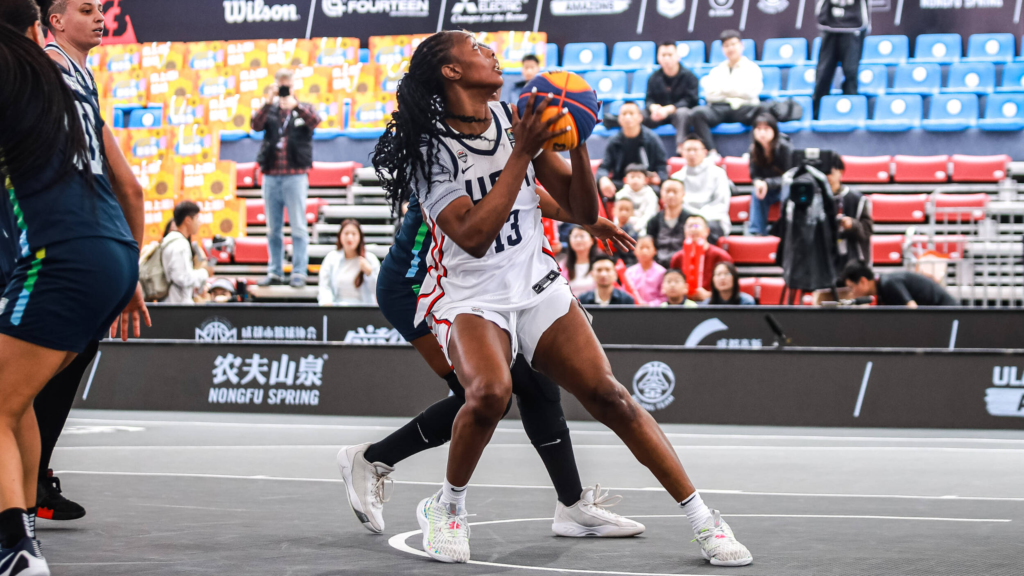
The pool draw presents a genuine test. Australia is a perennial international power in women’s basketball, and Spain has long been one of Europe’s most technically sophisticated programs. Navigating those matchups while maintaining energy for knockout play in a format this physically demanding will require everything the U.S. roster has — and will give Edwards a stage to demonstrate her game against opposition that would challenge any player, at any level.
For South Carolina fans tracking the program’s broader trajectory, Edwards’ continued ascent on the international stage is not just a point of pride — it is a meaningful data point. She arrived in Columbia as one of the most highly touted prospects in her class, spent her freshman year developing within a loaded roster, and is now spending her summer competing for a World Cup. That is the profile of a player accelerating, not waiting. When she returns to Columbia this fall, she will do so as someone who has spent the offseason tested by the best competition the world has to offer.
The 2026 FIBA 3×3 World Cup will stream live on YouTube.com/FIBA3x3 — and given what Edwards has shown so far, it is worth setting a reminder.
About The Author