South Carolina Places Three on Naismith Semifinalist Lists — and the Case for Each One Is Impossible to Ignore
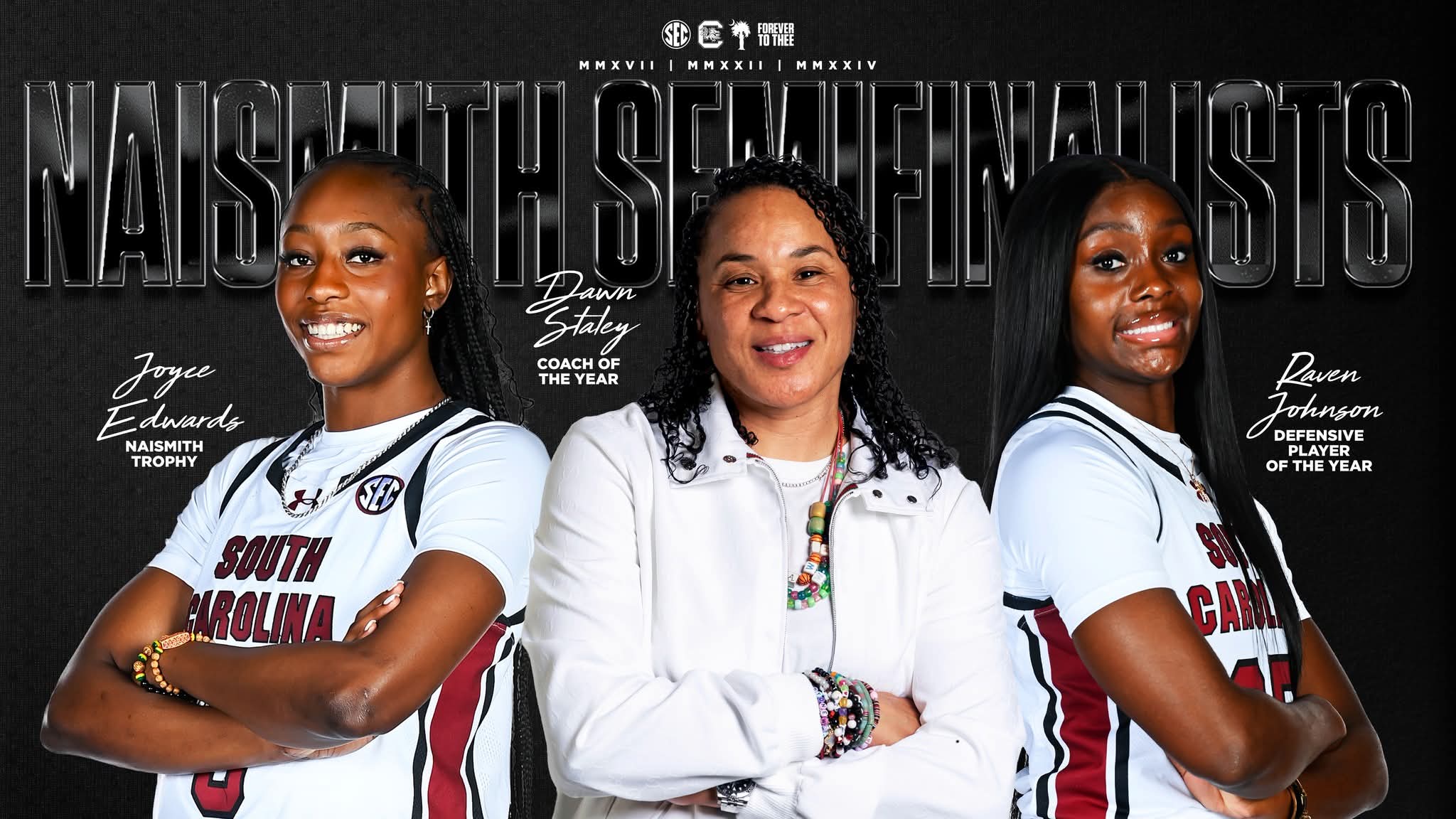
COLUMBIA, S.C. — When the Atlanta Tipoff Club released its Naismith semifinalist lists, South Carolina didn’t just appear on one. The Gamecocks placed a representative on all three — Joyce Edwards for national player of the year, Raven Johnson for defensive player of the year, and Dawn Staley for coach of the year.
That kind of across-the-board recognition doesn’t happen by accident. It happens when a program’s best player, its most complete two-way contributor, and its head coach are all operating at the highest level simultaneously. At South Carolina, in 2026, all three of those things are true at once.
Joyce Edwards: The Sophomore Making a National Player of the Year Case
The Naismith Trophy semifinalist list for national player of the year includes some of the most decorated names in women’s college basketball — Lauren Betts, Azzi Fudd, Sarah Strong, Hannah Hidalgo. For a sophomore to appear alongside that group is significant. For a sophomore to have a legitimate case is something else entirely.
Edwards has built that case methodically, efficiently, and emphatically. She ranks 22nd in the nation in scoring at 19.6 points per game while shooting 58.7 percent from the field — a combination that places her among the nation’s top 15 in efficiency. She has scored 20 or more points 19 times this season, a figure that ranks fifth in program single-season history. Her 667 total points are the seventh-most ever in a single season at South Carolina.
She is also a consensus second-team All-America pick and a finalist for the Katrina McClain Power Forward of the Year Award — recognition that reflects her standing not just as a great scorer, but as the premier player at her position in the country.
What elevates Edwards’ candidacy beyond raw numbers is her performance when the competition is stiffest. Against ranked opponents, she averages 16.5 points and 6.6 rebounds — numbers that hold up under the most demanding conditions the regular season offers. At the SEC Tournament, she posted 17.3 points and 6.7 rebounds per game, earning All-Tournament Team recognition and serving as the primary offensive force in South Carolina’s run to the title game.
The Naismith Trophy field is deep. But Edwards’ combination of volume, efficiency, and elevated performance in big moments makes her one of the most compelling candidates on the list.
Raven Johnson: Why Defense of the Year Would Complete a Defining Senior Season
Raven Johnson’s Naismith Defensive Player of the Year semifinalist nomination arrives as the capstone of a season in which she has already claimed the 2026 SEC Defensive Player of the Year award and earned AP All-America Third Team honors. It also arrives alongside a Nancy Lieberman Point Guard of the Year finalist nod — recognition that spans both ends of the floor and speaks to just how complete her game has become.
Johnson’s defensive credentials are well-established. But what makes her case for the Naismith award so compelling is the full statistical picture she presents. She is fourth in the nation with a 3.41 assist-to-turnover ratio — a figure that reflects elite decision-making and ball security. She averages 5.4 assists per game while posting a career-best 10.3 points per game on 50.6 percent shooting. Against ranked opponents, those numbers climb to 11.6 points on 53.0 percent shooting with 5.7 assists per game.
At the SEC Tournament, Johnson shot 60.0 percent from the field — including 5-of-8 from three-point range — averaging 12.7 points per game as South Carolina advanced to the title game for the seventh consecutive season. She is fourth in program history in career assists with 594 and owns three of South Carolina’s top seven single-season assist-to-turnover ratios.
The Naismith defensive list features genuinely elite competitors in Hidalgo, Betts, and Strong. But Johnson’s combination of lockdown defense, playmaking brilliance, and championship-level performance in high-stakes games makes her one of the most well-rounded candidates in the field.
Dawn Staley: A Coach of the Year Case Built on Adversity
Of the three South Carolina candidates, Staley’s nomination may carry the most context — because the 2025-26 season demanded more from her as a coach than any straightforward reading of the final record suggests.
The headline is familiar: a No. 1 regional seed, a fifth consecutive SEC regular-season title, a 15-1 conference record that led the league in scoring defense, scoring margin, field goal percentage, and blocked shots. Twelve wins over ranked opponents — third-most in the nation — with seven of those coming on the road or at a neutral site.
But behind those numbers is a season defined by roster disruption and surgical adjustment. Staley had just 10 games with her full roster available, and she finished just six of those games in the same starting position. At least one expected starter missed six of South Carolina’s 16 SEC games — all of which the Gamecocks won. Five new players were integrated into a 12-person roster, in a season where the SEC had as many as 10 ranked teams simultaneously.
That Staley guided this team to a regular-season title, a No. 1 seed, and a 31-3 record under those conditions — without the roster stability that typically defines championship-caliber programs — is the most persuasive argument for any coach of the year award she could receive.
The Naismith Coach of the Year semifinalist field includes respected peers in Geno Auriemma, Kara Lawson, and Vic Schaefer. But Staley’s ability to build a title contender out of uncertainty, injury, and constant lineup adjustment stands apart from any straightforward coaching achievement.
The Full Picture
South Carolina opens the NCAA Tournament on March 21 at Colonial Life Arena, facing the winner of the First Four matchup between Southern and Samford. The Gamecocks enter that game with three representatives on national award lists — a player of the year candidate, a defensive player of the year candidate, and a coach of the year candidate — all on the same roster, in the same season.
In a sport where individual recognition often comes at the expense of team success, South Carolina has managed to produce both simultaneously. That balance — star-level individual performance embedded within a championship-caliber collective — is exactly what Staley has always built in Columbia.
The awards will be decided in the coming weeks. The tournament begins Saturday.
For South Carolina, the two timelines run together — and both matter.
About The Author