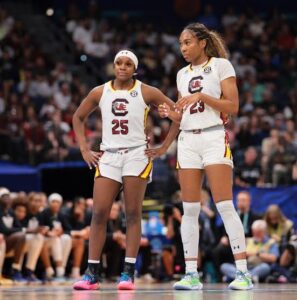
The Books Know What the Bettors Won’t Accept: A’ja Wilson Is Still the Favorite, No Matter How Much Money Chases Clark and Bueckers

The WNBA season has arrived, and with it, one of the most revealing annual snapshots in professional sports betting: the gap between what the public wants to happen and what the professionals believe will happen. In 2026, that gap is wider than it has ever been — and the data from sportsbooks across the country tells a story that cuts right through the noise of fan enthusiasm and gets to the most honest assessment of who the best player in this league actually is.
A’ja Wilson is the consensus preseason favorite to win her fifth WNBA MVP award. She is not the most bet player. She is not generating the most handle. She is not the public’s most popular choice. But she is the consensus favorite — and in sports betting, those two things are not the same, and the distinction matters enormously.
What the Odds Actually Say
As of Friday morning, Wilson sits at +220 at DraftKings, making her the odds-on preseason MVP favorite. Caitlin Clark follows at +240 — close enough to signal genuine contention. After that, there is a significant gap before Napheesa Collier at +800, which already accounts for the ankle injury that is expected to keep her sidelined until at least June.
The proximity of Wilson and Clark at the top of the board reflects both the reality of their talent and the reality of how sportsbooks manage exposure. Clark, despite generating the most betting volume, is priced to reflect genuine MVP probability — not just public affection. But the shift that happened in the days before the season opened is analytically telling: as recently as Wednesday, Clark topped the board at +245, with Wilson at +265. Within a week, Wilson moved into the odds lead, driven directly by the WNBA general managers’ preseason survey in which league executives voted Wilson as the MVP favorite by a dominant margin.
When the people whose professional livelihoods depend on correctly evaluating WNBA talent align with where the odds are moving, that is a meaningful data point — one that carries more analytical weight than public betting volume.
The Clark Economy
No one in the WNBA generates betting action quite like Caitlin Clark, and sportsbooks have developed an entire strategic framework around managing her presence in futures markets. At BetMGM, Clark is drawing a leading 29.5% of all MVP tickets — a number that reflects her cultural reach as much as any genuine MVP case.
Caesars Sportsbook pro basketball lead David Lieberman was unusually candid about how books think about Clark pricing.
“People will bet it regardless of what the price is. They just want to have a piece of the Caitlin Clark action,” Lieberman told ESPN. “So it’s just sort of a game that all the sportsbooks are playing, of how low can you go where people will still bet it and balance out your book a little bit.”
What Lieberman is describing is a structural market inefficiency created by enthusiasm rather than analysis. Clark’s odds are held artificially shorter than her pure MVP probability would justify because books need the action on her to balance their liability on other players. The practical effect is that Clark bettors are, in many cases, paying for the privilege of hoping — accepting worse value because the alternative is not betting on Clark at all, which the market has demonstrated is simply not something most fans are willing to accept.
Bueckers Is the Biggest Problem for the Sportsbooks
If Clark represents the expected volume challenge, Paige Bueckers represents something more structurally dangerous for the books: genuine liability.
The reigning Rookie of the Year checks in at 14-1 at DraftKings and as long as 20-1 elsewhere for MVP. DraftKings sportsbook director Johnny Avello described Bueckers as “the public’s most popular choice” — a designation that has translated into real financial exposure. BetMGM reports an overwhelming 85% of handle backing her, a concentration that suggests one or several large wagers have created a lopsided book.
“If any of those long shots have a good season, bettors will continue to bet them throughout the season, so the liability could even become stronger,” Avello said — a forward-looking warning that frames the entire season as a dynamic risk management exercise rather than a static book.
A $1,000 bet on Bueckers at 20-1 odds that cashes would return $20,000. Multiply that across dozens of similar bets at the same or worse odds, and the exposure becomes significant. The 85% handle figure at BetMGM is the kind of number that keeps traders up at night — not because Bueckers can’t win MVP, but because the payout obligation if she does would be disproportionate to the risk the book accepted.
Championship Odds: The Professionals Favor Experience
The WNBA Finals odds board offers an equally instructive read on where genuine expertise lands relative to public enthusiasm.
The New York Liberty are the championship favorites at +220, followed by Wilson’s Las Vegas Aces at +390 and Clark’s Indiana Fever at +450. The Fever have drawn heavy championship betting action, yet their odds have actually lengthened from a short point around +375 — the books pushing back against public volume with professional assessment.
“Those two are the best teams on paper,” Lieberman said, referencing the Liberty and Aces — a clean, direct assessment from a professional whose job requires accuracy rather than popularity.
The Atlanta Dream present an interesting case study. After a splashy offseason that generated genuine optimism — with former Gamecocks Allisha Gray, Te-Hina Paopao, and rookie Madina Okot headlining a retooled roster — they shortened from 18-1 to +650 for the title. Yet bettor attention remains limited, suggesting the public hasn’t fully caught up to what Atlanta’s front office built this offseason. That gap between odds movement and betting volume sometimes signals where sharp money has already moved.
Bueckers’ Dallas Wings have come in at 30-1 and are drawing action that has made them one of BetMGM’s and DraftKings’ largest liabilities — the same Bueckers effect from the MVP market spilling directly into the championship futures board.
If Collier were healthy, the Lynx would likely sit considerably higher on this board. BetMGM trader Tyler Groth was direct about the calculation.
“If Collier was healthy, her odds would be closer to Clark and Wilson,” Groth said. “How much time she misses will determine if she can contend for MVP.”
That is the honest variable hanging over the entire board — Collier’s return timeline has compressed the competition at the top to Wilson and Clark in a way that benefits Wilson specifically, given that her candidacy has no injury asterisk and no uncertainty attached to it.
The Bottom Line
Strip away the betting volume percentages and the liability figures and the media-driven enthusiasm, and what remains is a straightforward assessment that every professional in this market has arrived at independently: A’ja Wilson is the best player in the WNBA and the most likely MVP.
Clark and Bueckers represent the next generation — genuinely talented, genuinely compelling, and genuinely capable of winning this award at some point in their careers. The public enthusiasm for both of them is not irrational. But enthusiasm and probability are not the same instrument, and the books — who exist to be right, not to be popular — have made their position clear.
Wilson is the favorite. The chase is real. And for the first time in several years, the sportsbooks, the league’s general managers, and the analytical consensus are all pointing in the same direction at once.
That kind of alignment doesn’t happen by accident.
About The Author