Monte Lee Takes Personal Accountability as South Carolina Baseball’s Offensive Crisis Deepens in 8-3 Loss to Alabama
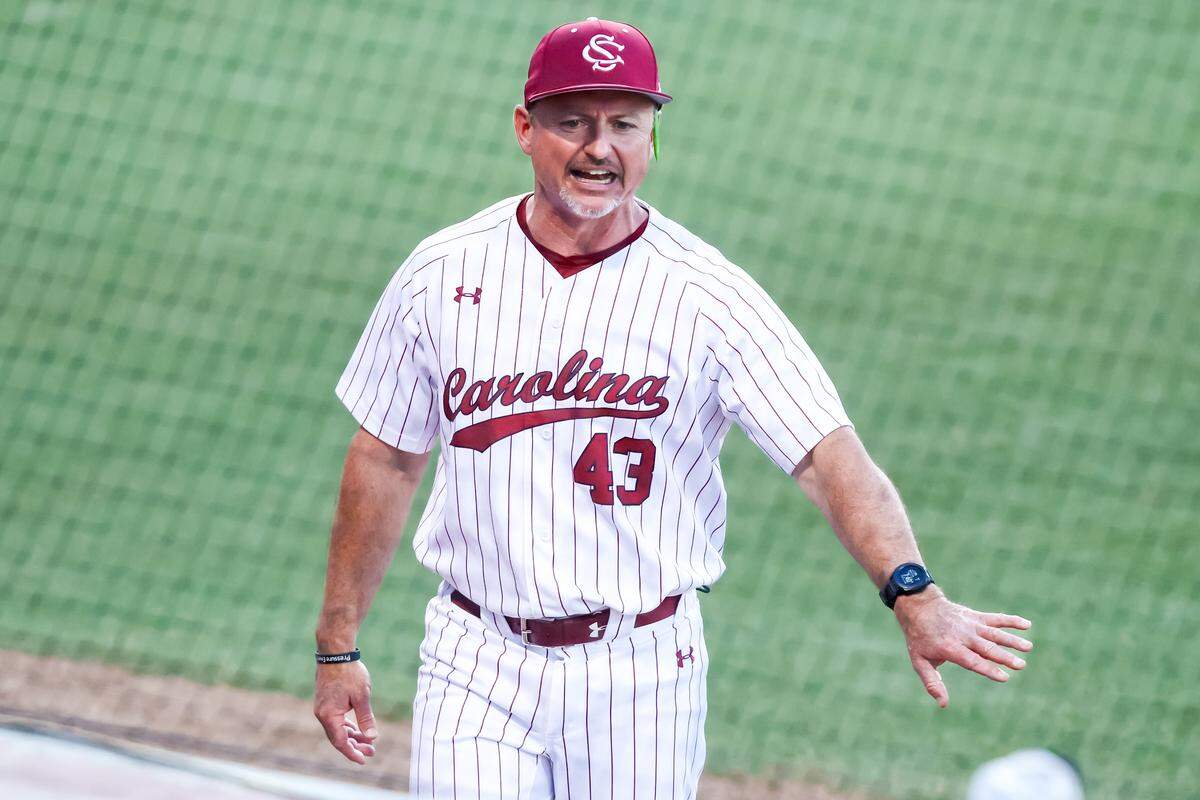
The questions were pointed, the answers were honest, and the picture that emerged from Monte Lee’s postgame press conference Friday night was of a program in genuine distress — and a leader who refused to deflect any of it away from himself.
South Carolina fell 8-3 to No. 19 Alabama at Founders Park, dropping to a season record that reflects a team that has been unable to solve its most fundamental problem: stringing together quality at-bats when the game demands them. After another night of sparse offense — four hits, 13 strikeouts, and a lineup that went cold for nearly four innings against a single pitcher — Lee stood at the podium and said, plainly and without qualification, that the responsibility runs in both directions.
A Coach Who Looked in the Mirror First
The most significant moment of the evening didn’t happen on the field. It happened in Lee’s opening statement, when he dropped a level of self-accountability that is genuinely rare in postgame settings.
“Give Alabama a lot of credit: played a great baseball game. They jumped on us early, put together the big inning in the second. Look, they pitched, they hit, played good defensively. They played a complete game, and they deserved to win. That’s it.”
No hedging. No recitation of what the team did well. Just a clean acknowledgment that the better team won — and then the harder admission that followed when asked about the state of his roster.
“It’s a really tough stretch that we’re going through right now. We’re not playing good baseball, really, in any of the facets of the game. And quite frankly, as their leader and their coach, I’m not doing a good job of leading them, either, and coaching them. I’ve got to find that answer.”
That statement deserves to be read carefully because it is analytically significant, not just emotionally candid. Lee is not performing humility for a media audience — he is genuinely processing a coaching challenge in real time and acknowledging that what he has tried hasn’t worked. A coach who cannot diagnose their own approach with honesty cannot adjust. The fact that Lee is willing to say it out loud suggests he is at least asking the right questions about what needs to change.
The Offensive Diagnosis: Two or Three Good At-Bats in a Row
When Lee moved from self-assessment to the specific mechanics of his team’s offensive struggle, he identified the problem with surgical precision.
“We got to swing the bats better. We haven’t been able to put together two or three good at-bats in a row. That’s been a big issue for our offense. We just got to find a way to do that. If we can put two or three good at-bats in a row and score some runs and get some momentum going, I think we can turn this thing.”
That framing is important because it reframes the problem from individual failure to sequential failure. It’s not that South Carolina’s hitters are incapable of putting together quality contact — Friday featured a fourth-inning sequence where LeCroy doubled and Scobey drove him in with a two-out RBI single, a legitimate offensive moment. The problem is that one good sequence cannot sustain an offense. It requires consecutive quality at-bats to generate runs with consistency, and this lineup has been unable to string them together against any pitcher of consequence.
The approach to Friday’s pregame preparation reflected how seriously Lee has taken the challenge. “I didn’t say anything to them, really, today at all. I just kind of let them go through BP in the cages.” The decision to step back from his typical instructional approach — to trust that the work was already done and give the players room to perform without additional input — represents a real adjustment, even if the results didn’t immediately vindicate it.
“Look, I talk too much sometimes to the players. I try to coach my way through things sometimes with the players just to try to give them everything I can. And I think, oftentimes, just backing off is the best thing that can happen.”
The coaching philosophy embedded in that admission is worth appreciating. Late in a season, when at-bats have accumulated and mechanical adjustments have been exhausted, the most effective intervention is sometimes the absence of an intervention. Lee is arriving at that understanding in real time, and his willingness to name it publicly rather than continuing to layer instruction on a lineup that may simply need to breathe is an honest response to an honest problem.
“This deep into the season, I think the hay’s in the barn. The guys got to go out, and they got to do it. They’ve had plenty of at-bats and opportunities, and ups and downs, and they should be able to make the adjustments they need to make.”
Why Tyler Fay Was Unsolvable
The most technically detailed portion of Lee’s press conference came when he broke down why Alabama right-hander Tyler Fay — who also threw a no-hitter against Florida on March 20 — was such a difficult assignment for a lineup already lacking confidence.
“He threw a two-seam fastball and a four-seam fastball. He was a really hard matchup for right-handed hitters because you can’t really sit on one side of the plate or the other just because he’s throwing a sinker that’s running in on you, and he’s throwing a four-seam ride fastball at the top of the zone, too. The breaking ball was good. His command of the breaking ball was pretty good. He threw a changeup, too, and he threw a changeup to right-handed hitters. You don’t see a lot of guys that can do that. So, it’s really kind of a four-pitch mix, I would say, because he’s throwing two fastballs, the breaking ball and the changeup. So yeah, he was good.”
This is a complete pitcher — and Lee’s assessment removes any ambiguity about the challenge his hitters faced. A starter who can move a sinker down and in on right-handers while simultaneously riding four-seam fastballs at the top of the zone eliminates the comfort of sitting in one zone. Add a usable breaking ball and a changeup that he throws to same-handed hitters — an uncommon weapon — and the hitter’s decision tree becomes genuinely overwhelming. Ten strikeouts and seven innings of one-run ball is not an upset. Against that four-pitch mix, it was the expected outcome for a lineup that has struggled to make consistent contact all season.
The Alabama Rally: How One Inning Changed Everything
Lee traced the second-inning rally to its roots with a revealing explanation of how momentum operates in hitting lineups.
“When teams come out, and they square the ball up like that in the beginning of the game, it just gives you confidence. I mean, I think that’s the key. It just gives you confidence as a lineup that, ‘Hey, we’re going to hit this guy.’ They see their teammates do it, and they feel a lot more confident going up there at the plate. And I think that’s just what happened.”
The first inning featured a series of long flyouts from Alabama’s lineup — balls hit hard, just not quite far enough. Those flyouts served a psychological function that the final score obscured: they told every Alabama hitter in the dugout that Amp Phillips was hittable. The second inning, predictably, was when that confidence became runs. Two home runs, two walks, four runs across. By the time Phillips found his footing and began executing properly from the third inning on, the game was already functionally decided.
The Phillips Recovery and What Comes Next
The credit Lee extended to Phillips after the second inning was genuine and analytically supported. A starter who surrenders a four-run inning early in a road game — or, in this case, against a ranked opponent at home — has every reason to unravel further. Phillips didn’t.
“I give Amp credit. I mean, good Lord, after the second inning, it could have went south quick. He stayed out there, and he battled. He got deeper into the ball game and helped us not have to burn too many guys out of the ‘pen. So, he did a good job of competing and staying out there for us.”
Lee also provided specific technical insight into what changed after the second inning: “From the third inning on, it just looks like he executed pitches a lot better. Just watching Talmadge [LeCroy] and where he set up, he wasn’t moving a whole lot to catch the ball. Amp did a really good job of locating down, keeping the ball out of the middle of the plate. The breaking ball was a little bit sharper.”
The difference between the Amp Phillips who gave up four runs in the second inning and the one who threw clean baseball for 3-plus innings after it wasn’t talent — it was location. When he was missing over the middle of the plate early, Alabama was ready. When he began working the bottom of the zone with precision and sharpening his breaking ball, even the same lineup that tagged him early couldn’t generate anything against him. That is the thin margin that separates competent college pitching from catastrophic outcomes.
Senior Day as a Reset
Whatever the team is carrying emotionally, Saturday offers a different kind of opportunity. Senior Day — five players celebrated before a 1 p.m. first pitch on SEC Network — creates an atmosphere that transcends the standings, and Lee invoked it directly as a rallying point.
“I told them, ‘Look, tomorrow is Senior Day, and we’ve got guys that are being recognized and celebrated for their time here. Every single one of those guys deserves our very best.’ So, just got to keep showing up and competing as hard as we can, and it’ll turn.”
Brandon Stone takes the mound at 5-3 with a 3.94 ERA — a pitcher whose numbers suggest a genuine chance to keep the Gamecocks competitive if the offense can answer. The question is whether this team, having heard their coach take accountability out loud, can respond with the two or three consecutive quality at-bats that Lee has identified as the simple, critical key to unlocking whatever offensive potential still remains.
Friday was another hard night. Saturday needs to be the answer.
About The Author