The NAACP Is Telling Black Athletes To Avoid Clemson And South Carolina — And The Reason Goes Far Beyond Sports
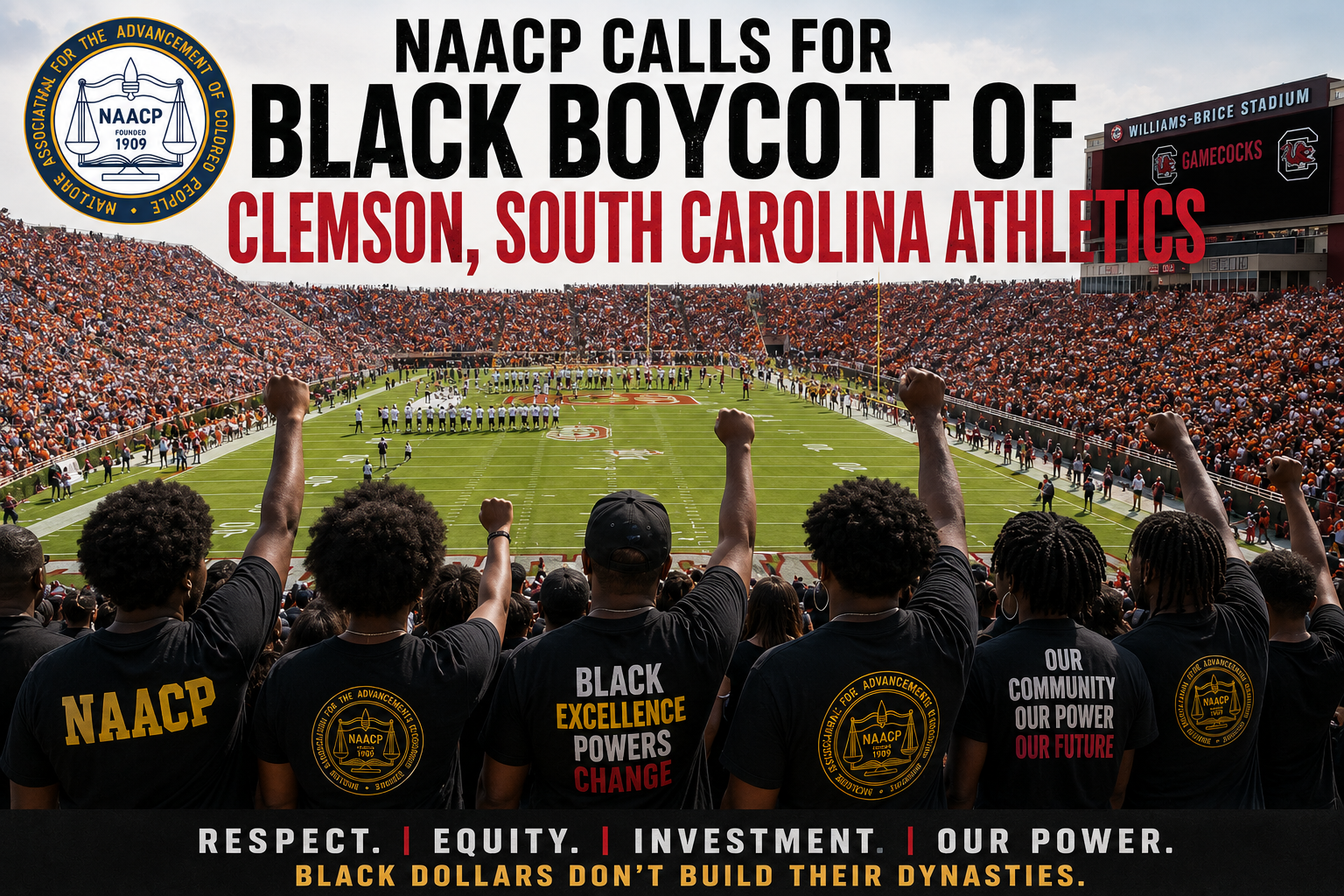
The intersection of athletics and civil rights activism has a long and consequential history in America. From Muhammad Ali to the 1968 Olympics to Colin Kaepernick, moments where Black athletes have been asked — or have chosen — to leverage their platform for political change have consistently sparked national conversations that outlast the sports headlines surrounding them. The NAACP’s newly launched “Out of Bounds” boycott campaign is the latest entry in that tradition, and its direct targeting of Clemson University and the University of South Carolina places two of the state’s most prominent athletic programs at the center of a debate that is fundamentally about democracy, representation, and power.
Understanding what the boycott is actually asking — and why — requires separating the athletic dimension from the political one, because the NAACP’s argument is rooted in legislative action, not athletic policy.
What Triggered The Boycott
The immediate catalyst in South Carolina is the state House of Representatives’ recent vote to redraw congressional maps in a manner the NAACP says materially diminishes the voting power of residents in the state’s sixth congressional district — the district with the highest Black voting age population in South Carolina. The organization frames this not as a policy disagreement subject to reasonable debate, but as a deliberate structural effort to reduce Black political representation.
That framing carries added weight in the context of the broader national landscape. The boycott was announced on May 19, and its targets extend well beyond South Carolina. The “Out of Bounds” campaign covers public college athletic programs generating more than $100 million in annual revenue across eight states: South Carolina, Alabama, Georgia, Florida, Louisiana, Mississippi, Tennessee, and Texas. Not all of those states have redrawn congressional maps, but the NAACP identifies all eight as states whose governments are actively dismantling the political power of Black communities through various mechanisms. The April 29 U.S. Supreme Court ruling that rolled back protections for minority voters under the Voting Rights Act provides the legal backdrop against which all of these state-level actions must be understood.
Eleven SEC schools are included in the boycott’s scope, with Clemson and Florida State representing the non-SEC programs identified. Both Clemson and the University of South Carolina exceeded $100 million in total operating revenue in fiscal year 2025, meeting the campaign’s targeting threshold.
What The NAACP Is Asking For
The boycott has three distinct pressure points, each aimed at a different constituency within the college athletics ecosystem.
First and most prominently, the NAACP is asking Black recruits and current athletes to withhold athletic commitments from the identified institutions. This is the component with the most immediate and tangible potential impact — college athletics at the Power Conference level is built on the labor and talent of disproportionately Black athletes, and a meaningful reduction in Black recruitment would have real consequences for program competitiveness and revenue generation.
Second, the campaign calls on alumni, fans, and donors to stop purchasing tickets and merchandise from the targeted programs. This pressure point operates on the financial infrastructure that makes these athletic departments viable at their current scale.
Third, and most structurally, the NAACP has articulated a clear condition for ending the boycott: the states identified must restore what the organization describes as “fair congressional maps and meaningful Black representation.” The boycott, in other words, is not open-ended protest — it is a targeted economic and reputational pressure campaign designed to force specific legislative outcomes.
The NAACP’s Case, In Their Own Words
The campaign’s messaging has been carefully constructed to draw a direct line between the political actions of state governments and the athletic institutions that benefit from and lend prestige to those same states. Tylik McMillan, national director of the NAACP’s youth and college division, made that connection explicit in the announcement.
“The state that is working to erase your grandmother’s congressional district is the same state whose governor will stand on the field and celebrate your touchdown or game-winning shot,” McMillan said. “We are asking young people — recruits, current athletes, fans — to see that connection clearly and to act on it.”
That framing is strategically significant. It personalizes the abstract machinery of congressional redistricting — making it about grandmothers and family, not just maps and district lines — and places it in direct visual contrast with the celebratory public relationship between state political figures and the athletic programs those same figures benefit from. The governor cheering at a football game while the legislature redraws districts to dilute Black voting power is the image the NAACP wants young Black athletes to hold in their minds when they consider where to take their talent.
NAACP National President and CEO Derrick Johnson was equally direct about the organization’s characterization of what these state governments have done.
“What these states have done is not a policy disagreement. It is a sprint to erase Black political power,” Johnson said.
The deliberate rejection of the “policy disagreement” framing is meaningful. It signals that the NAACP is not positioning this as a matter of competing legitimate interpretations of electoral law. It is asserting that what has occurred in these states is fundamentally anti-democratic and racially motivated — a conclusion that carries significant moral and political weight regardless of where one lands on the specific legislative details.
The Broader Analytical Context
The strategic logic of targeting athletics specifically — rather than broader economic boycotts or purely political campaigns — reflects a clear-eyed understanding of where leverage actually exists in these states. College football and basketball are not peripheral cultural institutions in Alabama, Georgia, South Carolina, Tennessee, and Texas. They are central ones. The athletic programs at institutions like South Carolina and Clemson generate hundreds of millions of dollars, command enormous public attention, and serve as sources of state identity and pride that cut across political lines.
More importantly, the talent pipeline that makes those programs competitive is overwhelmingly Black. The NFL and NBA draft rosters assembled from SEC and ACC programs year after year reflect the demographic reality of who is doing the athletic labor that generates those revenues. The NAACP’s campaign is essentially arguing that Black athletes should be conscious of and deliberate about the relationship between their labor, the institutions that profit from it, and the political environment those institutions exist within and implicitly validate.
Whether the boycott gains meaningful traction among recruits — who are 17 and 18 years old making life-altering decisions about their athletic futures, often with family financial considerations in play — remains to be seen. The history of sports boycotts suggests that collective action at scale is extraordinarily difficult to achieve, particularly among a population as geographically dispersed and individually situated as high school recruits.
But the campaign’s goal may not require universal participation to be effective. Even a measurable shift in Black recruiting patterns at the identified schools — or a sustained public conversation that forces administrators, coaches, and athletic directors to engage with the political context the NAACP is raising — would represent a form of impact. The reputational pressure alone, particularly at a moment when Name, Image, and Likeness dynamics have already fundamentally altered the power dynamics between athletes and institutions, creates a public relations challenge that athletic departments and university administrations are not well-equipped to navigate.
Neither Clemson nor the University of South Carolina has formally responded to the boycott at the time of publication. That silence, however comfortable it may feel in the short term, carries its own set of risks as the story develops and recruiting cycles continue.
The NAACP has drawn a line in the red clay of the American South, and it has asked Black athletes to see clearly which side of it their talent is being asked to perform on. How — and whether — those athletes respond will say something important not just about sports, but about the generation that currently plays them.
About The Author