The Dallas Mavericks May Interview Dawn Staley — And Her Own Words Tell You Everything About What Happens Next
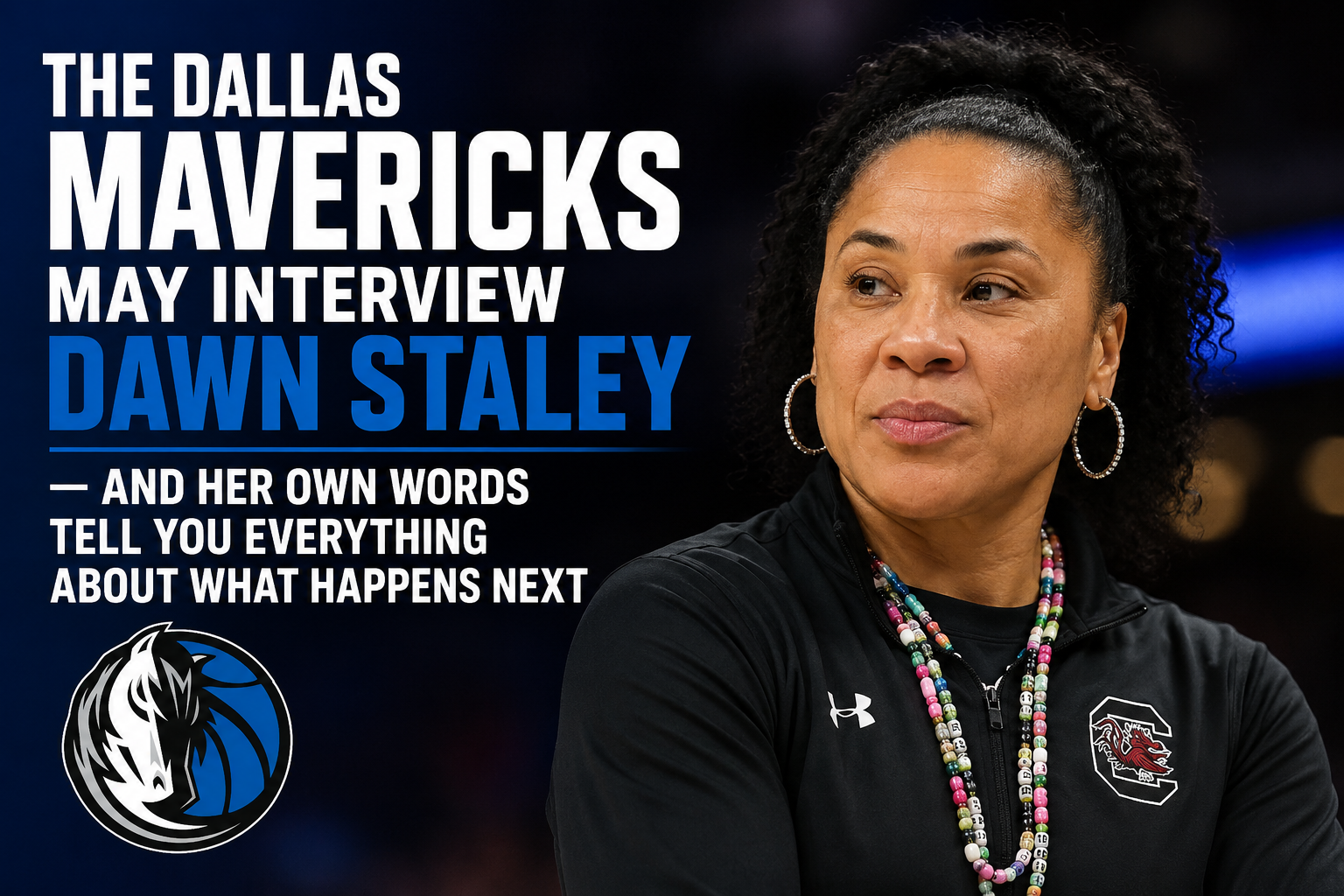
It is the kind of report that stops a sports news cycle in its tracks. The Dallas Mavericks, one of the NBA’s most storied franchises, are conducting a head coaching search — and according to a report from The Athletic’s Christian Clark, an NBA executive says it “wouldn’t be shocking” if Dallas wanted to interview South Carolina women’s basketball coach Dawn Staley for the position.
Let that land for a moment. The winningest active coach in women’s college basketball. Three national championships. Five hundred and eleven wins at South Carolina alone. Being linked — through an NBA executive’s assessment, no less — to a head coaching vacancy in the most visible men’s professional basketball league in the world.
The report is simultaneously thrilling, historically significant, and complicated by something Staley herself has already said on the record. And that complexity is where the most honest analysis of this story lives.
The Historical Weight Of What Is Being Discussed
Before examining the likelihood or the logistics, the magnitude of what this report represents deserves full acknowledgment. If the Dallas Mavericks were to hire Dawn Staley, she would become the first female head coach in NBA history. Not the first female assistant. Not the first female front office executive. The first female head coach of an NBA franchise.
That would be one of the most significant barrier-breaking moments in the history of American professional sports — comparable in its structural significance to Jackie Robinson’s integration of Major League Baseball, or the first female referees in major professional leagues. It would permanently alter the landscape of what is considered possible in professional basketball leadership, and it would do so at one of the sport’s highest-profile addresses.
The fact that this conversation is happening at all — that an NBA executive is willing to go on record, even anonymously, saying Staley’s name in this context — reflects how far the perception of women’s basketball leadership has traveled in a remarkably short period of time. Five years ago, this report would not have existed. The cultural and institutional conditions that make it plausible today are themselves a story worth telling.
Why The Mavericks Make Sense As The Setting
The specific franchise matters here, and it matters because of who is now running it.
New Mavericks President Masai Ujiri is not a conventional NBA executive. He is one of the most forward-thinking and culturally progressive leaders in professional sports — a man whose tenure with the Toronto Raptors produced a championship and whose institutional reputation is built on identifying unconventional talent and creating environments where that talent can succeed. Ujiri has already demonstrated a willingness to consider female candidates for NBA head coaching positions: in 2023, while still leading the Raptors’ front office, he interviewed Las Vegas Aces head coach Becky Hammon for Toronto’s vacant head coaching job.
That interview was not a publicity exercise. Ujiri does not conduct interviews for optics. It was a genuine evaluation of whether Hammon’s coaching credentials — built on years as a San Antonio Spurs assistant under Gregg Popovich — translated to a viable NBA head coaching candidacy. The fact that he went through that process in Toronto, and has now arrived in Dallas with a head coaching vacancy to fill, makes the Staley connection analytically coherent rather than speculative noise.
A president who has already demonstrated institutional willingness to interview female candidates for NBA head coaching positions, now presiding over a franchise with a vacancy — the report is not as surprising in that context as it might initially appear.
Staley’s Credentials — And The Honest Questions They Raise
The case for Staley as a credible NBA head coaching candidate begins with her record and does not need much additional argument. At South Carolina since 2008, she has compiled 511 wins against 113 losses — a winning percentage that the overwhelming majority of NBA coaches would envy. She has won three national championships, built one of the most dominant programs in the history of collegiate athletics, and developed multiple players who went on to become WNBA stars and international competitors.
Her basketball IQ is not in question. Her ability to recruit, develop, and manage elite talent is not in question. Her competitive standard — the culture of excellence and accountability she has built at South Carolina — is not in question.
What is legitimately worth examining is the professional coaching experience gap. Staley has never coached at the professional level in any capacity — no NBA assistant role, no WNBA head coaching experience, no professional front office involvement. The NBA game, at its highest level, presents tactical and personnel management challenges that differ meaningfully from the college game in ways that are not always immediately visible. Defensive rotations, offensive spacing in a pace-and-space league, managing veteran professional egos, in-game adjustments against NBA-caliber opposition — these are dimensions of the job that even experienced college coaches have found genuinely difficult to navigate in their initial professional transitions.
That gap is not disqualifying. Many successful NBA coaches came from unconventional backgrounds. But it is a real factor that any honest evaluation of Staley’s candidacy must acknowledge.
The Most Important Thing Staley Has Already Said
Here is where the report becomes most complicated — and most honest analysis of the story requires engaging directly with Staley’s own previously stated position.
After interviewing for the New York Knicks’ head coaching vacancy — a job that ultimately went to Mike Brown — Staley addressed the experience directly on a podcast and delivered an assessment that was remarkable for its candor.
“No NBA team is ready for a female coach right now,” Staley said.
Read that again. The person being linked to this vacancy is the same person who, after going through an actual NBA head coaching interview process, concluded publicly that the league’s institutional culture is not yet prepared to support a female head coach’s success.
That statement is not the conclusion of someone who declined an opportunity out of lack of confidence or ambition. It is the conclusion of someone who sat in those rooms, had those conversations, and emerged with a clear-eyed assessment of what the environment actually is versus what it is presented as being. Staley has never been naive about institutions. She has navigated them, challenged them, and built something extraordinary within and sometimes despite them. When she says an institution is not ready for something, she is speaking from experience and observation, not speculation.
Does Ujiri’s presence in Dallas change that calculation? Possibly. Ujiri is precisely the kind of progressive institutional leader whose environment might differ from the one Staley assessed during the Knicks process. A president who has already interviewed Becky Hammon for a head coaching role is signaling something specific about the culture he intends to build. If Staley’s concern was about institutional readiness — about whether the front office, the locker room, and the franchise infrastructure would genuinely support a female head coach rather than simply tolerating her presence — then Ujiri’s track record provides a more compelling counter-argument than most NBA front offices could offer.
But Staley’s assessment was broader than one executive. It was a read on the league’s culture as a whole — the players, the media, the external environment that any NBA head coach operates within. Whether that broader culture has shifted sufficiently since her Knicks interview is a question only she can ultimately answer.
The Other Candidates — And What They Tell Us About The Search
The Mavericks’ candidate pool, as currently reported, is a revealing mix of experience levels and profiles. Sean Sweeney spent several seasons under Jason Kidd on Dallas’ own staff before departing for San Antonio — giving him direct institutional familiarity with the franchise’s culture and personnel. Jon Scheyer comes from Duke with the credibility of having coached NBA Rookie of the Year Cooper Flagg in his lone college season, though his professional coaching experience is similarly limited to Staley’s. Micah Nori has built a reputation as an interview candidate across multiple NBA searches. Thiago Splitter brings the credibility of a championship playing career and the proof-of-concept of leading the Portland Trail Blazers to the playoffs after taking over mid-season following Chauncey Billups’ arrest.
The diversity of that candidate pool — from established assistants to college coaches to a player-turned-coach — suggests Ujiri is conducting a genuine wide-net search rather than working toward a predetermined conclusion. That is the environment in which an unconventional candidate like Staley has the most realistic chance of receiving serious consideration rather than a courtesy interview.
What Happens Next
The report, as it currently stands, is one NBA executive’s assessment of what “wouldn’t be shocking” — a formulation that carries considerably less weight than a confirmed interview request or a formal expression of interest from the Mavericks’ front office. Staley has not confirmed any contact. The Mavericks have not confirmed any outreach. The story exists at the level of league rumor and executive speculation.
But the fact that the speculation exists — that an NBA executive’s mind goes to Dawn Staley when asked about Dallas’ coaching search — is itself meaningful. It reflects a shift in how the broader professional basketball world thinks about the boundaries of coaching candidacy, and it places Staley’s name in a conversation that five years of dominant South Carolina basketball has earned her the right to occupy.
Whether she would accept an interview, whether an interview would produce an offer, and whether an offer would produce acceptance — all of that remains entirely unknown. What is known is what Staley herself said after her last experience with this process.
She told us exactly what she thought. The question now is whether Dallas, under Masai Ujiri, can make her think differently.
About The Author