
Dawn Staley And LaNorris Sellers Could Both Leave South Carolina Over A Senate Bill — And The Fallout Would Be Catastrophic
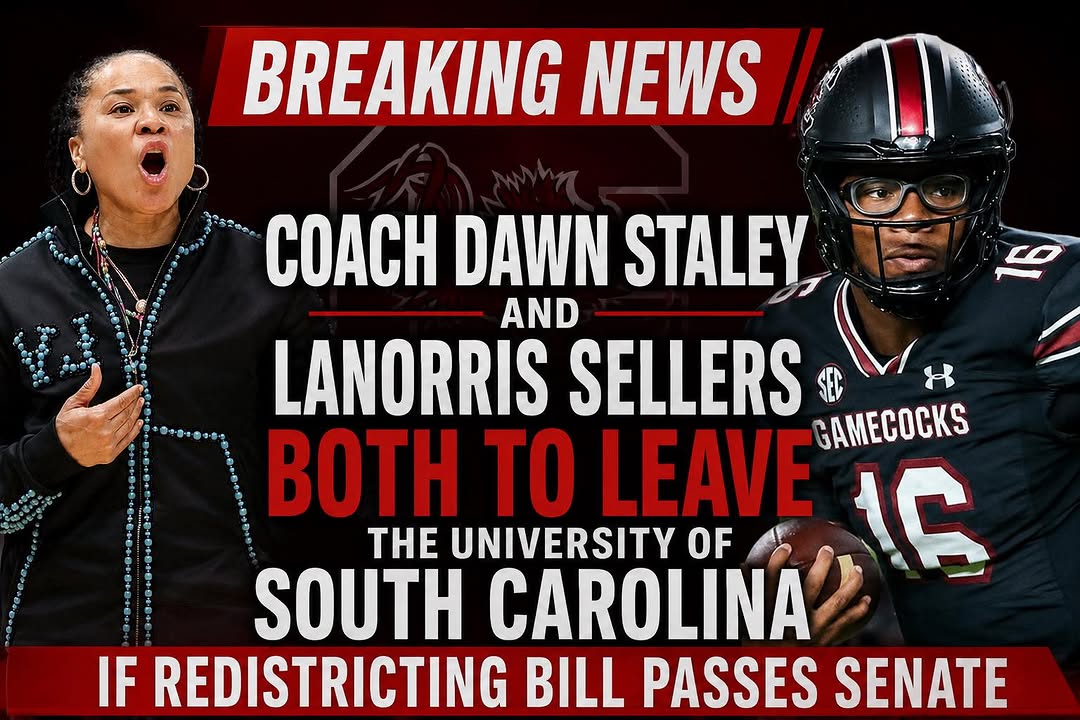
Before diving into the full analysis, an important editorial note: this report is based on a breaking news claim that Staley and Sellers are “reportedly prepared” to leave — language that signals sourcing that has not yet been independently verified or confirmed by either party directly. No direct quotes from Staley or Sellers exist in the current reporting. This piece will treat the claim with appropriate analytical weight while being transparent about where confirmed facts end and reported information begins. With that context established, the implications — if the report proves accurate — demand serious examination.
South Carolina athletics has survived coaching searches, conference realignments, and decades of competitive turbulence. What it has never had to contemplate is a scenario where its two most prominent and culturally significant athletic figures simultaneously walk away — not over contracts, not over roster issues, not over competitive frustrations, but over a political decision made in the state legislature.
That, according to breaking reports, is exactly the crossroads the University of South Carolina now finds itself approaching.
Dawn Staley, the most decorated women’s basketball coach in the country and the architect of what is arguably the most dominant collegiate program in any sport at any level right now, and LaNorris Sellers, the face of South Carolina football and one of the most marketable young quarterbacks in the SEC, are both reportedly prepared to leave the University of South Carolina if the proposed redistricting bill passes the state Senate.
The word “reportedly” carries enormous weight here, and responsible analysis requires acknowledging that. But in the context of everything that has already unfolded around this issue — the NAACP’s “Out of Bounds” boycott campaign, the political firestorm surrounding South Carolina’s congressional map redrawing, and the broader national conversation about Black voting power in Southern states — the report carries a credibility that cannot be dismissed simply because it is unconfirmed.
Why This Moment Is Different From Any Previous Crisis
South Carolina athletics has faced crises before. Coaching departures, recruiting scandals, losing seasons — the program has navigated all of it within the normal boundaries of institutional sports management. What makes this situation categorically different is that it operates entirely outside those boundaries.
This is not a negotiation about salary. This is not a competitive frustration with roster limitations. This is two of the most visible Black athletes and coaches in South Carolina — indeed in all of American sports — potentially making a values-based decision about whether the state government that benefits from their labor, their visibility, and their championship performances is one they can continue to represent.
That distinction is fundamental. When an employee leaves over compensation, a replacement can be found and the institution continues. When a figure of Staley’s stature leaves over a moral and political conviction — publicly, visibly, in a media environment that will cover every word of it — the institution does not simply absorb the departure. It is defined by it. The story of why she left becomes permanently attached to the story of South Carolina athletics in a way that no subsequent hire can fully erase.
Dawn Staley: What Her Departure Would Actually Mean
To understand the magnitude of a potential Staley departure, you have to set aside the wins and championships for a moment — as extraordinary as those are — and examine what she represents beyond them.
Staley is South Carolina. Not South Carolina basketball. South Carolina. She is the face of the university to millions of people across the country who have never set foot in Columbia and never will. She has turned a program into a cultural movement, built a fanbase that crosses racial, generational, and geographic lines in ways that defy standard sports audience demographics, and placed South Carolina at the center of the most important moment in the history of women’s basketball.
She has also been among the most prominent voices in the country connecting athletic excellence to community, social justice, and the responsibility of institutions to the people who build them. A coach who has operated with that level of public intentionality about values does not make a decision of this magnitude carelessly. If Staley is reportedly prepared to walk away over a redistricting bill, the analytical inference is not that she is making a tactical negotiating move — it is that she has reached a point of genuine moral conviction that the political environment surrounding her program has become incompatible with what she stands for.
The program she would be leaving behind is, by any measure, the most dominant in women’s college basketball. Three national championships. Multiple MVP players. A recruiting pipeline that is the envy of every program in the country. All of it built on her vision, her relationships, her standards, and her name. The institutional damage of losing her — in recruiting, in revenue, in national reputation — would be staggering and largely irreversible in any realistic timeframe.
LaNorris Sellers: The Football Dimension
The football implications of a potential Sellers departure operate differently but carry their own weight. Sellers is not just a quarterback. He is the embodiment of a South Carolina football program attempting to reestablish itself as a legitimate SEC contender — a program that has invested enormous resources in facilities, coaching, and recruiting infrastructure, all of which requires a franchise-level player to serve as its public face.
Sellers represents exactly that. He is the kind of quarterback who changes recruiting conversations, elevates program perception, and gives the entire enterprise a competitive credibility that sustains momentum across cycles. His departure — particularly if it is driven by a public, values-based stand against the state legislature — would not simply weaken the 2026/2027 football team. It would send a direct message to every recruit currently considering South Carolina about the political and social environment they would be entering.
In the current era of college athletics, where Name, Image, and Likeness agreements have fundamentally shifted the power dynamic between athletes and institutions, a high-profile player publicly declining to remain at a program over a political principle is no longer an anomaly. It is a precedent-setting act that other athletes — current and prospective — will watch closely and factor into their own decisions.
The Political Context That Makes This Credible
This report does not exist in isolation. It arrives in the direct wake of the NAACP’s “Out of Bounds” boycott campaign — which specifically named both Clemson and the University of South Carolina as institutions Black athletes should avoid because of the state government’s redistricting actions. The NAACP’s campaign identified South Carolina’s House vote to redraw congressional maps affecting the state’s sixth congressional district — the district with the highest Black voting age population — as a fundamental attack on Black political power.
“What these states have done is not a policy disagreement. It is a sprint to erase Black political power,” NAACP National President and CEO Derrick Johnson said in announcing the boycott.
That framing — a sprint to erase Black political power — is the political environment within which Staley and Sellers are now reportedly making their evaluations. And when you place two of the most prominent Black athletic figures in the state into that context, the reported willingness to walk away becomes not only understandable but, from a values-consistency standpoint, almost inevitable if the bill passes.
What The University Of South Carolina Must Do Now
The University of South Carolina and its athletic administration face a decision that is simultaneously political, institutional, and deeply personal — and the window for meaningful action is narrowing with every day the Senate bill advances.
Jeremiah Donati, who just oversaw the announcement of $168 million raised for Williams-Brice Stadium renovations with suite sales exceeding expectations, is presiding over a program at the peak of its institutional ambition. Every dollar of that investment, every recruiting relationship built on the foundation of South Carolina’s current excellence, every future championship conversation — all of it exists within an ecosystem that Staley built and that Sellers currently animates.
Allowing that ecosystem to be dismantled by a political calculation made in the state legislature, without the university’s voice being heard loudly and clearly in opposition, would represent an institutional failure of the first order. Universities have historically found ways to separate athletics from politics when convenient. This situation does not offer that convenience. The two are now inextricably linked, and the administration’s response — or silence — will be its own statement.
The Nationwide Ripple Effects
The report’s own framing is accurate in its warning: what happens next won’t just impact politics. It will impact recruiting pipelines across both football and women’s basketball. It will impact the university’s national reputation among the students, faculty, and donors it is trying to attract. It will impact South Carolina’s standing in the ongoing national conversation about race, power, and the role of athletics in American civic life.
Programs spend decades building the kind of national credibility and cultural momentum that South Carolina currently possesses. They can lose it — or have it fundamentally compromised — in a single legislative session, if the people who built it decide they can no longer in good conscience remain connected to it.
South Carolina is at a crossroads. The redistricting bill is moving through the Senate. Dawn Staley and LaNorris Sellers are reportedly watching what happens next.
So is the rest of the country.
About The Author