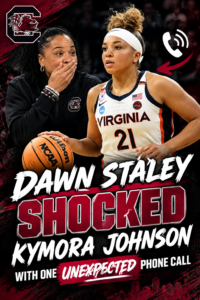
Caitlin Clark Gets All The Attention — But It’s Raven Johnson’s Defense That Could Actually Take The Indiana Fever To The Playoffs
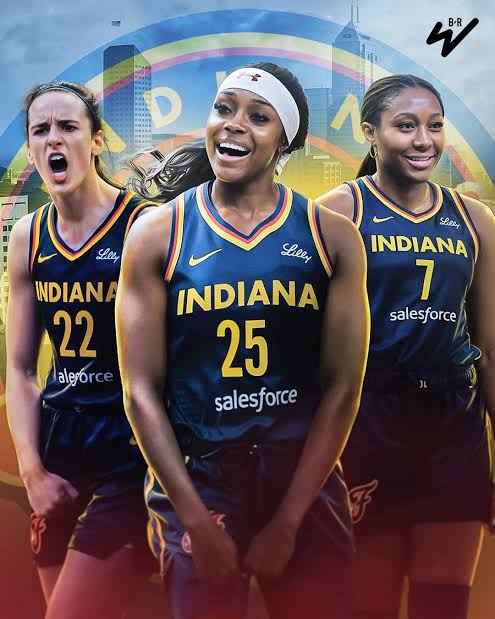
Indiana drafted another guard. That was the reaction in some corners of the WNBA world when the Fever selected Raven Johnson No. 10 overall in April — confusion rooted in the assumption that a team already built around two elite scoring guards in Caitlin Clark and Kelsey Mitchell didn’t need another one. What that reaction missed, and what is becoming increasingly clear as the 2026 season unfolds, is that Johnson was never drafted to score. She was drafted to defend, facilitate, and provide the kind of defensive infrastructure that transforms a team capable of winning games into a team capable of winning a championship.
The distinction is critical — and the experts who cover this team most closely understood it from the moment her name was called.
The Player Indiana Actually Drafted
To understand Johnson’s value to the Fever, you have to start with an honest assessment of what Indiana’s problem actually is. The Fever are averaging 94.4 points through their first five games — a figure that reflects the offensive firepower Clark and Mitchell generate on a nightly basis, as the two guards currently account for 50% of the team’s offensive production. Scoring is not Indiana’s issue. It has not been Indiana’s issue for as long as Clark has been in the building.
The issue is defense. The Fever are allowing 88 points per game and have surrendered over 100 points in two of their five contests — a rate that will eventually catch up to even the most prolific offense if it isn’t addressed. The architecture of the problem is straightforward: a backcourt built around scoring guards creates defensive vulnerabilities that opponents will exploit, particularly in the playoffs when preparation and game-planning are at their most sophisticated.
Johnson is the structural answer to that problem — a point guard whose entire identity is built on the defensive end of the floor.
“Indiana desperately needs Raven as a defender, that’s going to be the difference between Indiana going somewhere in the playoffs and not,” said ESPN women’s basketball writer Michael Voepel. “We know they’re going to be able to score, but can they defend? That’s somewhere where I think she can absolutely earn her minutes is the way that she could defend.”
Voepel’s framing cuts directly to the heart of why this roster construction makes sense. The Fever don’t need Johnson to score 15 points. They need her to guard the opposing team’s best perimeter player, protect passing lanes, and create defensive disruptions that translate into the transition opportunities Indiana’s offense thrives on. That is a specific, defined role — and it is one Johnson spent four years at South Carolina developing into one of the most refined skill sets in women’s college basketball.
The Development Arc That Made Her A First-Round Pick
Johnson’s path to the No. 10 overall selection is a story about focused development executed over multiple seasons, and the numbers tell it cleanly.
As a junior at South Carolina, Johnson averaged 4.9 points per game — a figure that reflected a player contributing to a championship-caliber team through defense, decision-making, and facilitation rather than individual scoring. Entering her senior year, the question surrounding her WNBA prospects centered on whether she could develop the offensive consistency to justify a first-round selection, or whether her defensive excellence alone would be sufficient.
The answer she provided was definitive. Johnson averaged 9.9 points per game as a senior — exactly double her junior output — while shooting a career-best 48.6% from three-point range. That shooting percentage from behind the arc, sustained over a full college season against SEC competition, is not a small developmental leap. It is a fundamental transformation of her offensive profile that forced defenses to account for her in ways they previously had not.
The combination — elite defensive ability plus demonstrated three-point shooting efficiency — created a prospect whose floor and ceiling both justified a first-round investment. USA TODAY Sports senior WNBA reporter Meghan L. Hall articulated exactly what the Fever are looking for beyond the scoring numbers.
“I think people obviously are going to look for her to bring that offense, but I’m not,” Hall said. “My head is, how can Raven impact in terms of facilitating, dishing it out to her teammates, clearing the floor, making sure people are in their right places — and she’s an absolute menace on the defensive end.”
That framing — an absolute menace — is not casual language from a reporter who covers this league with the seriousness Hall brings to it. It is a specific, informed characterization of a player whose defensive impact registers beyond the standard metrics.
The May 20 Game — A Preview Of What’s Possible
The clearest window into Johnson’s potential emerged on May 20, under circumstances neither she nor the Fever would have chosen. Clark missed the game with a back injury — another entry in a concerning injury history that saw the superstar play only 13 games last season — and Johnson was thrust into a dramatically expanded role with minimal warning.
The result was a career performance in Indiana’s 90-73 win. Johnson played a career-high 22 minutes, scored a career-high nine points, and added three rebounds while demonstrating the versatility and competitive readiness that made her a first-round pick. The shooting efficiency was not there — she went 1-of-8 from three-point range — but the broader performance revealed something more important than made shots: a player who belonged in those minutes, competed at the right level, and helped Indiana win comfortably without its franchise player.
Fever head coach Stephanie White addressed the shooting performance with the measured, process-oriented perspective of a coach who understands what she is developing.
“They weren’t guarding her so when you’re open, she’s going to shoot it,” White said. “I think there’s a difference in the type of shots, the drive and kick spray shots of course we want her to take. Sometimes teams are going to dare her to do that and it’s our job to try to help her understand what to do next while she’s working on the consistency from the 3-point line.”
White’s assessment is analytically precise. The shots Johnson took were not wrong decisions in the context of the defensive coverage she was seeing — when an opponent dares a shooter to fire and the shooter declines, it validates the defensive strategy. Johnson shot the ball. The efficiency will come with professional repetitions and comfort in the moment. What cannot be coached is the willingness to compete in those situations, and Johnson demonstrated that willingness clearly.
More tellingly, White’s praise for Johnson’s defensive contribution in those expanded minutes confirmed exactly what the Fever were looking for when they made the selection.
“I thought her activity level on the defensive end was really good for us,” White said. “She can guard bigger than her position and she can guard in a versatile way and it really helped impact us.”
The ability to guard bigger than her position is not a generic compliment. At 5-foot-8, Johnson’s capacity to switch onto larger players and not create exploitable mismatches is a tactical asset that gives Stephanie White lineup flexibility she would not otherwise have. In the playoffs — where opposing coaches attack specific defensive vulnerabilities with surgical precision — that versatility becomes a strategic weapon.
What Makes Her Defensive Profile Special
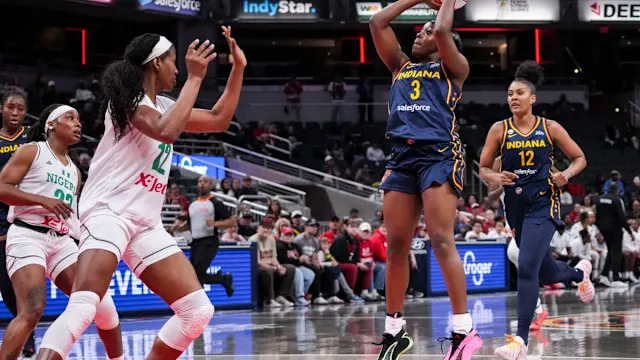
Johnson’s defensive game is built on a combination of physical tools and basketball intelligence that operate synergistically rather than independently. Her long, strong arms are the physical foundation — they allow her to contest shots without fouling, disrupt passing lanes that shorter guards cannot reach, and deflect or steal passes in transition that would otherwise become easy baskets.
But the more valuable dimension is her IQ. Johnson reads offensive setups before they develop — understanding where the ball is going based on spacing, movement, and the tendencies she has studied on film. That anticipatory quality is what separates defenders who react from defenders who prevent, and it is a characteristic that Dawn Staley’s system at South Carolina explicitly demands and develops. Four years in that environment, playing behind some of the best defensive players in college basketball history, did not simply sharpen Johnson’s individual technique. It installed a defensive framework that she now carries into every professional possession.
“I think she was the perfect fit to go to Indiana,” said Wilton Jackson II, who covers the Dream and the SEC for The IX. “Wouldn’t be surprised if depending on the matchup against really physical elite guard play, I could easily see Raven’s minutes increasing.”
Jackson’s projection is grounded in a clear analytical logic. As the season progresses and Indiana faces opponents with elite scoring guards — the Angel Reeses, the Breanna Stewarts, the A’ja Wilsons of the league — Johnson’s ability to provide legitimate defensive resistance without requiring offensive accommodation will become increasingly valuable. The matchups will come. The minutes will follow.
The Bigger Picture For Indiana
The Fever are a team in genuine transition — not rebuilding, but refining. The offensive infrastructure Clark and Mitchell provide is elite. The defensive infrastructure is still being assembled, and Johnson is one of its most important pieces. Her current averages of 2.6 points, 2.2 rebounds, and 1.2 assists in 12.2 minutes off the bench represent a player still finding her professional footing in a defined role. But the May 20 performance — 22 minutes, nine points, and a comfortable victory without Clark — provided a meaningful proof of concept for what an expanded role can produce.
The Clark injury history is real and must be acknowledged. Thirteen games played last season. A back injury already in 2026. Indiana needs depth at the guard position that can hold the team together when their franchise player is unavailable — and they need that depth to be capable of defending, not just scoring. Johnson is both of those things.
The WNBA playoffs reward teams with defensive versatility as much as offensive firepower. Clark and Mitchell will continue to carry Indiana’s offensive identity. But when the defense needs to hold a lead, shut down a hot guard, or create a stop when the game is on the line, Raven Johnson’s role may prove to be the difference between a first-round exit and a deep playoff run.
South Carolina built her for exactly this moment. Indiana was smart enough to recognize it at No. 10. The rest of the league is just beginning to understand what that means.
About The Author