Dawn Staley Is Building a Dynasty With a French Accent — And It’s No Accident
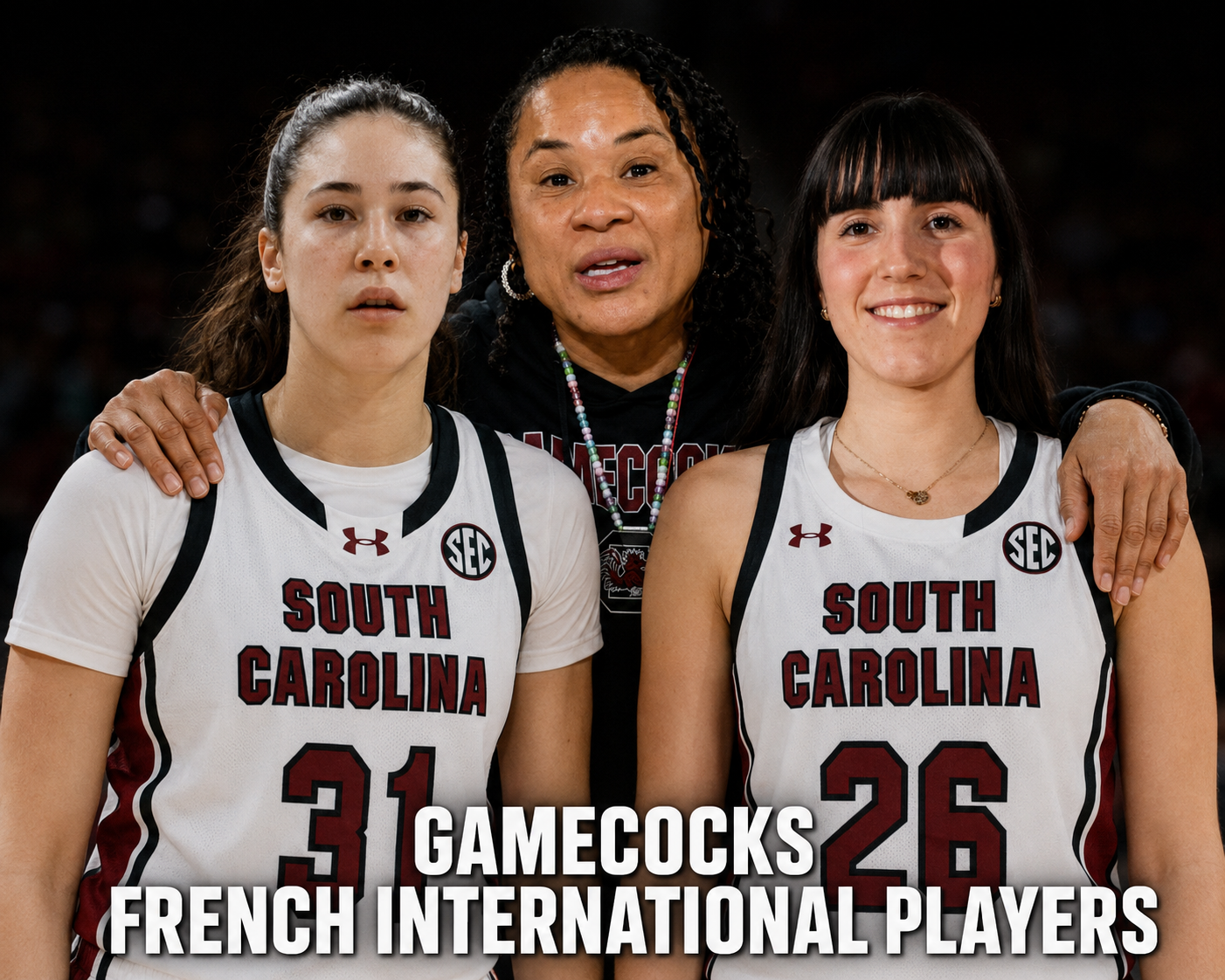
When Dawn Staley answered a question about the French language with a smiling “oui” back in January, it felt like a lighthearted moment. Months later, it looks more like a blueprint.
South Carolina women’s basketball has now added two players from France to its 2026-27 roster, and the decision to do so twice in the same offseason isn’t coincidence or novelty — it’s a deliberate strategic calculation from one of the most analytically sophisticated coaching staffs in the sport.
The Second Addition Nobody Saw Coming
When five-star prospect Oliviyah Edwards, the No. 3 recruit in the Class of 2026, committed to the Gamecocks on April 23, most observers assumed the roster was complete. Staley hadn’t carried more than 13 players since the 2021-22 season, and with 14 players already accounted for, the math seemed settled.
Then came Justine Loubens.
The program announced the signing of the 6-foot-1 shooting guard from La Roche Vendée Basket Club on April 29 — making her the 15th player on the 2026-27 roster and the second French professional to join the program in a single calendar year, alongside 6-foot-7 forward Alicia Tournebize.
The addition was notable not just for the surprise factor, but for what it signals about how Staley is thinking about roster construction at the highest level of the sport.
What France Is Producing Right Now
To understand why South Carolina is looking to France specifically, the broader context matters enormously.
“France is the top spot right now for youth development in basketball,” said Hunter Cruse, who covers women’s basketball recruiting and the WNBA draft for Bleacher Report. “They have some of the most athletic players in the world right now, that plays into it a lot … long-term development wise, they have more interesting young talent than anywhere else internationally.”
The numbers from the professional level back that assertion up. In this year’s WNBA draft, two of the ten international players selected were French. More striking still — in a survey of WNBA general managers, when asked which country outside the United States is currently producing the best WNBA talent, the response was unanimous. One hundred percent chose France.
The pipeline is real, the talent is legitimate, and South Carolina has identified it before most programs in college basketball have begun to look in that direction.
Why French Players Fit South Carolina’s System
The recruiting logic here isn’t simply about finding talented players — it’s about finding players who already understand how to function within a specific kind of team structure. That distinction matters more than it might initially appear.
“A lot of times when you’re recruiting high school players, their entire life they were built up as the No. 1 option on their team, they did everything as an on-ball player,” Cruse said. “Players like Tournebize or Loubens in France, they’ve never had that role. What is so desirable about their specific skill-set is how they adapt to their role.”
This is the key insight. South Carolina already has Tessa Johnson, Jordan Lee, Jerzy Robinson, and Oliviyah Edwards competing for perimeter minutes. What the roster didn’t need was another player conditioned to demand the ball and build a game around individual creation. What it can absorb — and benefit enormously from — is players who have spent their professional careers mastering the art of contributing within a defined structure.
Loubens is a specific kind of weapon. “My favorite thing is how she moves without the ball, her feel for off-ball movement,” Cruse said of the shooting guard. “That’s probably the most value she’s going to provide from Day 1 at South Carolina.” She brings a sharp left-handed jump shot and outside shooting range — skills that will create problems for defenses already occupied trying to contain South Carolina’s more prominent offensive pieces.
Tournebize: Year Two and What It Could Mean
Alicia Tournebize’s first half-season in Columbia was the proof of concept that likely accelerated the Loubens signing.
Joining midway through the year from Tango Bourges Basket, Tournebize averaged 4.0 points, 3.4 rebounds, and 12.6 minutes per game while shooting 41.8% from the floor — modest numbers that don’t fully capture the learning curve involved in transitioning from professional basketball in France to the pace and physicality of SEC competition in the middle of a championship run.
The areas for growth are identifiable and, crucially, addressable. Her decision-making was occasionally a beat slow, and foul trouble was a recurring issue. Cruse also noted that playing overseas seemed to have cultivated a tendency to avoid contact, pushing her toward mid-range jumpers rather than finishing at the rim.
“Year 2 is all about strength development for me,” Cruse said. “If she gets stronger I think the rest of her game will come into place as far as playing through contact. The ceiling is so high … that’s something that South Carolina does better than almost any other team is strength development. If that comes, the rest of her game will come, too.”
That last point deserves emphasis. Strength and conditioning development is one of the documented competitive advantages of South Carolina’s program infrastructure. If Tournebize adds functional strength — which, under normal developmental timelines, she should — the combination of her 6-foot-7 frame, transition running ability, and outside shooting range becomes something defenses will genuinely struggle to account for.
The Long Game
What makes the dual French investment particularly intelligent is the patience it requires — and the patience it produces on the other side of the equation.
South Carolina’s roster is loaded with high-profile recruits who expect significant roles. Managing minutes and expectations across 15 players, including blue-chip high school prospects who have never been anything other than the centerpiece of their programs, is a genuine coaching challenge.
Tournebize and Loubens solve part of that problem simply by being who they are.
“If you’re bringing in Tournebize and Loubens and they don’t play a lot next year, they’re more likely to be OK with the long-term process,” Cruse said. “With teams like South Carolina, that are bringing in so many talented players, you have to have that flexibility role-wise. Tournebize and Loubens know how to adapt their game to specific roles.”
The transfer portal era has made genuine long-term roster planning genuinely difficult. Players leave at the first sign of a diminished role. Recruiting professionals who have already been conditioned to embrace a defined function within a larger system — rather than high school stars who have never experienced anything other than being the focal point — is a way of building roster stability that most programs simply haven’t thought through at this level.
“You see the vision of what both players could be and it makes a lot of sense for South Carolina,” Cruse said. “If you’re going in the high school market, go after your top recruits, to balance that out to get some good players that know how to play their role too at the pro level already.”
South Carolina already holds the No. 2 recruiting class in the country for 2026. They could enter next season ranked No. 1 in the country. And quietly, running alongside the five-star prospects and national headlines, Staley is constructing a roster architecture that could prove as important as any individual recruit.
The French connection isn’t a curiosity. It’s a competitive advantage — and it’s only getting started.
About The Author