
Tessa Johnson Has Proven She Can Shoot. Now South Carolina Needs to Find Out How Much More She Can Be.
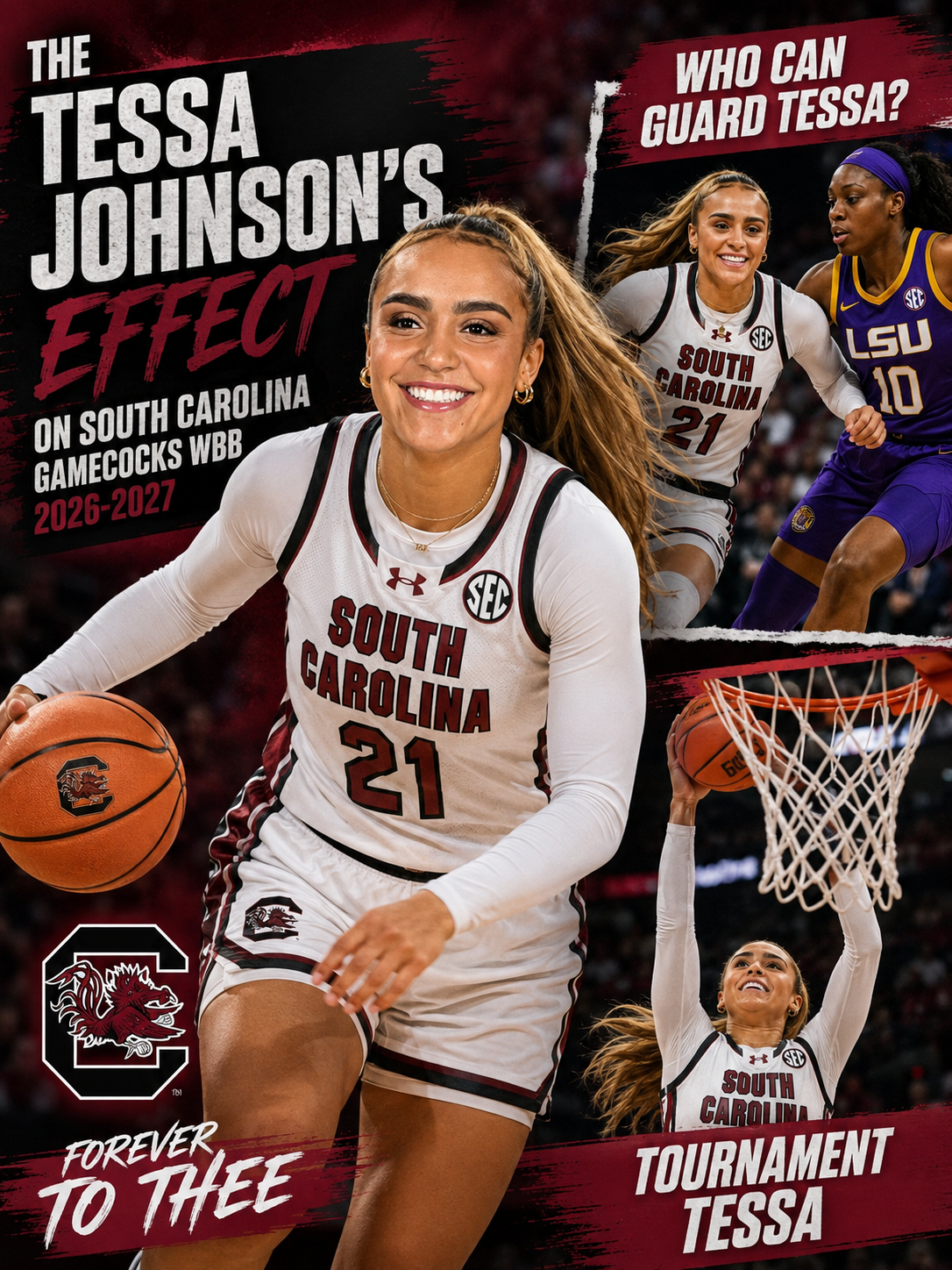
The label fit for two years. It doesn’t fit anymore.
Tessa Johnson arrived at South Carolina as a shooter — a specific, valuable, clearly defined role player whose ability to space the floor and punish defenses from three gave the Gamecocks a weapon they could deploy with confidence. That version of Tessa Johnson was good. The version that finished her junior season may be something considerably better. And the version that walks into her senior year carrying the weight of a program in transition could define her legacy entirely.
This is the moment the bridge was always building toward.
The Sophomore Year Nobody Should Overlook
Before the breakout can be fully appreciated, the foundation has to be understood.
As a sophomore, Johnson played 37 games without a single start, averaging 21.2 minutes per game off the bench. The numbers she produced in that role were quietly exceptional — 47.4% from the field, 42.7% from three, 82.5% from the free throw line. She wasn’t being asked to create, initiate, or lead. She was being asked to make smart decisions, knock down open shots, and protect possessions.
She did all of it.
That sophomore season mattered because of what it established — not statistically, but structurally. It taught Johnson how to be trusted. How to function within a demanding system on a championship-caliber roster without forcing the game or shrinking from the moment. Those are learned skills, not natural ones, and the players who master them in supporting roles are precisely the ones who explode when the opportunity expands.
The opportunity expanded.
The Junior Year That Changed Everything
Starting all 38 games as a junior, Johnson didn’t just step into a larger role — she validated it completely.
The numbers tell a story of sustained elite efficiency at genuine volume. She averaged 12.8 points, 3.4 rebounds, and 2.5 assists across 28.2 minutes per game, shooting 46.9% from the field and an extraordinary 44.8% from three-point range. She knocked down 90 threes on the season — the third-highest single-season total in program history — and did it while shooting 82.7% from the free throw line. The result was a Second Team All-SEC selection and a key role in South Carolina’s return to the national championship game.
The efficiency numbers deserve a moment of genuine appreciation. Shooting 44.8% from three at volume — 90 makes across a full college season — is not a product of selective usage or favorable shot selection. That is an elite shooter performing at an elite level under real defensive attention from the best conference in women’s college basketball. Defenses knew she could shoot. They game-planned around it. She shot 44.8% anyway.
Then came the national championship game against UCLA — a night when South Carolina’s offense struggled as a unit, when the moment was as large as it gets in college basketball. Johnson led the team with 14 points.
The best players don’t disappear when the game gets ugly. She didn’t disappear.
What the Senior Year Actually Demands
The departures of Raven Johnson, Taniya Lassiter, and Medina Okoro fundamentally alter the leadership architecture of this South Carolina program. The players who carried the emotional and competitive identity of last year’s team are gone — and what remains is a roster that needs veterans to step forward in ways they haven’t been required to before.
Tessa Johnson is one of those veterans. And the senior season ahead of her is asking for something different than what made her a Second Team All-SEC selection.
The shooting is already there. It was never the question. The questions now are harder: Can she lead? Can she create off the dribble with enough consistency to function as a secondary playmaker? Can she defend at the level this program demands — not occasionally, not when the moment calls for it, but every possession, every game? Can she help Maddie McDaniel settle into the point guard role while simultaneously elevating her own game? Can she build the kind of two-player chemistry with Joyce Edwards that creates genuine problems for opposing defenses?
These aren’t rhetorical questions. They are the specific developmental benchmarks that separate good college players from WNBA-ready ones — and right now, Johnson’s professional prospects hinge on how convincingly she answers them.
Her profile is already genuinely compelling for the next level. A 6-foot guard with elite shooting efficiency, positional size, championship experience, and the ability to produce within one of the most sophisticated offensive systems in the sport is exactly the kind of player that WNBA front offices pay attention to in early draft evaluation. But the WNBA rewards creation, defensive versatility, and the ability to make plays outside of structured sets. To cement herself as a legitimate 2027 draft prospect, Johnson needs to demonstrate that her game extends beyond catch-and-shoot excellence — that she can attack closeouts, make quick decisions in live dribble situations, and bring defensive energy that matches the offensive reputation she’s already built.
The Fit That Makes Everything Work
The most interesting basketball question surrounding Johnson’s senior year isn’t individual — it’s relational.
The combination of Johnson, McDaniel, and Edwards in South Carolina’s backcourt represents a collection of complementary skill sets that Dawn Staley will be working to maximize from the first day of practice. Edwards brings the athletic burst and defensive intensity. McDaniel carries primary playmaking responsibility at the point. Johnson, in theory, operates as the catch-and-shoot safety valve whose gravity opens driving lanes for both of her backcourt partners.
That structure works beautifully when Johnson’s gravity is maximized — when defenses are forced to respect her range so completely that they can’t help effectively on penetration. It works even better if Johnson can add even a modest off-the-bounce threat that keeps closeout defenders from fully committing. The difference between a defender who contests and recovers and a defender who panics on a closeout is often a single decisive counter move. Johnson developing that counter doesn’t require her to become a shot creator. It requires her to become enough of one that defenses can’t afford to gamble.
The Platform She’s Been Building Toward
Tessa Johnson’s journey at South Carolina has followed a narrative arc that college basketball rarely produces so cleanly.
The sophomore year was the bridge — learning to be trusted, learning the system, learning how to contribute without needing to carry. The junior year was the proof — starting every game, producing at an All-SEC level, delivering when the national championship stage got difficult. The senior year is the platform — the opportunity to become the complete player, the genuine leader, and the fully realized professional prospect that two years of elite efficiency have suggested she could be.
The shooting will always be there. The question is what surrounds it.
South Carolina is entering a transition year with enormous expectations and significant roster turnover. The players who define this program’s next chapter won’t be the ones who maintained what they were — they’ll be the ones who became something more.
Tessa Johnson has spent three years building toward exactly this moment. What she does with it will determine everything about how her story ends in Columbia — and how it begins at the next level.
About The Author