The Dam Has Broken: South Carolina Baseball’s Roster Collapse Reaches 13 Departures and Shows No Signs of Stopping
This is no longer a trickle. It’s a flood.
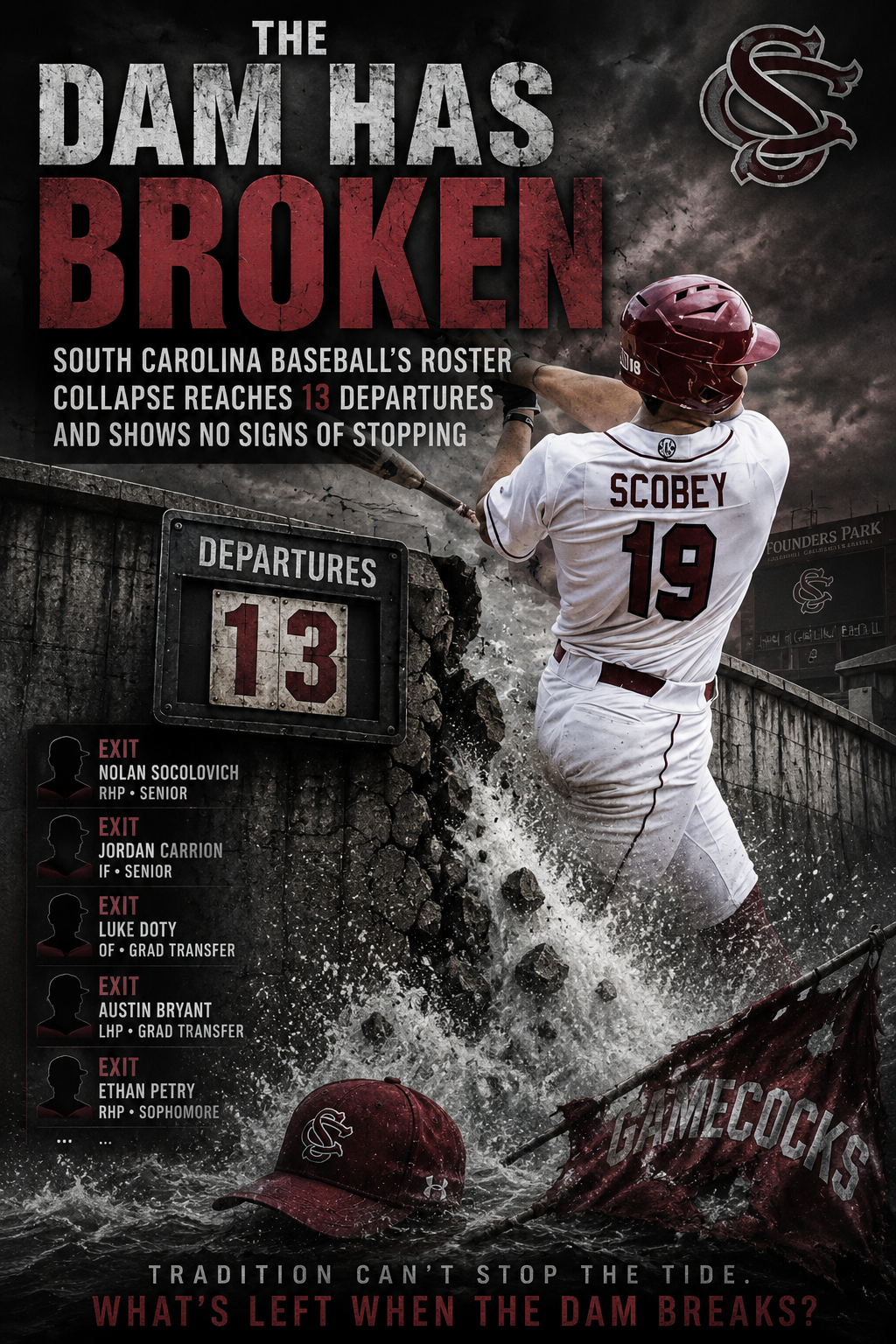
What began as a handful of early portal decisions before the official window even opened has now become a full-scale roster exodus at South Carolina baseball. With the transfer portal officially opening Monday, eight additional players announced their departures — bringing the program’s total to 13 players gone in the span of days, with the portal window still open through June 30 and no head coach yet in place to stanch the bleeding.
Infielders Beau Hollins, KJ Scobey and Will Craddock, along with pitchers Riley Goodman, Hudson Lee, Zach Russell, Josh Gregoire and Logan Prisco, have all entered the portal, per TheBigSpur’s Jamie Bradford. They join pitchers Josh Gunther, Alex Valentin and Patrick Dudley, third baseman Dawson Harman, and catcher Gavin Braland — all of whom had already departed before Monday’s official opening.
The math is stark: 13 players gone, a coaching vacancy still unfilled, and a portal window with three weeks remaining. The 2027 South Carolina baseball roster is going to look dramatically different from anything the program has fielded in recent memory.
The Infield Is Being Gutted
The most structurally damaging losses on Monday came from the infield, where South Carolina is losing experience, production, and positional depth simultaneously.
Beau Hollins and KJ Scobey were multi-year starters — the kind of returning foundation that programs rely on to provide stability during transition years. Their departures don’t just remove two names from a lineup card. They remove the institutional knowledge, veteran presence, and leadership that comes with players who have lived through an SEC schedule for multiple seasons.
Hollins’ exit is complicated by a difficult sophomore campaign. After hitting over .300 in his first year, he regressed significantly — hitting just .200 with no home runs and eight RBI in 90 at-bats before a shoulder injury ended his season on April 4. A healthy Hollins may well be a more attractive player than his 2026 numbers suggest, but South Carolina never got to find out. His next program will be betting on the version of him that hit .300-plus, not the one that struggled through injury.
Scobey’s situation is more nuanced and, frankly, more frustrating from a program management standpoint. His offensive production was genuine — nine home runs, 16 doubles, and 36 RBI in 222 at-bats is a meaningful contribution. The problem was the decision to move him from third base to shortstop, a transition that went poorly by any measure. He committed a team-worst 15 errors and fielded at a .931 clip — numbers that raise fair questions about whether the positional shift was the right call, or whether a more settled Scobey at his natural position might have looked like a completely different player.
Will Craddock’s departure is perhaps the most surprising of the three. The freshman started 51 games at multiple infield positions and became the team’s home run leader, finishing with 10 home runs, 29 RBI, a .260 average, and an .832 OPS. Those are productive numbers for any player, let alone a first-year college hitter absorbing an SEC schedule. Craddock leaving after one season — before he’s had the chance to build on a promising freshman campaign — is a significant blow to whatever the next coaching staff was hoping to construct around proven young talent.
A Pitching Staff Walking Out the Door
The pitching departures are equally damaging in aggregate, even if no single name represents a dramatic individual loss.
Zach Russell is the most impactful arm leaving. A reliable bullpen presence all season, Russell went 3-1 with a 2.53 ERA across 25 relief appearances — the kind of consistent, high-leverage performer that programs build bullpens around. Losing him removes what was arguably South Carolina’s most dependable relief option heading into a rebuild.
Logan Prisco was another trustworthy left-handed option out of the bullpen, posting a 3.45 ERA in 28.2 innings with 34 strikeouts. In a conference where left-handed relievers are coveted precisely because of the lineup matchup advantages they create, Prisco’s departure leaves a specific and difficult-to-replace void.
Hudson Lee pitched through a broken foot this season — a fact that deserves more recognition than it typically receives — and still managed a 3.72 ERA across 15 appearances. Whatever his healthy ceiling looks like, South Carolina will no longer be the program that finds out.
Josh Gregoire provided meaningful innings with a 4.30 ERA across 23 frames and 30 strikeouts, adding to a bullpen corps that, taken together, was more functional than the program’s overall record suggested.
The most complicated departure is Riley Goodman, who entered the season as South Carolina’s Opening Day starter and projected Friday ace. The early-season struggles that knocked him from the rotation — ultimately producing an 0-3 record and 8.59 ERA in 12 appearances — were severe enough to raise questions about fit and development that a new coaching staff would have had to address regardless. His exit, while another number added to a growing list, may be the least surprising of Monday’s announcements.
The Structural Problem Nobody Can Ignore
Thirteen players entering the transfer portal before the month of June is half over is not a coincidence. It is a consequence.
The absence of a head coach — a vacancy that has now extended deep into the portal window — is directly accelerating the pace of departures. Players who might otherwise wait to evaluate a new staff, build relationships with incoming coaches, or assess their role on next year’s roster are instead making decisions in a vacuum. When there is no coach to call, no program vision to evaluate, and no meaningful conversation to have about your future at a school, the rational choice for a player with eligibility remaining is to protect your options and enter the portal while the market is open.
South Carolina’s athletic director Jeremiah Donati has maintained that the search timeline isn’t fixed. That flexibility may be strategically sound from an administration standpoint — ensuring the right hire rather than a rushed one. But every day the position remains vacant is another day that players make decisions without the stabilizing influence of a coaching staff invested in retaining them.
The program has now experienced double-digit portal departures in consecutive years. At some point, that pattern stops being a reflection of individual player decisions and starts being a reflection of something systemic — a program culture, roster management approach, or competitive environment that is producing more exits than a healthy program should sustain.
Whoever takes the head coaching job in Columbia will inherit a roster that is being rebuilt almost entirely from scratch, a pitching staff that has been substantially depleted, and an infield that has lost its two most experienced starters. They will need to move immediately and aggressively in the transfer portal themselves — pursuing arms and bats with the kind of urgency that the calendar demands.
The portal closes June 30. The clock is running. And South Carolina baseball’s next chapter cannot begin until someone is finally hired to write it.
About The Author