Dawn Staley Is Quietly Building A Global Empire — And France Is Just The Beginning
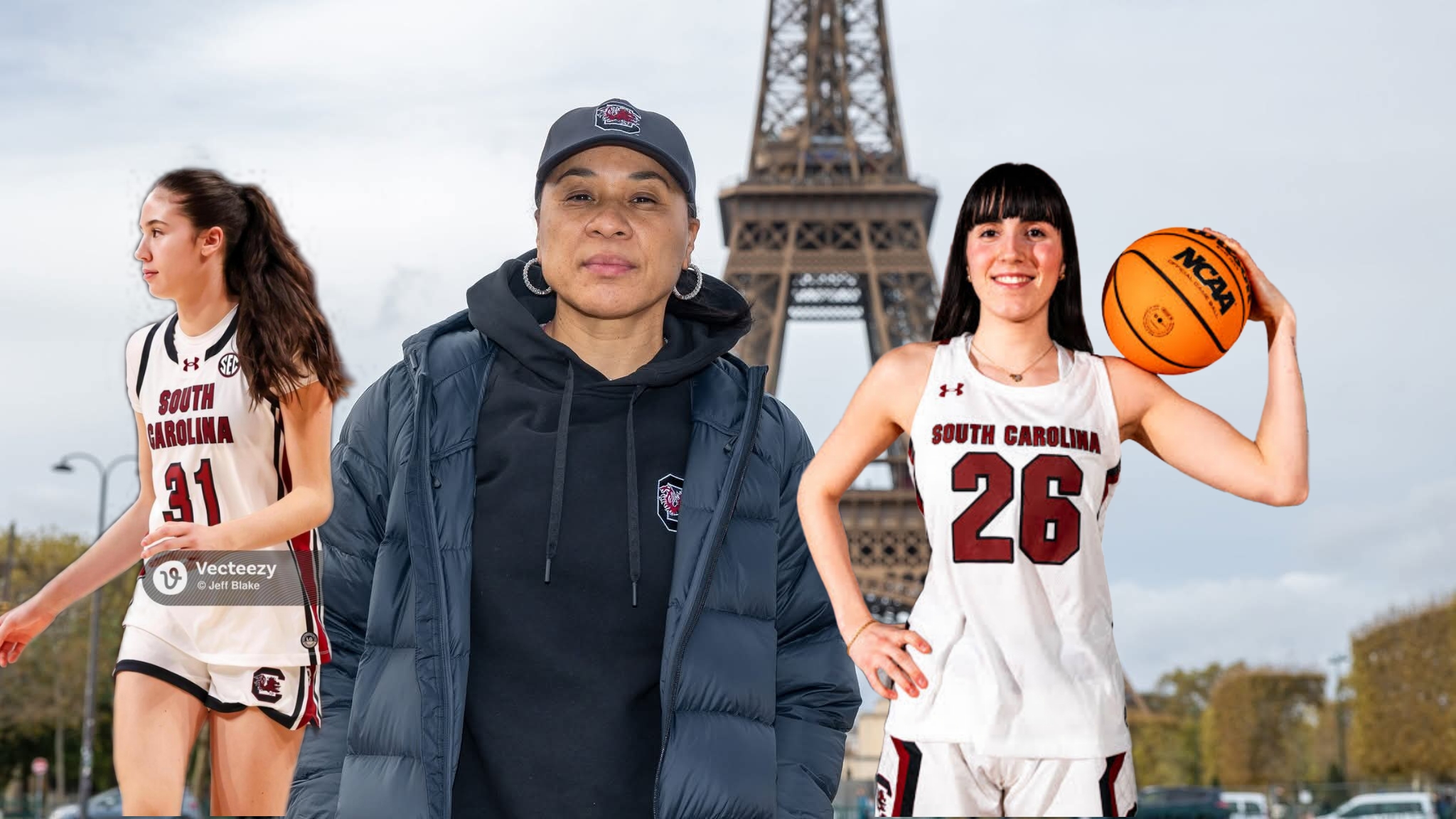
Thirteen percent of South Carolina women’s basketball’s 2026-27 roster speaks French. That’s not a coincidence — but it’s also not a pipeline. It’s something far more interesting: proof that Dawn Staley’s program has become so dominant, so globally visible, that the world’s best talent is now coming to her.
Two Players, One Country, One Vision
In the span of four months, Staley added two French forwards to her roster. 6-foot-7 forward Alicia Tournebize arrived in early January, and Justine Loubens followed in April, both making the jump from professional basketball in France to college basketball in Columbia.
Tournebize played for Tango Bourges Basket while Loubens suited up for La Roche Vendée Basket Club, but the two shared common ground as teammates for France’s national team in FIBA junior competition.
The natural assumption is that South Carolina has found a pipeline. Associate head coach Lisa Boyer pushed back on that narrative quickly — and her reasoning reveals something far more telling about where the program actually stands.
“I don’t think there’s any correlation there,” Boyer told The Greenville News. “International recruiting, people are doing it all over the place … schools are investing in sending their coaches overseas because there’s talent over there. So sometimes, you find a couple of hidden gems.”
Hidden gems. That framing matters. South Carolina isn’t scouring one country — it’s operating globally, and France simply produced two of the best available players at the same time.
Why International Players Are Choosing College Basketball Now
The surge in international recruiting isn’t happening in a vacuum. With NIL and revenue sharing now reshaping the economics of college athletics, players with WNBA ambitions have a compelling case to stop in the NCAA for four years first rather than grinding through professional leagues overseas for a fraction of the exposure.
Social media has also eliminated the geographical barrier that once made overseas scouting cost-prohibitive, giving coaches the ability to watch players across the world without ever boarding a plane. FIBA tournaments further amplify that exposure by placing international players directly in front of American coaching staffs.
Boyer acknowledged all of these forces are reshaping the landscape simultaneously. The programs positioned to capitalize are the ones with the brand recognition to make a young player overseas stop scrolling.
South Carolina is one of those programs. Perhaps the program.
The A’ja Wilson Effect Is Real — And It’s Global
No honest analysis of South Carolina’s international appeal begins anywhere other than A’ja Wilson. Wilson played four years for Staley, won a national championship in 2017, went No. 1 overall in the WNBA Draft, and has since become the league’s first four-time MVP. In 2025, she launched her Nike partnership, amplifying her global visibility to levels unprecedented for a women’s basketball player.
Pair that with Staley herself — the highest-paid women’s basketball coach in the country, with six straight Final Four appearances and three consecutive national title game runs — and you have a program that doesn’t need an overseas scouting budget to get noticed. March Madness finds its own audience.
“Dawn has that global presence,” ESPN women’s basketball writer Michael Voepel said. “A’ja being the best player in the world obviously helps the South Carolina brand. Some of these international players may not know very much about South Carolina other than Dawn and A’ja, and that’s enough.”
That last line is the key. In recruiting, “enough” is everything. A player in France who turns on women’s basketball and immediately sees Staley’s sideline and Wilson’s name in highlights has already started building a connection to Columbia before a single coach has picked up the phone.
The Stories Behind the Signings
Both recruitments reveal a program that is methodical, relationship-driven, and willing to play a long game.
Tournebize came with a family backstory that makes the connection feel almost poetic. Long before South Carolina fans knew her name, Staley and Boyer knew her mother — Isabelle Fijalkowski, who played college basketball at Colorado and in the WNBA before returning to France professionally. Staley and Fijalkowski faced each other when the United States defeated France in the Goodwill Games championship on August 7, 1994. The relationship between these two programs, through these two families, stretches back over 30 years.
South Carolina had Tournebize on its radar for roughly a year before actively recruiting her, and even when Staley and Boyer traveled to see her in person in October, Tournebize didn’t play — all they witnessed were warmups. Boyer acknowledged that Tournebize used that visit to gauge how serious the Gamecocks truly were. The answer was serious enough. She came on an official visit in late November, committed just before Christmas, and made her debut on January 15.
Loubens arrived through a different but equally deliberate channel. Her agent initiated contact with South Carolina’s staff, who reviewed her film, continued conversations, and eventually brought Loubens and her family in for an official visit toward the end of the regular season.
What sealed it, according to Boyer, was the environment inside Colonial Life Arena. “They got to see a practice, a game and we’re very fortunate we have a great in-game experience, we have phenomenal fans and they support us,” Boyer said. “I think that’s always really good, kids want to play in front of people.”
That detail is easy to overlook but analytically significant. South Carolina’s home atmosphere isn’t just a recruiting bullet point — it’s a closing argument. When an international player and her family sit in a sold-out arena and feel what Gamecock basketball looks and sounds like, the decision becomes visceral rather than intellectual.
Paris, Full Circle
The Gamecocks were part of the first NCAA regular-season basketball game ever played in France back in 2023. Now, they return to Paris on November 2 to open the 2026-27 season against Maryland — this time with Tournebize and Loubens on the floor.
The symmetry is striking. South Carolina went to France before it had French players. Now it returns with two of them, playing in front of the country that produced them, representing a program that has made itself impossible to ignore from anywhere in the world.
That’s not a pipeline. That’s a global brand doing exactly what global brands do.
About The Author