South Carolina Women’s Basketball’s 2027 Recruiting Class: Where Things Stand and What the Updates Tell Us
COLUMBIA, S.C. — Recruiting in women’s college basketball operates on a calendar that requires patience, and Dawn Staley’s program has never been better at playing the long game. Six weeks after GamecockCentral’s initial breakdown of South Carolina’s positioning within the top 30 prospects in the 2027 recruiting class, a June check-in reveals a landscape that is largely stable — with a handful of meaningful developments that quietly shift the contours of where this class could ultimately land.
The overarching context is important: South Carolina hasn’t had a non-COVID summer commitment since Olivia Thompson in 2019. Most of the commitments come in late October and November. That means the relative quiet of early June is not a warning sign. It is simply the nature of the calendar. The Gamecocks are planting seeds right now — and the harvest comes in the fall.
Here is an honest, analytical breakdown of where the most important prospects stand, what has changed, and what it means for South Carolina’s 2027 class.
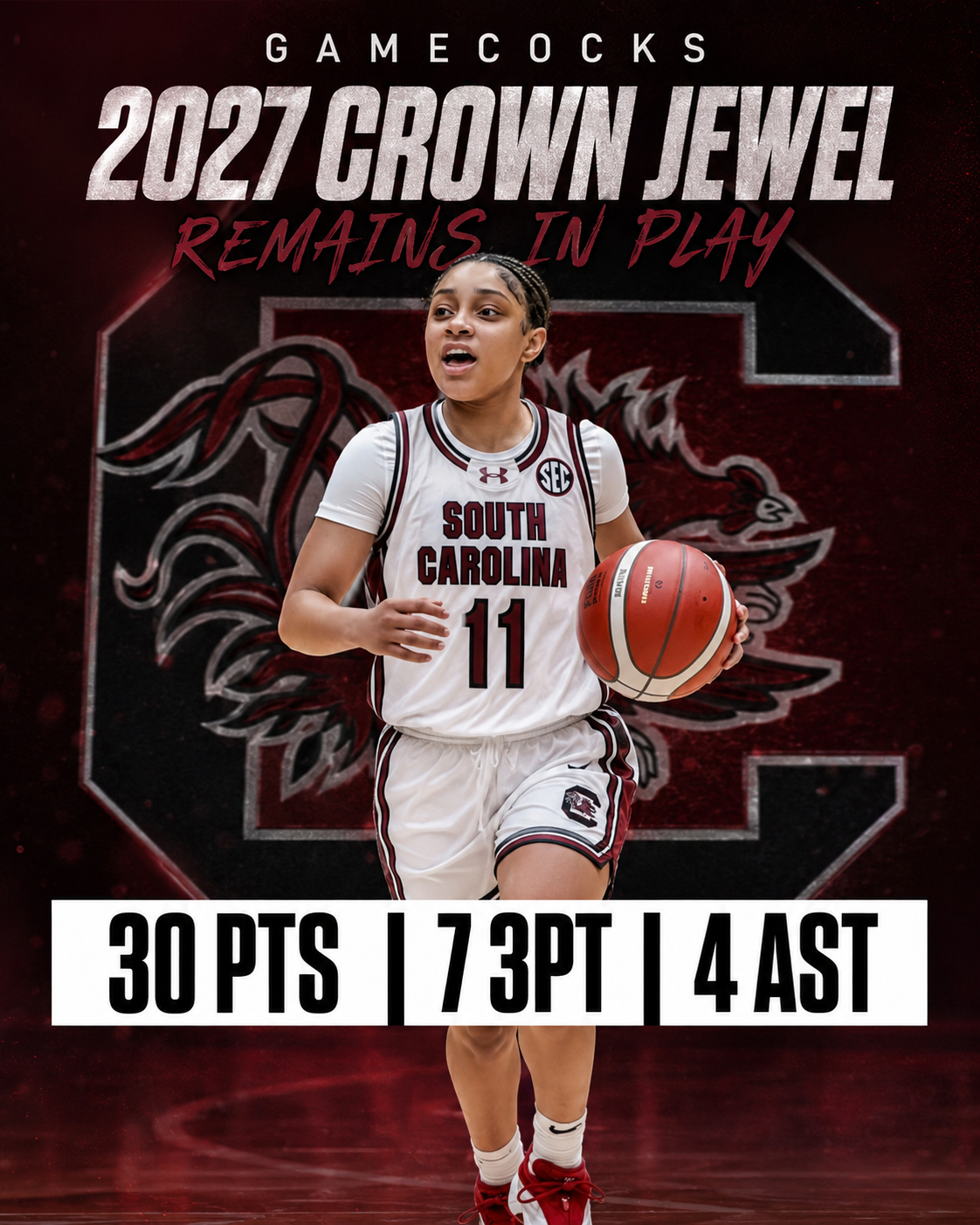
The Crown Jewel: KK Smith Remains in Play
No prospect in the 2027 class commands more attention — or more caution — than Kaleena “KK” Smith, the 5-5 point guard who has drawn the rare designation of generational talent. That phrase gets overused in recruiting circles, but Smith is a true generational talent — and the specificity of that claim carries real strategic implications for South Carolina.
Programs chasing Smith will need to decide how she fits into their budget. The NIL landscape has turned elite point guard recruitments into something closer to professional negotiations than traditional college commitments, and Smith — wisely — is keeping her options open. South Carolina has both offered and expressed genuine interest, and the Gamecocks’ outlook remains a cautious optimistic. But the honest reality is that landing Smith will require not just the right pitch but the right price. No update this cycle, which in context means the door remains open rather than closed.
The Strategic Alternative: Jezelle “GG” Banks
If Smith represents the ceiling of what this class could be, Jezelle Banks represents the floor — which is still an extraordinary floor. The 5-9 point guard is an elite prospect in her own right who may actually benefit from the outsized recruiting attention directed at Smith.
Programs might decide that Smith isn’t worth the cost and turn their attention to Banks. South Carolina’s positioning here is particularly strong: the Gamecocks have been interested in Banks for a long time, since before she became a top-five prospect, and may like her as much or more than Smith. That kind of early, sustained interest — before a player’s stock exploded — reflects genuine evaluation rather than reactive recruiting. It also builds the kind of relationship trust that matters when a player ultimately makes her decision. No change this cycle, but South Carolina’s standing with Banks appears to be one of the program’s most authentic connections in this entire class.
The Wing Situation: Three Options, Probably One Spot
South Carolina’s recruiting approach at the wing position in 2027 reflects a program that understands its own roster construction clearly. Ivanna Wilson-Manyacka, Jordyn Palmer, and Micah Ojo all represent legitimate targets — and the Gamecocks are genuinely interested in all three — but out of Wilson-Manyacka, Palmer, and Ojo, South Carolina probably only focuses on bringing in one player because the Gamecocks already have Jerzy Robinson and Agot Makeer from the last two classes.
That roster awareness is actually a sign of organizational discipline, not limitation. Programs that recruit without regard to roster balance create logjams, lose players to the portal, and waste scholarship resources. Staley’s staff knows what it has and what it needs.
Wilson-Manyacka fits the mold of a Gamecock player: physical and defensive-minded — a description that doubles as the highest compliment Staley’s program can pay a recruit. Palmer has incredible upside, is a little more offensively focused, and plans to visit South Carolina this summer — a visit that could prove pivotal in separating the Gamecocks from the competition. Ojo may be a little less polished than the wings above her in the rankings, but that just means she has more upside. All three remain in play. No changes this cycle for any of them, which means South Carolina is still alive in all three conversations heading into the summer evaluation period.
The Biggest Upgrade: Avery Arije Emerges as a Real Target
The most significant positive development in this June update is one that flew somewhat under the radar: Avery Arije, the 6-0 guard from Crestwood Prep in Canada, has named South Carolina to her top six. This matters for several reasons that extend well beyond the ranking.
Arije played with current Gamecock Agot Makeer at Crestwood Prep — meaning there is a built-in relationship and firsthand knowledge of what the South Carolina program offers. Arije has watched her former teammate navigate this program’s demands, culture, and opportunity, and she is still putting the Gamecocks in her top six. That kind of peer-to-peer recruiting pipeline is among the most authentic forms of program endorsement that exists. There is a lot of familiarity, since Arije played with Makeer, making her one to keep a close eye on as the summer progresses.
The timing of South Carolina’s offer — which was not widely reported but clearly happened before Arije’s top six announcement — suggests the staff identified her value quietly and moved before the broader recruiting world caught up. That is how elite programs operate.
Taylor Brown: More Than a Consolation Prize
Perhaps the most telling shift in the entire June update is South Carolina’s extended scholarship offer to Taylor Brown, the 5-7 point guard who had previously been characterized as a potential fallback option if the Gamecocks struck out on Smith and Banks.
The offer changes that framing entirely. It appears South Carolina thinks of her as more than a consolation prize. That re-evaluation matters. A program of South Carolina’s caliber does not extend scholarship offers to hedge its bets — it extends them to players it genuinely believes fit the system and can contribute at the highest level. Brown now moves into the category of a legitimate Gamecock target, not a backup plan.
The Doors That Have Closed
Honest recruiting analysis requires acknowledging what is no longer realistic, and several prospects in the top 30 have effectively moved on from South Carolina’s orbit.
Caroline Bradley committed to LSU in early April, ending one of the least surprising recruitments in recent history — a clean, definitive conclusion to a pursuit that never had strong momentum. Eve Long committed to Notre Dame, removing another post option from consideration. Lauren Hassell committed to Vanderbilt in late May after it seemed like she would end up at UConn or Vanderbilt — one of two predicted outcomes arriving on schedule. Sydney Mobley narrowed her list to Ohio State, Illinois, and Virginia Tech at the end of May, effectively closing that door as well.
None of these departures represent major losses for the Gamecocks. Bradley’s commitment to LSU was anticipated. Long, Hassell, and Mobley were never strong South Carolina targets. The program’s energy is clearly concentrated elsewhere, and the closed doors simply confirm where the real recruiting focus lies.
The Post Question Lingers
The most unresolved dimension of South Carolina’s 2027 outlook is the post position, and the June update does not fully resolve it. Saniyah Murray’s top six did not include the Gamecocks — she is deciding between Alabama, Florida, Mississippi State, Oklahoma, Ole Miss, and North Carolina — effectively removing her from serious consideration. Khalia Hartwell, the top 2027 prospect in the state of South Carolina, has seen her outlook downgraded to the empty nest category: neither side seems to have much interest, and normally the Gamecocks would have extended an offer if they had any interest at all.
That leaves Harper Dunn — a 6-6 prospect with more potential than production and a convoluted high school career — as one of the few remaining post targets with any South Carolina connection, however tenuous. Jayla Forbes at 6-7 is acknowledged to have a ranking more reflective of her height than her production at this point. The post landscape for 2027 remains genuinely unsettled, and it is the area of greatest uncertainty for a program that has built its identity around frontcourt dominance.
The Bottom Line
South Carolina’s 2027 recruiting picture, as of early June, reflects a program that is clearly positioned in the most important conversations without yet closing any of them. The point guard pursuit — centered on Smith, Banks, and now Brown — is the class-defining storyline, and the Gamecocks are active in all three. The wing recruitment is concentrated and deliberate, with a summer visit from Palmer potentially accelerating a decision. The Arije development is the most encouraging new addition to the board, built on genuine program familiarity. And the post position remains the most pressing unanswered question.
The waiting game continues. Most commitments come in late October and November, and the true shape of this class will not emerge until the fall. But the foundation being built this summer — through visits, relationships, and continued offers — will determine everything that follows.
For South Carolina, the seeds are planted. Now comes the cultivation.
About The Author