South Carolina Women’s Basketball’s Two Biggest Questions Heading Into 2026-27: The Point Guard Dilemma and the Freshman to Watch
COLUMBIA, S.C. — Dawn Staley’s program enters the 2026-27 season with championship expectations firmly intact, a roster loaded with proven talent at virtually every position, and a coaching staff that has navigated Final Fours and title games with consistent regularity. On paper, South Carolina is once again one of the two or three best teams in the country.
But paper does not play games — and when GamecockCentral writers Chris Wellbaum, Kevin Miller, and Mingo Martin were asked to identify the program’s biggest concern heading into next season and the freshman most likely to make an immediate impact, all three converged on the same answers with a unanimity that itself tells a story.
The concern is real. The upside is real. And both center on the same truth: this South Carolina team will go as far as its youngest and least experienced players can carry it when the pressure is highest.
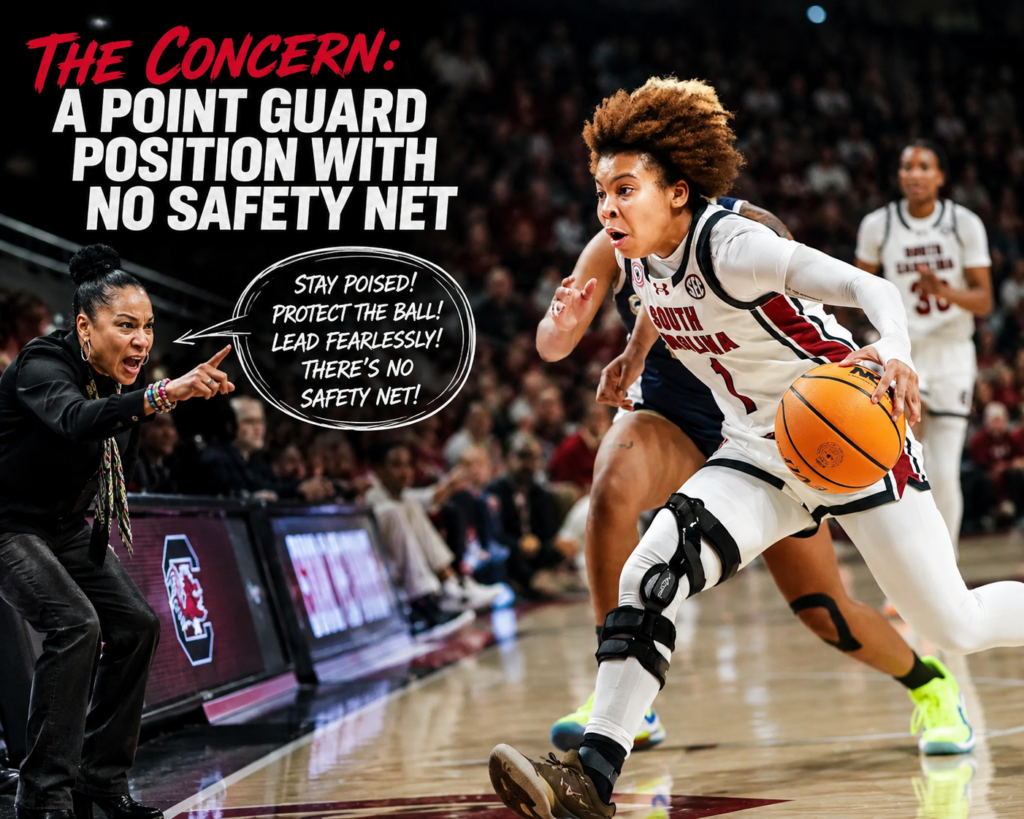
The Concern: A Point Guard Position With No Safety Net
In a program that has returned experienced, polished guards season after season — from Destanni Henderson to Zia Cooke to Raven Johnson to Ta’Niya Latson — the 2026-27 Gamecocks face a genuinely unfamiliar situation at the most demanding position on the floor. All three writers identified it without hesitation, and the convergence of their concern is worth taking seriously.
Wellbaum put it most directly: “South Carolina has experience and depth at every position except point guard, where it has neither. There is talent – Maddy McDaniel would have led the nation in assist-to-turnover ratio had she been eligible last season, but she hasn’t run the show on her own yet. McDaniel doesn’t have a safety net, either. Nobody else on the roster has played more than spot minutes at the position in college. If the season goes sideways, it will be because of issues at point guard.”
That framing is both honest and important. McDaniel’s statistical projection — leading the nation in assist-to-turnover ratio in a season she was ineligible to play — reflects extraordinary theoretical capability. But capability projected through practice metrics and actual performance in high-stakes SEC and NCAA Tournament environments are two different things. Staley’s system demands precision decision-making at the point, and the margin for error in March is essentially zero. A point guard who has not yet been tested as the primary operator carries a question mark that talent alone cannot fully erase.
Miller reinforced the concern while adding important nuance: “In 90% of the team’s games, it won’t matter because of South Carolina’s overwhelming talent, but there will come a point in the 2026-2027 campaign when the spot is truly tested. The Gamecocks don’t have a proven starter, and they don’t have anyone on the roster who is a natural point guard beyond Maddy McDaniel. There is a reason why USC hosted a major transfer point guard earlier this offseason.”
That final observation is quietly the most telling detail in the entire conversation. When a program of South Carolina’s caliber is hosting transfer point guards in the offseason, it is not exploring options recreationally. It is acknowledging a specific vulnerability and attempting to address it. The fact that no transfer addition materialized at the position means the Gamecocks either did not find the right fit or chose to trust what they have — and either way, the question mark remains.
Martin was the third voice to arrive at the same conclusion, and his solution is the most unconventional: “I think to achieve expectations, South Carolina is gonna have to look to unconventional point guard play to share the load with the young starter. Dawn Staley may not like having Joyce run point, but I’d expect to see more of it next season.”
The idea of Joyce Edwards — the program’s leading scorer at 19.2 points per game — absorbing additional ball-handling and creation responsibilities is both intriguing and telling. Edwards has improved her playmaking every season, averaging 2.4 assists last year, and her combination of size, vision, and skill gives Staley genuine flexibility in how she distributes offensive creation duties. Using Edwards as a secondary or occasional primary creator could take meaningful pressure off McDaniel in the moments when the offense stalls — a workaround that smart coaching staffs deploy when traditional positional structure creates bottlenecks.
Miller also raised an interesting secondary option in Agot Makeer: “I am also intrigued to see how much Agot Makeer might play on the ball. Though not a ‘traditional point guard,’ she played the position some in high school and had five games against power conference opponents in which she dished out at least three assists, despite operating as a third or fourth creator in a lot of her minutes.” That situational versatility — demonstrated against power conference competition, not cupcake opponents — suggests Makeer could serve as an unconventional pressure valve without requiring Staley to fundamentally alter her system.
The honest assessment is this: McDaniel is talented, competitive, and statistically gifted. She is also untested as the undisputed primary operator in a program with championship expectations. Those two facts coexist, and South Carolina’s ability to manage that tension — through unconventional creation sharing, smart roster deployment, and McDaniel’s own growth — will likely determine whether this team makes a Final Four or falls short of it.
The Freshman to Watch: Jerzy Robinson, and It Is Not Particularly Close
If the point guard question is the area of greatest concern, Jerzy Robinson is the area of greatest anticipation — and all three writers arrived at her name with the same conviction they brought to the point guard discussion.
Wellbaum made the case on the basis of readiness: “She isn’t your typical 18-year-old freshman. Robinson has been training like a pro for half her life, and she has the most college-ready game. She is a guard who can score in the post, something none of the Gamecocks’ other guards can do, and the ability to give opponents different looks will earn her playing time.”
That last point is strategically significant in a way that extends beyond Robinson’s individual talent. South Carolina’s offense is built around Joyce Edwards in the post and perimeter guards who create and move without the ball. A guard who can score in the post is a matchup wrinkle that opposing defenses are not accustomed to preparing for — because most Gamecock guards operating on the perimeter cannot punish defenders who shade them away from the basket. Robinson can. That creates a second interior scoring threat that changes how defenses allocate their attention and, in turn, creates better looks for Edwards and the perimeter shooters around them.
Miller emphasized the physical foundation underpinning Robinson’s early-impact potential: “She is strong, athletic, and unafraid, three traits that will allow her to put the ball in the basket against most collegiate defenders when things are going well for her. Robinson will have to be efficient to carry a consistent role, but the pathway exists for her. Oliviyah Edwards is a wildcard here with her length and athleticism, but the frontcourt is so crowded that it probably won’t happen immediately.”
The three traits Miller identifies — strength, athleticism, and fearlessness — are precisely the qualities that separate college-ready freshmen from players who need a year to absorb the physicality and speed of the game before contributing. Robinson was not developed in a standard high school environment. She has been in elite training settings, competing against older players, for years. That preparation compresses the adjustment timeline in a way that traditional freshman development simply does not.
Martin added a detail that often gets overlooked in freshman impact projections: “Her not playing with Team USA this summer also allows her more time to get with the team and develop chemistry.” This is a meaningful practical point. Every additional week Robinson spends in Staley’s system — learning the defensive schemes, building trust with Edwards and McDaniel, internalizing the team’s offensive principles — is a week of developmental runway that players competing internationally this summer will not have. By the time the season opens, Robinson may simply be more prepared than her recruiting ranking or traditional freshman status would suggest.
The consensus projection is that Robinson’s impact will arrive primarily off the bench, in an important and defined role rather than as an immediate starter. That framing is both realistic and optimistic — it sets a clear expectation without capping her ceiling prematurely. If her post scoring, defensive versatility, and physical tools translate the way the coaching staff clearly believes they will, Robinson’s role could expand well beyond what anyone is currently projecting.
The Bottom Line
South Carolina enters 2026-27 with the talent to compete for a national championship and a specific, identified vulnerability that could complicate that pursuit at the worst possible moment. The point guard position is the program’s most honest question mark — and the answers available, while encouraging, are unproven at the level that ultimately matters.
But the same team that carries that vulnerability also carries Jerzy Robinson, a freshman built differently than most, arriving with more preparation and a more distinctive skill set than the program has seen from a guard in some time.
Dawn Staley has built six consecutive Final Four teams by solving problems other programs could not. The point guard challenge is the most pressing problem she has faced in years. How she solves it — through McDaniel’s growth, Edwards’ expanded role, Makeer’s versatility, and Robinson’s early contribution — will define whether 2026-27 is remembered as another chapter in a dynasty or a season that exposed the limits of depth.
The talent is there. The questions are real. And in Columbia, that is exactly the kind of tension that tends to produce great basketball.
About The Author