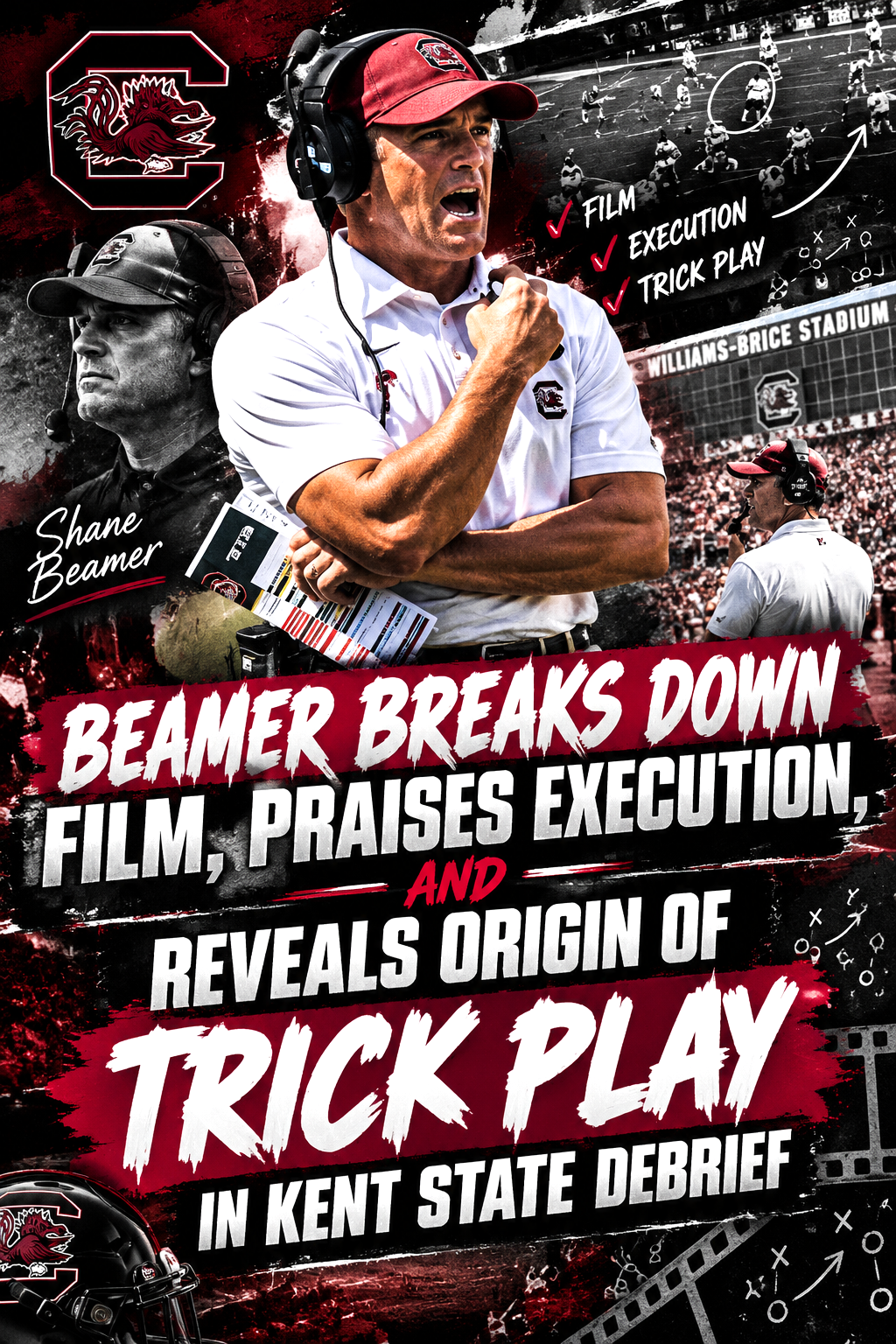
Beamer Breaks Down Film, Praises Execution, and Reveals Origin of Trick Play in Kent State Debrief
Overall Assessment
Reflecting on film from the win, Shane Beamer was pleased with what he saw across all three phases, even while flagging areas to improve. On defense, he emphasized run-stopping success: “Defensively we stopped the run. Other than two quarterback runs/scrambles that we let get out of the pocket, we really did a great job from a run game standpoint. Didn’t really allow any explosives the entire game other than those two quarterback runs, but we got to get those handled better.”
On offense, Beamer credited ball security as the driving factor behind the blowout: “When you don’t turn the ball over, you’re going to probably win the game. When you win the explosive play battle and you don’t turn the ball over, you’re definitely going to win the game.” He did flag two fumbles the team recovered as a point of concern, along with early perimeter blocking that needed in-game adjustment: “They came out a little bit differently than we had anticipated, Kent State. So we took a little bit after that first series to adjust.” He also noted special teams was solid overall but felt the punt return game with Vicari Swain fell short of standard.
Players of the Game
Beamer named Nolan Hay and Donovan Murph as offensive players of the game, Judge Collier and Tomiwa Durojaiye on defense, and Kyler Farrow on special teams, specifically praising his difficult snap on the trick-play two-point conversion.
The Trick Play’s Origin Story
Asked about the now-viral backwards-snap, jump-pass two-point conversion, Beamer revealed genuine excitement about the play’s history and design: “I told Jordan (Kaye) after the press conference yesterday that I was really disappointed and hurt that nobody asked about it, but I thought that was a pretty cool play.” He traced its roots back to 2021 against Eastern Illinois with tight end Nick Muse, noting similar plays have been run with Tonka Hemingway, Kai Kroger, TJ Sanders, and Moe Brown over the years. On why he called it: “I like doing that one. It makes teams have to prepare for stuff that you’re doing on extra points… I just wanted to run it. So I told Matthew (Smiley) on the next touchdown, we’re going to run it. I don’t care how they line up, we’re going to run it anyway.”
On Mazeo Bennett’s Response to a Penalty
Beamer confirmed he personally addressed Bennett after a costly pre-snap penalty, telling him: “Don’t let one play affect the next play.” He praised Bennett’s overall standard and leadership, noting his teammates voted him a captain: “Mazeo has worked really, really hard. He has a high standard for himself… he’s just a really, really good football player.”
On Signing Kicker Ethan Sanchez
Beamer explained the decision to add veteran kicker Ethan Sanchez to an already competitive room featuring Max Kelley, Malik Orsan, and Upton Bellenfant: “Here’s a guy that has kicked at the Power-Four level. He’s an older guy, has kicked a lot of game-winning field goals. He’s kicked at Williams-Brice Stadium.” Beamer noted he ran the idea by team captains first, and they were fully supportive before working through compliance and SEC approval.
On LaNorris Sellers’ Performance
Despite minimal rushing yardage, Beamer was thrilled with Sellers’ operation of the offense: “LaNorris, I thought, was great yesterday… thought he was very poised, confident… I just flat-out asked him, are you having fun? And he was very adamant how much fun he’s having.” He also expressed confidence the run game can remain strong without leaning heavily on Sellers’ legs, citing the depth at running back.
Personnel Notes
Beamer highlighted several players who impressed enough to warrant increased playing time going forward, including Donovan Murph, Lex Cyrus, Malik Clark, and Jabree Coleman at receiver/running back, along with defensive contributors J’Zavien Currence, Kendall Daniels Jr., Jamian Risher Jr., Julian Walker, and Aiden Harris.
On Offensive Scheme and Personnel Advantages
Beamer detailed the strategic emphasis on attacking the perimeter, citing a perceived size advantage: “We felt like we had a size advantage out there, particularly our perimeter guys versus who we thought was going to play nickelback for them. So we wanted to get the ball in the perimeter.” He emphasized the offense’s identity around spreading touches: “If you look at the amount of players that touched the ball yesterday, that’s a fact. And we’ve got to be able to continue to spread the ball around running it and throwing it.”
On the Defensive Tackle Rotation
Beamer praised the depth at defensive tackle as a major asset, contrasting it with previous seasons: “Back in 2024 we had a four-man rotation… certainly last year we didn’t have much of a rotation at that defensive tackle position, but we’ve got so many now. That’s really an advantage.” He singled out freshman Noah Clark as particularly disruptive, along with Kelby Collins, Gabe Brownlow-Dindy, and Troy Pikes.
Looking Ahead to Towson
Beamer offered early impressions from film study, noting Towson’s aggressive, athletic style: “I see a team that plays really, really hard. You watch them play defense, they fly to the ball and I see athleticism, athleticism in the secondary, athleticism at receiver, they can certainly run.”
On DJ Black’s Fumble Response
Asked about Black’s ability to bounce back from a fumble to throw a key block later in the game, Beamer praised his mental toughness: “I don’t want to penalize a guy. He fumbles and you penalize him by taking him out… he responded the right way and got better.”
On Season Captains
Beamer also explained his unusual decision to name captains before the season rather than after, as he’s typically done throughout his career: “I really feel like this team is… older, more mature. I had a pretty good idea how the captain vote would go because we have so many. I knew we would have a lot of guys that would get votes.”
About The Author