Duke Basketball’s Loss to Michigan State Reveals Offensive Struggles, While Drew Scharnowski Provides a Bright Spot

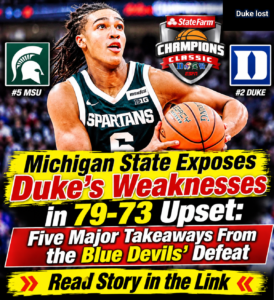
Duke suffered a disappointing defeat against Michigan State on Tuesday, with offensive inconsistency, poor three-point shooting and defensive breakdowns contributing to the result. Despite the setback, several individual performances offered encouragement, particularly from Belmont transfer Drew Scharnowski, who made an immediate impact coming off the bench.
The Blue Devils showed flashes of competitiveness but struggled to establish offensive rhythm against Michigan State’s defensive pressure. Here are three major takeaways from the game.
1. Drew Scharnowski Emerges as a Positive Off the Bench
One of the most encouraging developments for Duke was the performance of Drew Scharnowski.
The Belmont transfer provided energy and physicality after entering the game as a reserve. At 6-foot-10, the forward demonstrated his ability to contribute on both ends without forcing plays outside his responsibilities.
Offensively, Scharnowski used pick-and-roll opportunities to attack the basket, create scoring chances and draw defensive attention.
He finished with eight points on 2-of-3 shooting, six rebounds and two assists in 15 minutes.
His defensive contributions were equally valuable. Scharnowski recorded a block and a steal while helping protect the paint, including stretches when he was Duke’s primary interior presence.
Alongside Sebastian Wilkins, he was one of only two Blue Devils to finish with a positive plus-minus.
Although Scharnowski may not be expected to carry the team’s scoring responsibilities, his performance demonstrated the value of having an experienced player who can provide energy, rebounding and defensive support.
His ability to make an impact in limited minutes could become an important asset for Jon Scheyer’s rotation.
2. Turnovers and Defensive Pressure Disrupt Duke’s Offense
The word that best describes Duke’s performance is sloppy.
Both teams recorded 13 turnovers, while the contest featured 46 combined fouls. However, Duke experienced greater difficulty converting possessions into productive offensive opportunities.
Michigan State’s defensive pressure repeatedly disrupted the Blue Devils’ execution.
Duke struggled around the basket, with its players experiencing eight blocked shots and losing possession seven additional times through steals.
When the Blue Devils managed to retain possession, their offensive sequences frequently ended with difficult attempts rather than high-quality scoring opportunities.
Free throws helped keep Duke competitive. The team converted 26 of its 37 attempts, providing an important source of offense despite its shooting struggles.
Michigan State, however, maintained its defensive intensity. Jordan Scott was particularly influential, recording six blocks.
On the opposite end, Jeremy Fears Jr. consistently found ways to attack Duke’s defense.
His ability to penetrate the paint created problems for the Blue Devils, and he drew 12 fouls by putting pressure on defenders throughout the game.
Duke also struggled to defend without committing unnecessary contact, surrendering four three-point-play opportunities.
For Scheyer’s team, the performance highlighted the importance of better defensive positioning, improved communication and more disciplined decision-making.
3. Three-Point Shooting Becomes Duke’s Biggest Offensive Problem
Duke’s inability to consistently score from beyond the arc was another major factor in the defeat.
The Blue Devils finished 7-for-29 from three-point range, shooting just 24%.
Although some attempts were reasonably open, shot selection and execution also contributed to the poor percentage.
Caleb Foster experienced particular difficulties from the perimeter. The veteran guard attempted several challenging shots, including two deep three-pointers late in the game that failed to find the basket.
Those misses proved costly because they gave Michigan State opportunities to control important possessions.
Foster finished 2-for-7 from three-point range and missed all three of his two-point attempts.
Freshman Joaquim Boumtje Boumtje also struggled with his outside shooting, missing all three of his attempts from beyond the arc.
However, he was more effective closer to the basket, converting both of his two-point attempts.
Given his 7-foot-2 frame, attacking the paint and using his size around the basket could provide a more productive offensive approach.
Duke needs better shot selection and greater perimeter efficiency if it hopes to compete consistently against nationally competitive opponents.
What This Means for Duke Moving Forward
Despite the defeat, there are encouraging elements for the Blue Devils to build on.
Scharnowski demonstrated that he can provide meaningful contributions off the bench, while Duke’s ability to remain competitive despite shooting difficulties offers some perspective on the team’s potential.
However, the concerns are equally clear.
The Blue Devils must improve their three-point shooting, protect the basketball and develop more reliable offensive possessions.
Their defensive discipline also requires attention, particularly against guards capable of consistently attacking the paint.
Final Takeaway
Duke’s loss to Michigan State exposed several areas that require improvement, but Scharnowski’s performance provided a positive development for Jon Scheyer.
The combination of bench production, improved offensive execution and more disciplined defense will be essential to Duke’s progress this season.
A six-point defeat is not the end of Duke’s ambitions, but the performance serves as an early reminder that championship expectations require consistency on both ends of the floor.
About The Author