Who Stepped Up and Who Struggled? Grading Duke’s Players After the Michigan State Defeat
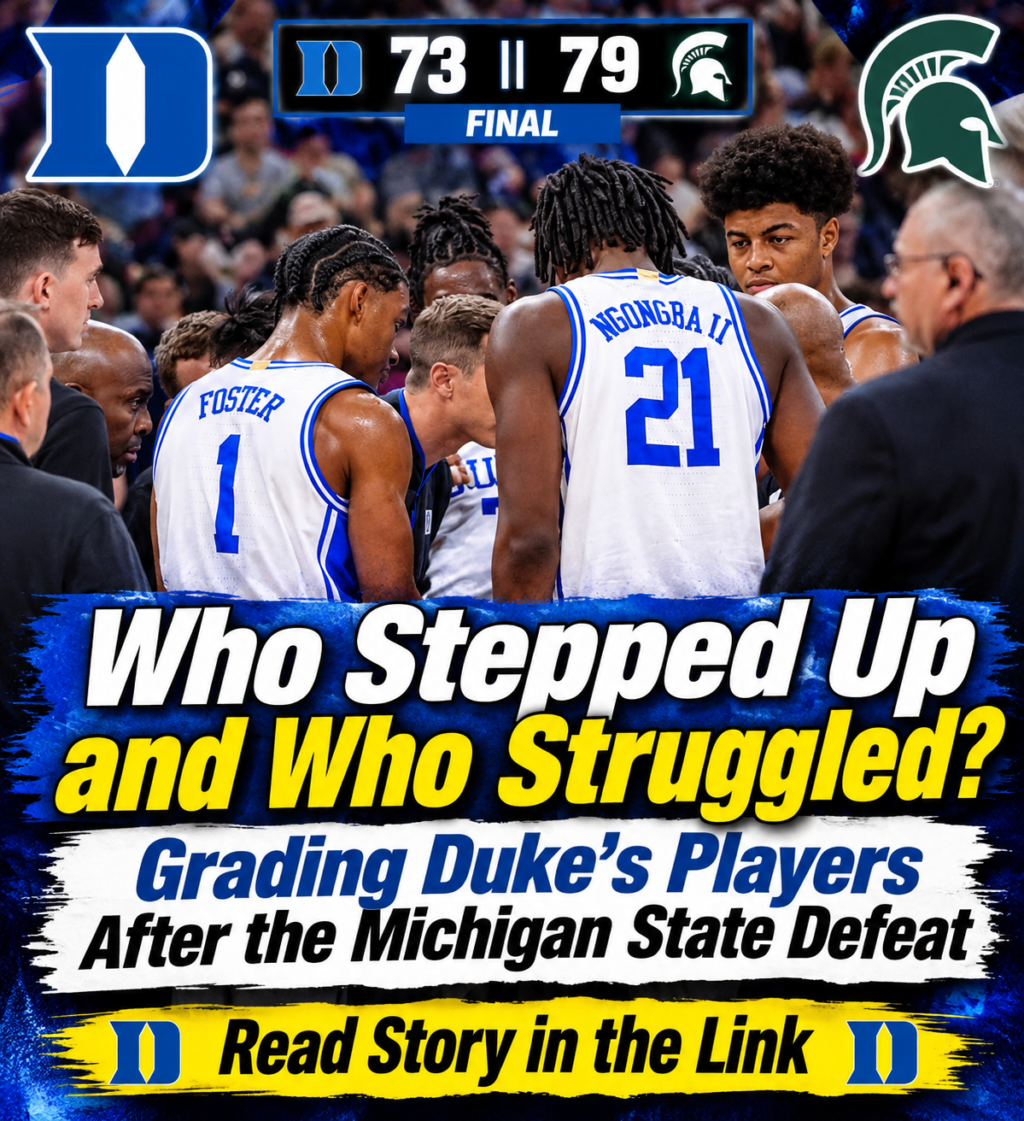
Duke entered Tuesday night’s Champions Classic matchup against Michigan State with plenty of confidence after opening the season with two convincing victories. However, the No. 2 Blue Devils encountered a different level of defensive pressure against No. 5 Michigan State, falling 79–73 at the United Center in Chicago.
The defeat exposed several areas Duke must address, particularly its shooting efficiency, decision-making under pressure, and ability to generate consistent offense against an aggressive defense.
Although the Blue Devils showed improvement after halftime, their slow start created a deficit they could never completely overcome. John Blackwell led Duke with 17 points, while Patrick Ngongba II contributed 11 points and seven rebounds. Caleb Foster and Sebastian Wilkins added nine points apiece.
But individual contributions were not enough to overcome Michigan State’s defensive intensity.
Here is how Duke’s players performed, based on their production and overall influence on the game.
1. John Blackwell — Grade: B+
17 points, 5 rebounds, 6-for-16 shooting, 4-for-11 from three-point range
Blackwell was arguably Duke’s most reliable offensive contributor on a difficult night.
His 17 points led the Blue Devils, and his four three-pointers provided some much-needed perimeter production. He also helped Duke remain within striking distance during stretches when the offense struggled to establish any rhythm.
However, Blackwell was not particularly efficient, shooting 37.5% from the field. Michigan State made him work for his opportunities, and Duke needed more consistent scoring from its leading offensive option.
Nevertheless, Blackwell deserves credit for continuing to compete and providing the scoring spark Duke desperately needed.
2. Patrick Ngongba II — Grade: B-
11 points, 7 rebounds, 6 assists, 4 blocks
Ngongba delivered one of Duke’s more complete statistical performances, although his offensive efficiency left room for improvement.
Coming into the game after recently dealing with the flu, he still managed to contribute in several areas. His seven rebounds and six assists demonstrated his importance beyond scoring, while his four blocks provided a significant defensive contribution.
However, his two-for-seven shooting from the field and seven-for-13 performance at the free-throw line highlighted some of Duke’s offensive difficulties.
His early turnovers also contributed to Michigan State establishing control.
Ngongba showed resilience and versatility, but Duke needed greater finishing efficiency from its center.
3. Caleb Foster — Grade: C
9 points, 5 rebounds, 4 assists, 2-for-10 shooting
Foster had moments when he appeared capable of changing the game’s direction.
His timely three-pointer in the second half briefly helped Duke build momentum, and his four assists demonstrated his ability to contribute as a facilitator.
The problem was his shooting efficiency. Foster finished two-for-10 from the field and two-for-seven from beyond the arc.
Duke needed more reliable perimeter shooting, especially when Michigan State began extending its advantage. His nine points were useful, but his missed opportunities made it difficult for the Blue Devils to sustain their comeback.
4. Sebastian Wilkins — Grade: B
9 points, 2 rebounds, 4 assists, 1-for-1 from three-point range
Wilkins was one of Duke’s encouraging contributors off the bench.
He scored nine points while shooting an efficient two-for-four from the field and converting his only three-point attempt. His four assists also showed that he was willing to create opportunities for teammates rather than focus exclusively on scoring.
His ability to contribute without committing a turnover was another positive.
Although he did not play enough minutes to completely change the outcome, Wilkins provided useful energy and offensive efficiency when Duke needed both.
5. Drew Scharnowski — Grade: B
8 points, 6 rebounds, 2 assists
Scharnowski offered a productive contribution in limited playing time.
He finished two-for-three from the field and converted four of his five free throws. His six rebounds helped Duke compete on the glass, while his two assists demonstrated additional value as a reserve.
His open layup in the first half also helped end a difficult scoring stretch for the Blue Devils.
Scharnowski did not dominate the game, but his efficiency and activity made him one of Duke’s more encouraging bench performers.
6. Dame Sarr — Grade: C-
6 points, 2 rebounds, 1 assist
Sarr struggled to establish an offensive rhythm against Michigan State’s pressure.
He finished with six points, shooting one-for-five from the field and missing both of his three-point attempts. His four-for-six performance at the free-throw line helped his scoring total, but Duke needed more production from the floor.
He had opportunities to contribute, but the Spartans made it difficult for him to find consistent openings.
Sarr’s defensive activity and ability to get to the free-throw line were positives, but his overall offensive contribution was limited.
7. Cayden Boozer — Grade: C
6 points, 3 rebounds, 2 assists
Boozer showed flashes of what he can bring to Duke’s offense.
His second-chance basket helped briefly lift the Blue Devils during the second half, while his ability to attack the basket provided another option when perimeter shots were not falling.
He finished two-for-five from the field and added two assists.
However, Duke needed more consistent offensive creation from its backcourt. Boozer’s contribution was respectable, but he did not produce enough to shift the momentum.
8. Joaquim Boumtje Boumtje — Grade: C-
5 points, 4 rebounds, 1 steal
Boumtje Boumtje had some positive defensive moments, including a steal during Duke’s attempt to recover in the first half.
However, his three-point shooting was a major problem. He missed all three of his attempts from beyond the arc and finished two-for-five overall.
His four rebounds provided some value, but the early turnover and inability to convert perimeter opportunities contributed to Duke’s offensive struggles.
9. Deron Rippey Jr. — Grade: D
2 points, 2 rebounds, 2 assists
Rippey Jr. had a difficult night offensively.
He finished one-for-five from the field, missed his only three-point attempt, and struggled to convert opportunities during Duke’s early offensive problems.
His two assists showed that he was still able to contribute as a playmaker, but his scoring impact was limited.
Duke needs more dependable production from its guard rotation, particularly when opponents apply the kind of pressure Michigan State brought to Chicago.
The bigger picture: Duke’s shooting problem was difficult to overcome
The individual grades tell only part of the story. Duke’s biggest problem was its collective offensive performance.
The Blue Devils finished:
- 20-for-60 from the field (33.3%).
- 7-for-29 from three-point range (24.1%).
- 26-for-37 at the free-throw line (70.3%).
- 18 assists and 13 turnovers.
The first-half numbers were particularly concerning. Duke made just seven of its 27 field-goal attempts and two of 12 three-point attempts before halftime.
Although the Blue Devils improved after the break, the early deficit proved costly.
Michigan State also demonstrated how much defensive pressure can influence Duke’s offensive decisions. The Spartans recorded eight blocks, with Jordan Scott accounting for six of them.
That defensive presence made attacking the basket difficult and forced Duke to work harder for quality scoring opportunities.
What must Duke improve before facing Illinois?
The loss should provide valuable lessons for Jon Scheyer and his players.
First, Duke must improve its shot selection and perimeter efficiency. A team with championship ambitions cannot expect to win consistently when it shoots below 25% from three-point range.
Second, the Blue Devils must handle physical defensive pressure more effectively. Michigan State disrupted their rhythm early, and Duke spent much of the night trying to recover.
Third, Duke needs more consistent contributions across its rotation. Blackwell and Ngongba provided the strongest scoring performances, but the team will need multiple players capable of stepping forward when its primary options struggle.
Final verdict
Michigan State deserved the victory, but Duke’s defeat should not be viewed as a reason to panic this early in the season.
Blackwell was the leading scorer, Ngongba contributed across several categories, and Wilkins and Scharnowski offered encouraging performances from the bench.
However, the shooting struggles and difficult first half were too much to overcome.
The biggest question moving forward is whether Duke can turn the lessons from this defeat into improvement before its next major test.
The Blue Devils return to Cameron Indoor Stadium to face SIU Edwardsville before preparing for another ranked challenge against Illinois.
For Scheyer, the Michigan State loss is an early reminder that talent alone will not be enough. Duke must execute, take better shots, and find ways to respond when opponents make the game uncomfortable.
About The Author