Michigan State Exposes Duke’s Weaknesses in 79-73 Upset: Five Major Takeaways From the Blue Devils’ Defeat
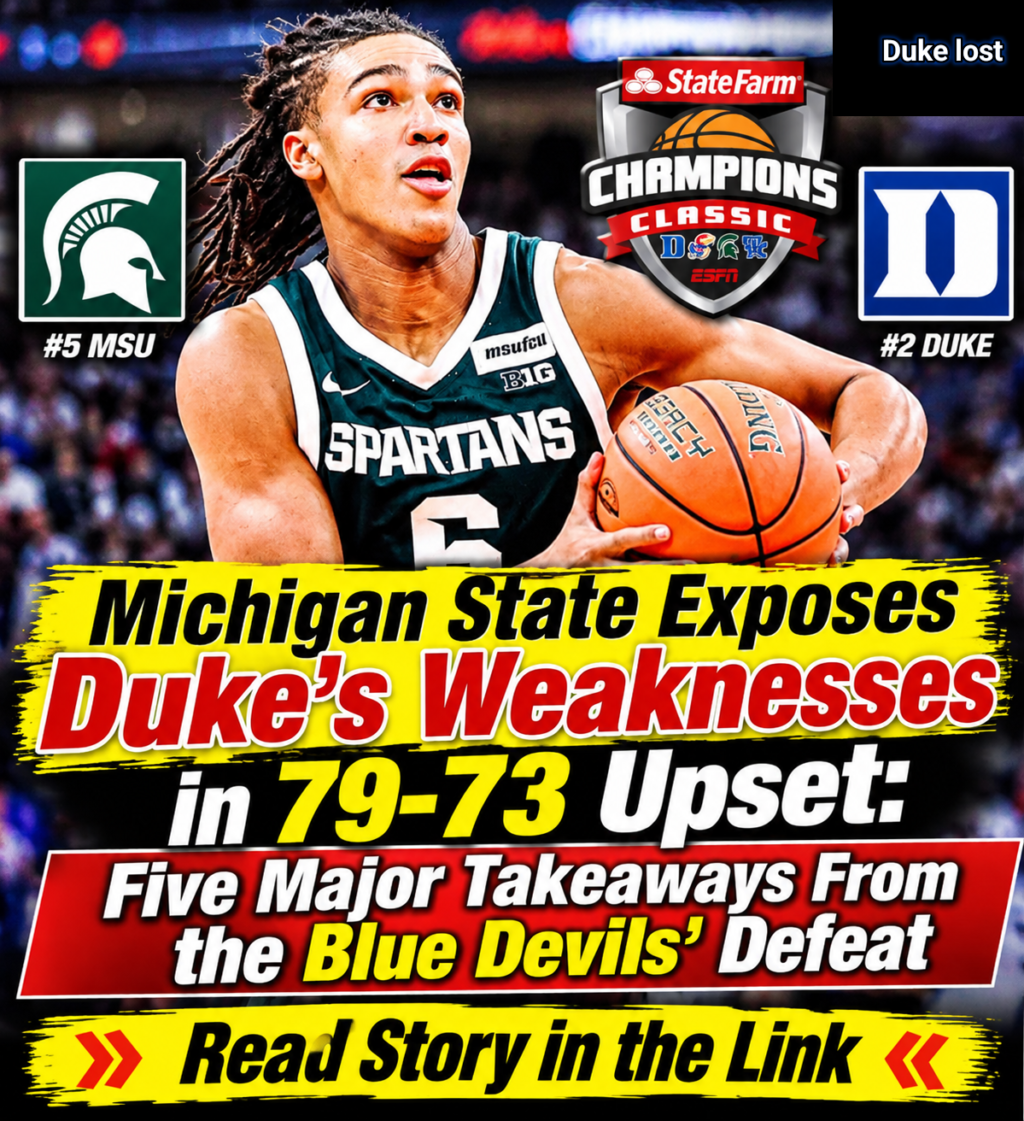
No. 2 Duke suffered its first major setback against a ranked opponent Tuesday night, falling 79-73 to No. 5 Michigan State at the United Center in the State Farm Champions Classic. The Spartans took advantage of Duke’s shooting struggles, costly turnovers and inability to establish consistent offensive rhythm to secure an impressive victory.
The Blue Devils finished the contest shooting just 33.3% from the field and 24.1% from three-point range. Their offensive difficulties were particularly evident during the opening half, when Michigan State built a nine-point advantage and forced Duke to spend much of the evening chasing the game.
Head coach Jon Scheyer acknowledged that his team lacked the connection and execution necessary to compete at its best.
“It was a little bit of an out-of-body experience,” Scheyer said. “We weren’t connected. We’re going to fix it. I can promise you that much.”
Despite several attempts to make the game competitive, Duke struggled to find answers whenever Michigan State threatened to pull away.
1. Duke’s Shooting Problems Created an Uphill Battle
One of the biggest reasons behind Duke’s defeat was its inability to convert scoring opportunities consistently.
The Blue Devils struggled to establish an offensive rhythm from the opening minutes. Missed perimeter shots, unsuccessful drives and turnovers prevented them from putting sustained pressure on Michigan State.
The first half was especially difficult. Duke managed only 25.9% shooting from the field and 16.7% from beyond the arc before halftime.
Michigan State also experienced a brief offensive slowdown, missing five consecutive shots at one point. However, Duke could not take full advantage of that opportunity to completely change the momentum.
Even when the Blue Devils moved within three points at 24-21, the Spartans responded before halftime and restored control.
For a team with ambitions of competing against the nation’s best, Duke will need more reliable shot selection and better offensive execution in upcoming games.
2. Turnovers Allowed Michigan State to Control the Game
Duke’s ball security became another major concern.
The Blue Devils repeatedly gave Michigan State additional possessions through careless mistakes. Patrick Ngongba II was called for two traveling violations during the opening two minutes, while other turnovers disrupted Duke’s attempts to establish offensive flow.
Michigan State used those opportunities to create separation and maintain pressure.
The Spartans eventually stretched their advantage to 14 points, putting Duke in a difficult position. Every time the Blue Devils appeared ready to build momentum, another mistake or defensive response from Michigan State interrupted their progress.
The problem was not simply the number of turnovers. It was when they happened. Duke needed possessions that could produce points, but instead, several opportunities ended without a quality attempt.
Against strong defensive teams, protecting the basketball will be essential if Duke hopes to avoid similar problems.
3. Michigan State’s Defense Made Life Difficult for Duke
Michigan State deserves considerable credit for the way it defended throughout the contest.
The Spartans consistently challenged Duke’s attempts to get comfortable offensively, making it difficult for the Blue Devils to find open looks or attack the basket with confidence.
Duke showed occasional flashes of improvement. Cayden Boozer helped spark a brief stretch with a basket, while Caleb Foster and Sebastian Wilkins contributed important perimeter shots.
However, Michigan State continued to respond.
Scheyer recognized the quality of the opposition but was disappointed with how his players handled the physical and defensive challenges.
“They have a great defense. It’s what they do, but I’m still disappointed in our ability to fight for the rim and fight for better shots,” Scheyer said.
That assessment highlights an important issue for Duke: the Blue Devils must become more effective at creating quality scoring opportunities when their first offensive option is taken away.
4. Patrick Ngongba II and Isaiah Evans Blackwell Provided Some Positives
Although Duke struggled collectively, there were individual performances worth recognizing.
Isaiah Evans Blackwell finished with 17 points and five rebounds, providing one of the team’s more dependable offensive contributions.
Ngongba also delivered a productive statistical performance, recording seven rebounds and six assists despite playing after recently dealing with the flu.
His contribution demonstrated his ability to influence the game beyond scoring, although Duke needed more consistent production from the entire lineup.
The Blue Devils also received contributions from Caleb Foster, Sebastian Wilkins and Cayden Boozer during their attempts to close the gap.
Unfortunately, those individual efforts were not enough to overcome Michigan State’s collective performance.
Patrick Ngongba II was particularly honest about the difference between the two teams.
“I just feel like they outplayed us. They just did everything,” Patrick Ngongba II said. “They had a better game, made shots. We never picked it up throughout the game.”
That statement reflected Duke’s biggest problem: the team never found the sustained energy and execution required to take control.
5. Jeremy Fears Jr. Delivered a Complete Performance
While Duke searched for answers, Michigan State guard Jeremy Fears Jr. played a major role in keeping the Spartans in control.
Fears finished with an impressive 18 points, 11 assists and seven rebounds, demonstrating his ability to score, create opportunities for teammates and influence the game in multiple areas.
His playmaking was particularly important because it helped Michigan State maintain offensive pressure whenever Duke attempted to make a comeback.
Coen Carr also delivered important contributions, including a second-chance dunk that helped the Spartans maintain their advantage during the second half.
With just over eight minutes remaining, Michigan State had extended its lead to 64-51. Duke continued fighting, but the Spartans consistently found answers.
Fears’ performance showed how important an effective lead guard can be in a competitive matchup. His ability to control possessions and involve teammates gave Michigan State an offensive advantage that Duke struggled to match.
What This Loss Means for Duke Moving Forward
The defeat provides Duke with an opportunity to identify areas that need immediate improvement.
The Blue Devils cannot afford to combine poor shooting with repeated turnovers, particularly with another challenging opponent approaching.
Duke will return to Cameron Indoor Stadium on Friday to face SIU Edwardsville at 8 p.m. before preparing for another major test against No. 3 Illinois next Tuesday.
Scheyer understands that the upcoming schedule will not offer much room for complacency.
“Our schedule doesn’t get any easier, so on one hand, that’s tough,” Scheyer said. “On the other hand, there’s great opportunity, and this is game three of hopefully a long season.”
The message is clear: one defeat does not define Duke’s season, but the team must respond with better execution.
The biggest questions now are whether Duke can improve its shooting, reduce turnovers and become more connected offensively before facing another ranked opponent.
Michigan State exposed several weaknesses, and how Scheyer’s team responds could reveal a great deal about its potential for the remainder of the season.
About The Author