“A Real Apology”: Dawn Staley Co-Signs Sandy Brondello’s Message to Angel Reese as Suspension Fallout Continues
Sandy Brondello’s one-game suspension is now behind her, but the fallout from Friday’s incident with Angel Reese continues to ripple through the WNBA — and Dawn Staley just weighed in publicly on how the Toronto coach handled the aftermath.
What actually happened Friday night
The incident unfolded late in the fourth quarter of Toronto’s 111-92 loss to Atlanta, with 3:16 remaining. Reese secured an offensive rebound and drove to the basket against Toronto’s Nyara Sabally, putting her shoulder into Sabally’s chest to create space. Officials called a foul on Sabally, who went down in pain and left the game during the ensuing timeout. As the call was under review, broadcast microphones picked up Brondello yelling at officials, referring to Reese with a phrase that sounded like “protected species.” The Tempo had challenged the call, arguing Reese committed a hostile act by elbowing Sabally in the ribs.
The reaction was swift. Reese posted to social media after the game, writing “ARE WE SURPRISED?!” tagging Brondello with a clown emoji, in a post that appeared to interpret the comment as racially charged. When another social media user framed the moment as “Calling a Black woman a species,” Reese amplified that message as well.
Notably, Brondello is Australian, and multiple native Australians explained to ESPN that “protected species” is a phrase commonly used in Australian sporting environments to express frustration that a player is being officiated more favorably than others — a cultural context that doesn’t erase the impact of the comment, but does complicate any assumption about original intent.
The league’s response
The WNBA moved quickly, suspending Brondello without pay for one game for what it officially described as “an inappropriate comment.” In its statement, the league said it expects all coaches and team personnel to uphold the highest standards of professionalism and respect that are fundamental to the league. Brondello, now in her 14th season as a WNBA head coach, served her suspension Monday when the Tempo hosted the Las Vegas Aces. ESPN also reported that a previously scheduled meeting between players and commissioner Cathy Engelbert next week will now include a discussion of the incident — a sign the league views this as more than an isolated one-off.
Brondello’s apology, in her own words
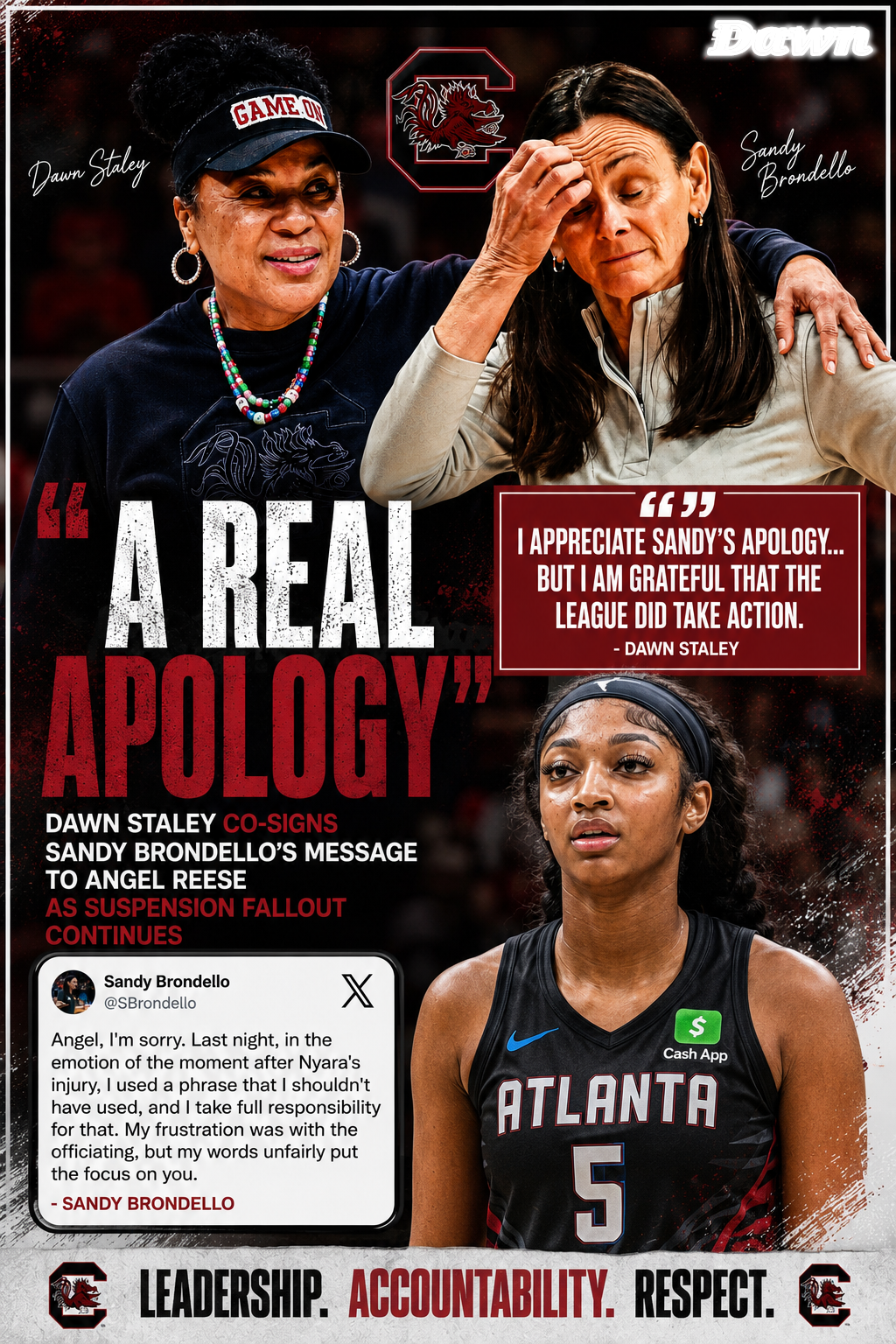
Hours before the suspension was announced, Brondello posted a written apology to Reese on social media. As captured in the uploaded post, she wrote: “Angel, I’m sorry. Last night, in the emotion of the moment after Nyara’s injury, I used a phrase that I shouldn’t have used, and I take full responsibility for that. My frustration was with the officiating, but my words unfairly put the focus on you.”
She went further, directly acknowledging the racial dimension of the backlash rather than sidestepping it — writing that she understood her words carried an impact beyond what she intended, particularly for Black women in the league, and that she was deeply sorry for that, noting she’s spent her career competing with, coaching and learning from Black women throughout her career. She closed by extending the apology beyond just Reese, to her teammates and the Dream organization as a whole.
That structure matters analytically: rather than a narrow, legalistic apology focused only on the officiating context, Brondello’s statement explicitly named the racial impact of her words — a distinction that likely shaped how the apology was received.
Dawn Staley’s public approval
That distinction is exactly what drew Dawn Staley’s attention. Responding to the apology on social media, the South Carolina and Team USA head coach offered a simple but pointed endorsement: “A real apology.” Coming from someone with Staley’s stature and long-standing voice on issues affecting Black women in basketball, that two-word reaction functions as a meaningful public validation — suggesting Staley read Brondello’s statement as genuine accountability rather than a defensive, PR-driven response designed just to move past the controversy.
Angel Reese addresses the media
Reese herself spoke to reporters after news of Brondello’s suspension broke, offering a measured response that separated her feelings about the apology from her feelings about the league’s formal action. “I appreciate Sandy’s apology… but I am grateful that the league did take action,” Reese said. That framing is notable — it credits Brondello’s personal outreach while still making clear that an apology alone wasn’t sufficient in her eyes; the suspension mattered as an institutional acknowledgment that the comment crossed a real line.
As of Saturday afternoon, before this response, Reese had not directly addressed Brondello’s apology, having finished Friday’s game with 23 points, 12 rebounds and three steals in the win.
What this all suggests going forward
Taken together, the sequence — a heated in-game comment, immediate public backlash, a same-day written apology, a league suspension, and now public reactions from both Reese and a high-profile coaching voice in Staley — reflects a story that moved through nearly every stage of a modern sports controversy within 48 hours. The upcoming meeting between players and commissioner Engelbert suggests the league sees this as an opportunity to address broader questions about language and officiating disputes, not just a single closed incident. For Brondello, Staley’s public endorsement of her apology may go a long way toward reputational repair — but Reese’s own comments make clear that, in her view, the suspension — not just the apology — was the necessary response.
About The Author