
Maryam Dauda’s Basketball Journey Comes Full Circle in Italy
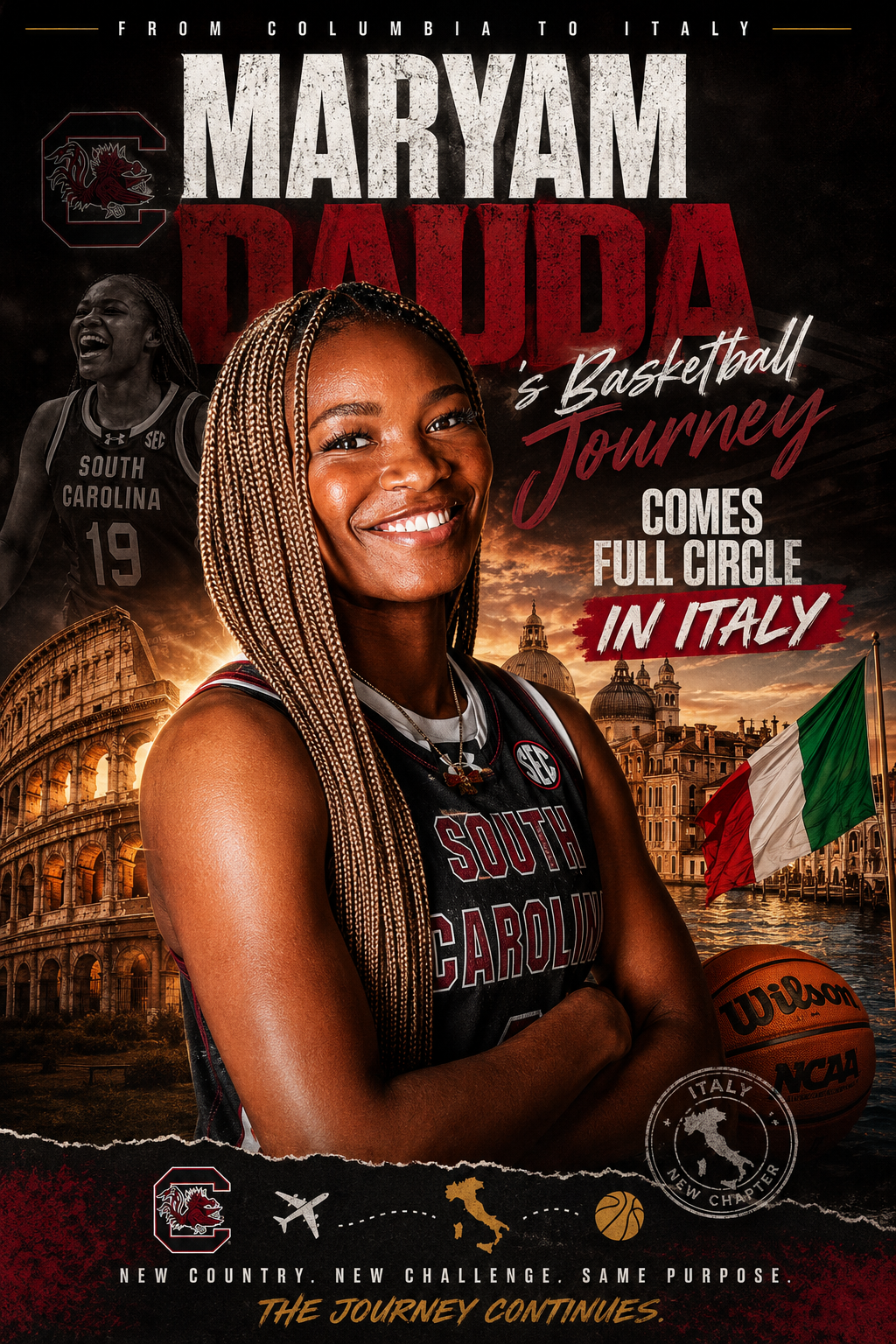
Maryam Dauda is starting her professional career with Alama San Martino di Lupari in Italy, closing out a college basketball journey that took her from Arkansas to two national championship runs at South Carolina — and opening a new chapter across the Atlantic.
A path that began long before college
Dauda’s basketball story starts in Nigeria, where she was born on September 20, 2002, before moving to the United States at age 12, settling in Bentonville, Arkansas alongside her older brother — himself a basketball player, following in the footsteps of their father. That family basketball background clearly shaped her early development: she made a name for herself starting in high school, becoming a finalist for the Naismith High School Player of the Year award, and finished her time at Bentonville as the program’s all-time leader in scoring, rebounding and shot-blocking. Those numbers reflect more than a solid high school career — they mark her as a foundational figure in her school’s basketball history.
Her college career began at Arkansas, though not without an early setback. She had to sit out her first season with the Razorbacks due to injury — a difficult start that made her subsequent two-season stretch at Arkansas, where she averaged 10.1 points and 6.3 rebounds as a redshirt sophomore, a genuine bounce-back rather than a straightforward continuation of her high school dominance. Her standout moment in a Razorbacks uniform came fittingly against her future team, scoring 19 points against South Carolina in March 2024.
The move to Columbia — and a role that changed
Months after that 19-point outing against the Gamecocks, Dauda transferred to South Carolina, joining a signing class that included Joyce Edwards, Madisen McDaniel and Adhel Tac. Dawn Staley made clear at the time why she wanted Dauda in the program, saying her skill set changes the game in multiple ways and praising her footwork and scoring ability inside and out.
The on-court role, though, looked different than her Arkansas production suggested it might. Across two seasons at South Carolina, Dauda averaged just 2.4 points and roughly 2.5 rebounds per game — a steep drop from her Arkansas numbers, reflecting the reality of joining a deeper, championship-caliber roster where her minutes were far more limited. Notably, in a Final Four run defined by high-profile names, Dauda spent stretches of the season in a “Highlighters” practice jersey, the scout-team role reserved for players simulating upcoming opponents — hardly a glamorous assignment, but one Staley made clear wasn’t an insult.
What Dauda lost in playing time, she made up for in impact off the court. Staley didn’t hold back when describing her value to the program: “She’s just a great teammate, a great friend, a great … just special,” Staley said, adding that Dauda has probably influenced every recruit who has come through the program over the past two years. Staley went further still, saying she’d hire Dauda before someone who plays 30 minutes a game — about as strong an endorsement of character and locker-room value as a coach can give a player whose stat line doesn’t reflect her true contribution.
That sentiment extended into her final college game. Dauda closed her college career with three points and two rebounds in 13 minutes against UCLA, and Staley made a point afterward of crediting her specifically: she called Dauda a high-character individual and one of the greatest teammates she’s coached through a senior season spent mostly off the floor, adding that Dauda never stopped competing.
Why Italy, and why now
That combination — a skilled, physically gifted forward whose college role never matched her natural talent level — is a common profile for players who go on to find real opportunity overseas, where roles and systems differ significantly from high-major NCAA programs. Alama San Martino di Lupari announced the signing of the 23-year-old Nigerian forward for the 2026/27 season, noting she arrives as a two-time NCAA runner-up. That framing matters: European clubs often value the pedigree of playing for a championship-contending program, even when raw college stats were modest, because it signals a player who has practiced against elite competition daily and absorbed a demanding, detail-oriented system.
Dauda’s own comments from earlier in her South Carolina career hint at exactly what she may bring to her new club. Reflecting on the difference between facing Staley’s program and being part of it, she said playing against the best and then seeing how they operate in practice made clear why the Gamecocks are the best. She also pointed to defense and physicality as the areas she worked hardest to develop, describing a culture where teammates and coaches hold each other accountable and there’s no room to coast.
A new chapter begins
For Dauda, joining Alama San Martino di Lupari represents exactly what her college career was building toward — a genuine opportunity to be a featured contributor rather than a valuable role player watching from the bench. Given the defensive rigor and accountability she absorbed at South Carolina, along with the scoring touch and footwork that made her a 10-point scorer at Arkansas, her transition to professional basketball in Italy looks like a natural next step for a player whose talent level was never really in question — only the minutes to show it.
About The Author