Agot Makeer Is South Carolina’s Most Important Returning Player — And She Is Just Getting Started
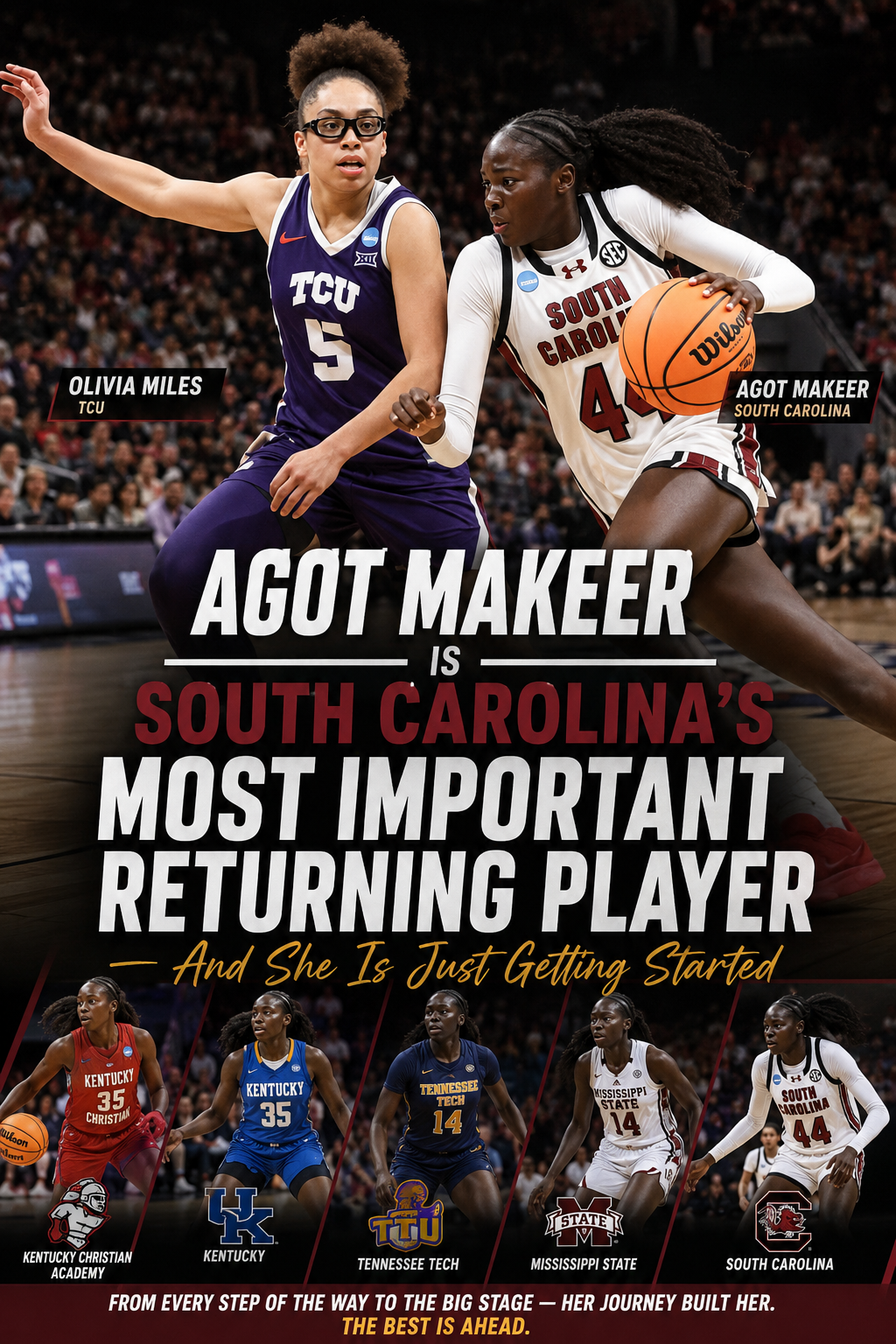
A mindset shift, a historic postseason, and a hunger that survived the heartbreak of a national championship loss. The sophomore version of Agot Makeer should terrify the rest of the SEC.
The scoreboard read 79-51. The confetti was falling on the wrong side of the court. And somewhere in the middle of processing the most painful loss of her young career, Agot Makeer was already thinking about what came next.
“I hope I can bring more to the table because obviously what I brought is not enough,” she said after South Carolina’s national championship defeat to UCLA. “Get better in the offseason, get healthy in the offseason and keep it going.”
Pause on that for a moment. A freshman who had just completed one of the most impactful postseason runs of any first-year player in program history — carrying the Gamecocks through the Elite Eight and the Final Four on her back — was sitting in the aftermath of a championship loss telling the world her best wasn’t good enough yet.
That is not disappointment talking. That is the competitive DNA of a player who is going to be very, very dangerous in year two.
What She Did in March Was Special
The raw numbers from Makeer’s first NCAA Tournament deserve to be stated plainly, because they don’t get nearly enough attention.
Across six tournament games, she averaged 14 points — the second-highest on the entire team — along with 2.3 assists and 2.2 steals. She shot 55% from the floor and 46.2% from three-point range. For context, 6-foot-6 center Madina Okot shot just 0.8% better from the field during that same stretch. A 6-foot-1 freshman perimeter player was matching the shooting efficiency of one of the most physically dominant centers in the country. That is not a footnote. That is a headline.
The individual performances built on each other in the way that only truly special players are capable of across a tournament run.
Against TCU in the Elite Eight, Makeer recorded a career-high 18 points, four rebounds, three assists, and three steals — a performance so complete and so timely that it could reasonably be called the most important individual output of South Carolina’s entire postseason. Without that game, the Gamecocks very likely do not reach the Final Four.
She followed it against UConn with 14 points in a Final Four win that required every single basket. She was 2-of-2 from beyond the arc, including a first-quarter buzzer-beater that tied the game at a critical juncture and an even larger three-pointer with six minutes remaining that pushed South Carolina’s advantage from four to seven. In a game decided by margins, Makeer provided the margin.
Even in the championship loss — a night that went sideways for the entire program against a dominant UCLA team — she checked in, hit a timely three-pointer to make it 13-10 in the first quarter, and finished with 11 points. She competed until the building emptied.
Six games. Six meaningful contributions. Zero nights where she disappeared under the pressure of the moment.
The Injury Gauntlet That Preceded All of It
What gives Makeer’s tournament production its fullest meaning is understanding what she navigated to get there.
Somewhere between November 27th and December 3rd, she sustained a concussion and missed five games entirely. She returned for the final non-conference game on December 28th, only to have starting guard Ta’Niya Latson sprain her ankle almost simultaneously — thrusting Makeer into the starting lineup for three consecutive games before the rotation stabilized again.
Then came January. Makeer started on the 25th and 29th before going down early in the first quarter of a game with what Staley described as a “lower leg injury.” Three more games missed. She did not return until February 14th.
In spite of all of that — the concussion, the ankle complications for a teammate that altered her own role, the lower leg setback — Makeer finished the regular season averaging 19.3 minutes, 7.2 points, 3.3 rebounds, 1.3 assists, and 1.1 steals across 32 games. Those minutes represent the most playing time any first-year player has logged under Dawn Staley since Brea Beal’s 21.2 in 2019-20 — with only Joyce Edwards’ 21.4 minutes as a freshman in 2024-25 standing as the lone exception.
In a program that demands players prove themselves before they receive meaningful minutes, those numbers are not given. They are earned.
The Mindset Shift That Changed Everything
Here is where the analysis of Makeer’s season becomes most interesting — because both she and her head coach agree that health alone does not explain the transformation in her game during the postseason.
“I feel like my mindset changed, starting in the SEC Tournament I just started approaching games differently,” Makeer said. “I feel like it wasn’t just one-dimensional thinking. I just wanted to go and do whatever I can to get the team to win.”
That quote is worth reading twice. At some point in the SEC Tournament — well before the NCAA bracket was even set — something shifted internally for Makeer. The noise around individual performance, individual statistics, and individual standing fell away. What remained was a singular focus on team outcome, and the basketball that followed that shift was the best of her young career.
Dawn Staley identified something equally important about the psychological component of Makeer’s development: “For our program, you’ve got to show and prove to us and actually do the things that we need you to do in practice. Because we know that if you do, it’s a no-brainer, it’s going to happen in the game. Agot, she was in and out with injuries, then she got pushed up to knowing that she was going to play. I do think she’s a different player when she knows she’s going to play. So I think it’s that.”
That last observation is analytically critical. Staley is identifying role clarity as the unlock for Makeer’s best performance. When Makeer knows she is playing — when the uncertainty of a rotation spot is removed and the expectation is clearly defined — her talent operates at a measurably higher level. That is not a weakness. That is a highly actionable piece of information for a coaching staff building a championship rotation.
The prescription for 2026-27 practically writes itself: give Makeer her role, make it clear, and let her play within it from the opening tip of the season rather than somewhere in the middle of March.
Staley’s summary of the tournament was characteristically direct: “We just really challenged her to go out there and be who she is. I mean, she’s had a tremendous postseason. And her future is bright.”
And former teammate Raven Johnson offered perhaps the highest compliment a player can receive from someone who shared a locker room with her, saying Makeer’s basketball IQ is “above and beyond” and that she had never seen a freshman who understood the game the way Makeer does. Basketball IQ at that level, combined with the physical tools she already possesses, is the combination that programs spend years trying to recruit. South Carolina already has it in a player entering her sophomore season.
The 2026-27 Question: Starter or Weapon?
With Ta’Niya Latson now in the WNBA, the rotation picture at South Carolina’s wing positions has opened meaningfully. The primary competition for a starting role is Jordan Lee — a junior who carries one additional year of system experience over Makeer. Staley genuinely cannot make a wrong call starting either player, and she knows it.
But the honest analytical case for Makeer earning the starting nod is stronger than the experience gap might suggest. A fully healthy Makeer — entering the season without concussion protocols, without lower leg complications, and without the interrupted rhythm that defined her freshman year — operating from day one with the mindset she discovered in the SEC Tournament is a categorically different player than the one who averaged 7.2 points across a fragmented regular season.
Even if Staley opts to start Lee and deploy Makeer in a high-impact reserve role, the danger of that decision for opponents is equally real. South Carolina’s transition game — the engine around which everything Staley builds is organized — thrives on exactly the speed, instinct, and opportunistic scoring that Makeer provides naturally. A starting five that has already worn opponents down for ten minutes, followed by Makeer entering at full speed against fatigued defenders, is a matchup problem that SEC coaching staffs cannot scheme around.
At 6-foot-1 with the ability to shoot off the catch, create off the bounce, finish through contact, and guard at an elite level across multiple positions, Makeer is not a specialist. She is a complete player whose ceiling has not yet come into full view — and the glimpses she provided in six NCAA Tournament games suggest that ceiling is extraordinary.
The Bottom Line
Agot Makeer’s freshman season was a story defined by injury, interruption, a late-season mindset breakthrough, and ultimately a postseason that carried South Carolina to the national championship game and announced her arrival as one of the most important players in women’s college basketball.
The loss to UCLA stings. It will continue to sting. But a player who responds to that pain with “what I brought is not enough — I need to get better” is a player who has already done the hardest part of athletic growth: honest self-assessment in the face of a devastating result.
The sophomore version of Agot Makeer — healthy, experienced, role-clear, and hungry — is one of the most compelling storylines heading into the 2026-27 season. For South Carolina, she is not just a returning piece of a championship roster.
She is the player the rest of the SEC should be losing sleep over. 🐔
About The Author