
Dawn Staley Has A Roster Headache With Talent And A Rotation Puzzle That Could Define South Carolina’s Hunt For A Fourth Title
When Jordan Lee committed to South Carolina last week, she didn’t just add another name to the roster — she threw a fascinating puzzle into Dawn Staley’s lap that will likely keep the coaching staff busy all summer long. The Gamecocks now possess an embarrassment of riches at virtually every position, and projecting how it all fits together is one of the most compelling exercises in women’s college basketball heading into the 2025-26 season.
Let’s break it down.
The Backcourt — Too Much Talent, Not Enough Minutes
The backcourt conversation begins and ends with one certainty: Maddy McDaniel is the point guard. At 5-9 and entering her junior year, she is the only true floor general on the roster, which means her spot in the starting five is essentially locked. Everything else, however, is a genuinely fascinating puzzle.
What makes South Carolina’s guard and wing situation so intriguing is the blurred positional lines that define Staley’s system. The distinction between guard and wing is less about traditional labels and more about matchups — the bigger player takes the wing to handle the opponent’s bigger perimeter threat. With that framework in mind, the rotation essentially sorts itself into three tiers of decision-making.
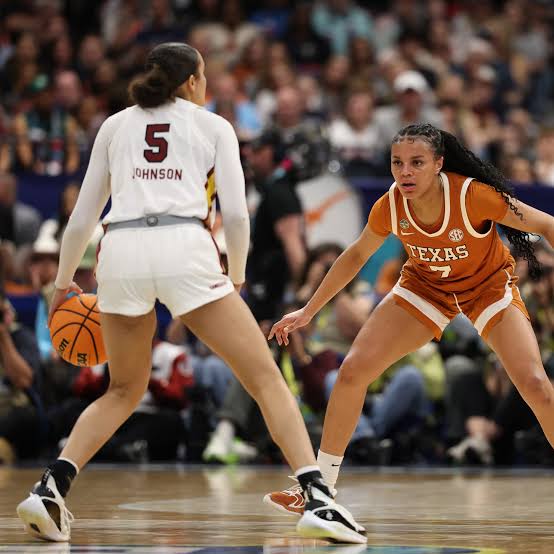
Tessa Johnson gets the first nod at guard. She is a senior, a team leader, and a returning starter — and critically, moving her back to the guard position rather than the wing should make her a more effective defender. Johnson occasionally struggled when matched against bigger wing players last season, and this adjustment addresses that vulnerability directly while keeping one of the team’s best spacers on the floor.
That leaves the wing battle, and this is where Jordan Lee’s arrival genuinely reshapes the conversation. Between Lee, Agot Makeer, and Ayla McDowell, South Carolina has three legitimate wing options who could each start for most programs in the country.
For now, Makeer gets the starting nod at wing — her defensive disruption and athleticism give her a slight edge in a starting role where defensive versatility matters most. But here is the critical strategic wrinkle: South Carolina will want either Johnson or Lee on the floor as a floor-spacing threat at all times, which actually makes it beneficial that they aren’t both in the starting lineup simultaneously.
The beauty of this trio — Johnson, Lee, and Makeer — is that the starting designation is almost irrelevant. All three should log 25 to 28 minutes per night, and with no true backup point guard currently on the roster, both Johnson and Makeer will see time running the offense as well. This is a three-headed perimeter rotation that gives Staley the flexibility to mix and match based on opponent and game situation in a way that will be genuinely difficult to prepare for.
Then there is Jerzy Robinson — the freshman who may possess, as one analyst put it, “the most sophisticated offensive game of the six players fighting for minutes, and definitely the most physical.” Her ceiling is enormous, and her playing time will be determined largely by how quickly she adjusts to the pace and physicality of the college game. If she adjusts fast, South Carolina’s backcourt depth becomes almost unfair.
The Frontcourt — A Jumble With Championship Potential
If the backcourt is a fascinating puzzle, the frontcourt is a full-blown jigsaw with pieces still being sorted. The two anchors are clear — Chloe Kitts and Joyce Edwards played well together in 2024-25 and earn their spots as the projected starters. But the honest assessment of that pairing comes with an important caveat: they are a small frontcourt without significant rim protection, and matching them against big, traditional post players is asking too much of either.
Edwards is a versatile enough player to operate at the post against smaller teams — her performance against UConn being the prime example — but she is not built to battle physically dominant centers night after night. Kitts brings shooting and ball-handling that could theoretically allow her to slide to the wing in certain lineups, but that flexibility comes with its own defensive tradeoffs.
This is where the supporting frontcourt cast becomes absolutely critical to South Carolina’s championship ceiling.
Alicia Tournebize is the most intriguing name in the entire frontcourt discussion. The 6-foot-7 French sophomore has the size to play either frontcourt position, and the primary question surrounding her — physical strength — is one that a full summer in Molly Binetti’s strength and conditioning program is specifically designed to answer. She simply wasn’t strong enough last season to battle experienced college bigs consistently. If that changes — and every indication from the coaching staff suggests it will — Tournebize becomes a matchup nightmare that no team in the country is truly equipped to handle. A 6-foot-7 player who can step out and shoot threes while also protecting the paint is the kind of weapon that changes the entire strategic calculus of how opponents approach South Carolina.
Adhel Tac brings genuine interior toughness when healthy — a strong rebounder and finisher inside who adds the physicality the starting frontcourt currently lacks. The word “when healthy” is doing significant work in that sentence, and her availability will be one of the most closely watched storylines of the preseason.
Kelsi Andrews presents perhaps the highest ceiling of the freshman frontcourt options, but she missed most of her senior season due to injury, making her readiness to contribute immediately a genuine unknown. Her potential is undeniable — the question is simply one of timing.
Kaeli Wynn, the 6-foot-2 freshman, adds another versatile piece who can operate between the forward and wing positions, giving Staley yet another option for the positional flexibility she has always valued.
The Kitts Question — Starter Or Secret Weapon?
One of the most interesting strategic decisions Staley will face heading into the season involves Kitts herself. She has unquestionably earned the right to start, and under normal circumstances the conversation would end there.
But Staley is not a conventional thinker. If Kitts enters the season less than fully healthy, or if Staley determines that the second unit needs an impact player to maintain quality depth across all 40 minutes, the option to bring Kitts off the bench becomes genuinely tempting. It is a decision that has less to do with Kitts’ value and everything to do with the kind of lineup flexibility that wins games in March.
The Fundamental Question Staley Must Answer
At the core of every rotation decision this summer is one philosophical question that Staley will ultimately have to resolve: Does she want to start small with her five best players and bring size off the bench, or does she build a more traditional lineup and deploy an impact player as a bench weapon?
Both approaches have merit. Going small maximizes the team’s offensive versatility, three-point spacing, and defensive athleticism — all hallmarks of Staley’s best teams. Going bigger addresses the rim protection concern and gives opponents a more physically imposing frontcourt to contend with from the opening tip.
The honest answer is that South Carolina will probably deploy both approaches depending on the opponent — and having the personnel to make either work is exactly the kind of luxury that separates programs competing for championships from programs simply competing.
The Bottom Line
Jordan Lee’s commitment didn’t just improve South Carolina’s roster. It created a depth chart that is genuinely complex, genuinely competitive, and genuinely exciting in a way that should have every Gamecock fan counting down the days to October.
Dawn Staley has a headache. It just happens to be the best kind of headache in women’s college basketball — the kind that comes from having too many good players and not enough minutes to give them all. 🏀
About The Author