Dawn Staley’s Revenge Tour Is Coming: Why the 2026-27 South Carolina Gamecocks Could Be the Most Dangerous Team in Women’s College Basketball History
The morning after a 79-51 humiliation on college basketball’s biggest stage, Dawn Staley didn’t have the luxury of grief. The transfer portal opened at midnight — hours after UCLA completed its historic demolition of South Carolina in the national championship game — and the business of building a dynasty never sleeps. Two months later, the offseason picture has come sharply into focus. And what’s emerging in Columbia is not a team licking its wounds. It’s a team preparing for a reckoning.
Here is a comprehensive breakdown of everything you need to know about the Gamecocks heading into 2026-27.
The Roster: Addition by Return and Subtraction by WNBA
Before analyzing what’s coming in, it’s worth acknowledging what’s gone. Ta’Niya Latson and Raven Johnson — two of the program’s most dynamic perimeter threats — have moved on to the WNBA. Center Madina Okot, who averaged an SEC-best 10.6 rebounds per game in her lone season, saw the NCAA deny her waiver for an additional year of eligibility, officially ending her college career. Three starters gone. For most programs, that’s a rebuild. For South Carolina, it’s a roster puzzle with very attractive pieces.
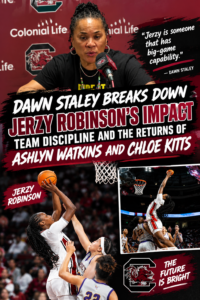
The returns are significant. Chloe Kitts and Ashlyn Watkins — both of whom missed the entire 2025-26 season — come back as proven, physical contributors who give South Carolina two elite rebounders the team desperately lacked in its title game collapse. Joyce Edwards, the program’s all-time single-season scoring record holder at 768 points, returns as the unquestioned centerpiece. Tessa Johnson enters her senior year. Maddy McDaniel returns at point guard. The foundation is not just intact — it’s arguably upgraded.
Then there’s the portal haul.
Jordan Lee and Oliviyah Edwards Acquisition Changes Everything
Jordan Lee surprised many with her decision to leave Texas, and the move is even more intriguing given that she chose to join the Longhorns’ chief SEC rival in South Carolina. ESPN rated Lee as the best two-way player available in the transfer portal. She averaged 13.2 points per game, including three double-figure scoring performances specifically against the Gamecocks. Her work as a perimeter defender and her basketball IQ could make her a vital component for coach Dawn Staley’s pursuit of a fourth national championship.
Let that context sink in. South Carolina didn’t just add a talented guard — they stripped Texas of a player who had beaten them, repeatedly, and who helped the Longhorns reach the Final Four in back-to-back seasons. Texas head coach Vic Schaefer’s loss is a massive win for Dawn Staley. The Longhorns, reeling not only from Lee’s departure but also the exits of Justice Carlton and Aaliyah Crump, now look considerably less formidable heading into next season.
The arrival of Lee, on top of the returns of Chloe Kitts and Ashlyn Watkins, plus another heralded recruiting class, inspires significant confidence in the Gamecocks’ chances of once again being a legitimate title contender — though a starting-caliber primary ball handler still stands as a potential weak point for South Carolina.
That honest caveat matters. Lee is a scorer and defender first. McDaniel must grow into the primary playmaking role. The backcourt architecture will be tested, especially in high-leverage SEC and tournament games.

Then came the bombshell that sent shockwaves through college basketball recruiting circles. Five-star forward Oliviyah Edwards committed to South Carolina, flipping from Tennessee after visiting Columbia on April 14. The 6-foot-3 prospect from Lincoln High School in Tacoma, Washington, is ranked among the top-three overall recruits in the class of 2026 by ESPN — one of the most significant recruiting flips in women’s college basketball this cycle. (Rolling Out)
With Edwards joining Jordan Lee as spring additions, South Carolina is expected to have 14 players on next season’s roster. Edwards can play the four or five, and arguably the wing as well — fitting into South Carolina’s increasingly positionless basketball philosophy. She joins Chloe Kitts, Agot Makeer, Jerzy Robinson, Joyce Edwards, and Alicia Tournebize as players who can operate at multiple positions, creating matchup nightmares for any opponent.
The Freshmen: A Recruiting Class Built for Depth and Explosiveness
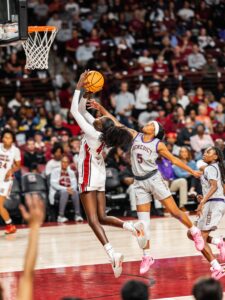
The incoming class fills critical gaps across the roster. Jerzy Robinson, a 6-foot-1 wing from Sierra Canyon School in Chatsworth, California, chose South Carolina over UConn and LSU. Kaeli Wynn, a 6-foot-2 forward from Mater Dei High School in Santa Ana, California, committed with Stanford as the other finalist. Kelsi Andrews, a 6-foot-3 center from IMG Academy in Bradenton, Alabama, also joins the program.
Each addition addresses a specific structural need. Robinson provides the wing versatility and athleticism South Carolina lacked from its bench last season. Wynn adds frontcourt depth behind Kitts and Edwards, which is essential if injury strikes again. Andrews provides interior insurance. None of these players are expected to carry the load immediately, but in a program where Agot Makeer averaged 14 points per game during March Madness after barely contributing in the regular season, the developmental ceiling within Staley’s system is well established.
Final Four Probability: What Are the Honest Odds?
This is the question every Gamecocks fan wants answered. Based on all available information — roster composition, transfer portal outcomes, conference landscape, and historical precedent — a realistic assessment puts South Carolina’s chances of reaching the 2027 Final Four at approximately 70-85%, and their odds of winning the national championship at roughly 40-55%.
Here is the reasoning:
South Carolina returns its best player in Joyce Edwards, adds the portal’s most complete two-way guard in Jordan Lee, and gets back two full-season contributors in Kitts and Watkins. CBS Sports’ way-too-early power rankings place South Carolina among the nation’s elite, noting that Joyce Edwards and Tessa Johnson are far from left without help, with Kitts and Watkins returning and the addition of Robinson and Lee making this a dangerous group. That’s an independent validation of what the roster suggests on paper.
However, three factors prevent a higher probability ceiling: the loss of three starters including the SEC’s best rebounder, the unproven depth of the freshman class under tournament pressure, and the mental fragility exposed in three of four losses this past season — where South Carolina missed at least 12 layups per game and was regularly outrebounded by double digits. Talent alone doesn’t fix those things. Experience and maturity do. Whether this group has grown enough by March 2027 is the defining unknown.
The Threats: Who Can Actually Beat South Carolina?
The competitive landscape has shifted dramatically, and South Carolina’s rivals did not stand still while the Gamecocks were building.
UConn (Big East) is arguably the most dangerous program heading into next season. Despite Azzi Fudd’s departure, UConn is returning the core group that made the Final Four, including Naismith Player of the Year Sarah Strong, KK Arnold, Blanca Quiñonez and Ashlynn Shade. Sarah Strong is arguably the best player in women’s college basketball heading into next year — a legitimate force who can punish South Carolina’s interior if Kitts or Edwards get into foul trouble.
Oklahoma State (Big 12) has emerged as a shocking wildcard. Former Iowa State star Audi Crooks, who averaged nearly 26 points per game as the nation’s second-leading scorer, joined forces with Liv McGill, who averaged 22.5 points and 6.3 assists at Florida last season. The two could form the highest-scoring duo in the sport. McGill led the nation with 20.8 pick-and-roll possessions per game with a 54.6% frequency — a style of play that would test any defense, including one of South Carolina’s caliber. The Cowgirls have turned themselves into a legitimate national threat almost overnight.
USC (Big Ten) represents another threat. The return of JuJu Watkins is a game-changer, and it will be compelling to watch her alongside Jazzy Davidson, who just wrapped up an impressive freshman season. Lindsay Gottlieb is also adding another high-profile freshman in Saniyah Hall, the No. 2 player in the 247Sports rankings.
UCLA (Big Ten), the defending champion, is in a significant transitional moment. All six of UCLA’s senior players were selected in the 2026 WNBA Draft, five in the first round, setting a historic record. UCLA has added Donovyn Hunter from TCU, Bonnie Deas from Arkansas, and Elina Aarnisalo returning to Westwood, giving coach Cori Close an experienced backcourt to pair with Sienna Betts for their championship defense. But replacing six draft picks — including the tournament’s Most Outstanding Player in Lauren Betts — is a mountain even the best programs struggle to climb in one season.
Can South Carolina Fix Its Weak Points?
The four critical failures of 2025-26 were identifiable and largely correctable — which is both encouraging and conditional.
Rebounding is the most structurally improved area. The return of Kitts and Watkins gives South Carolina two proven board-crashers who weren’t available when UCLA dominated the glass 49-37 in the title game. The addition of Andrews in the frontcourt provides insurance depth. On paper, the Gamecocks’ rebounding unit for 2026-27 is meaningfully better than what they put on the floor this past season.
Bench scoring remains the biggest question mark. South Carolina ranked 145th nationally in bench scoring last season at 18.5 points per game. The freshman trio of Robinson, Wynn, and Andrews must be ready to contribute meaningful minutes immediately, and Agot Makeer’s expected bump in role — particularly if she slides into a starting or high-usage bench position — should help close that gap. But this is a prove-it moment, not a solved problem.
Layup execution and mental toughness are the hardest variables to predict externally. Missing 12 or more layups in three separate losses isn’t a technique problem — it’s a composure problem. That only improves through high-pressure repetition, which means the early portion of the 2026-27 season will serve as a crucial barometer. How this team handles its first close game, its first significant road environment, or its first in-season adversity will reveal whether that fragility has been addressed.
Point guard development is the final piece. A starting-caliber primary ball handler still stands as a potential weak point for South Carolina. Yahoo Sports McDaniel must take a genuine developmental leap into a full-time lead playmaker role, or Staley may need to use Lee in a hybrid creation capacity more often than anticipated.
Depth Insurance: What Happens If Someone Goes Down?
This is where the 2026-27 Gamecocks are meaningfully better positioned than the team that nearly unraveled when Okot faced mismatches and Latson’s early-season injury exposed roster thin spots.
The depth chart, if everyone remains healthy, now includes Edwards, Kitts, Watkins, Lee, Makeer, Tessa Johnson, McDaniel, Robinson, Wynn, Andrews, and returning contributor Alicia Tournebize. That’s a legitimate 10-player rotation — the kind of depth Staley had in her best championship-contending seasons.
The injury wildcard, however, is still present. Adhel Tac, the 6-foot-5 forward who missed 16 games this past season and had prior injury absences as well, remains an important depth piece if healthy but cannot be counted on as a reliable rotation anchor. Her availability is a genuine swing variable for the frontcourt depth equation.
The realistic scenario is this: if Edwards, Kitts, and Lee stay healthy, South Carolina can sustain any other single injury without catastrophic roster consequences. If two of those three go down simultaneously, the depth cushion shrinks considerably.
The Bottom Line
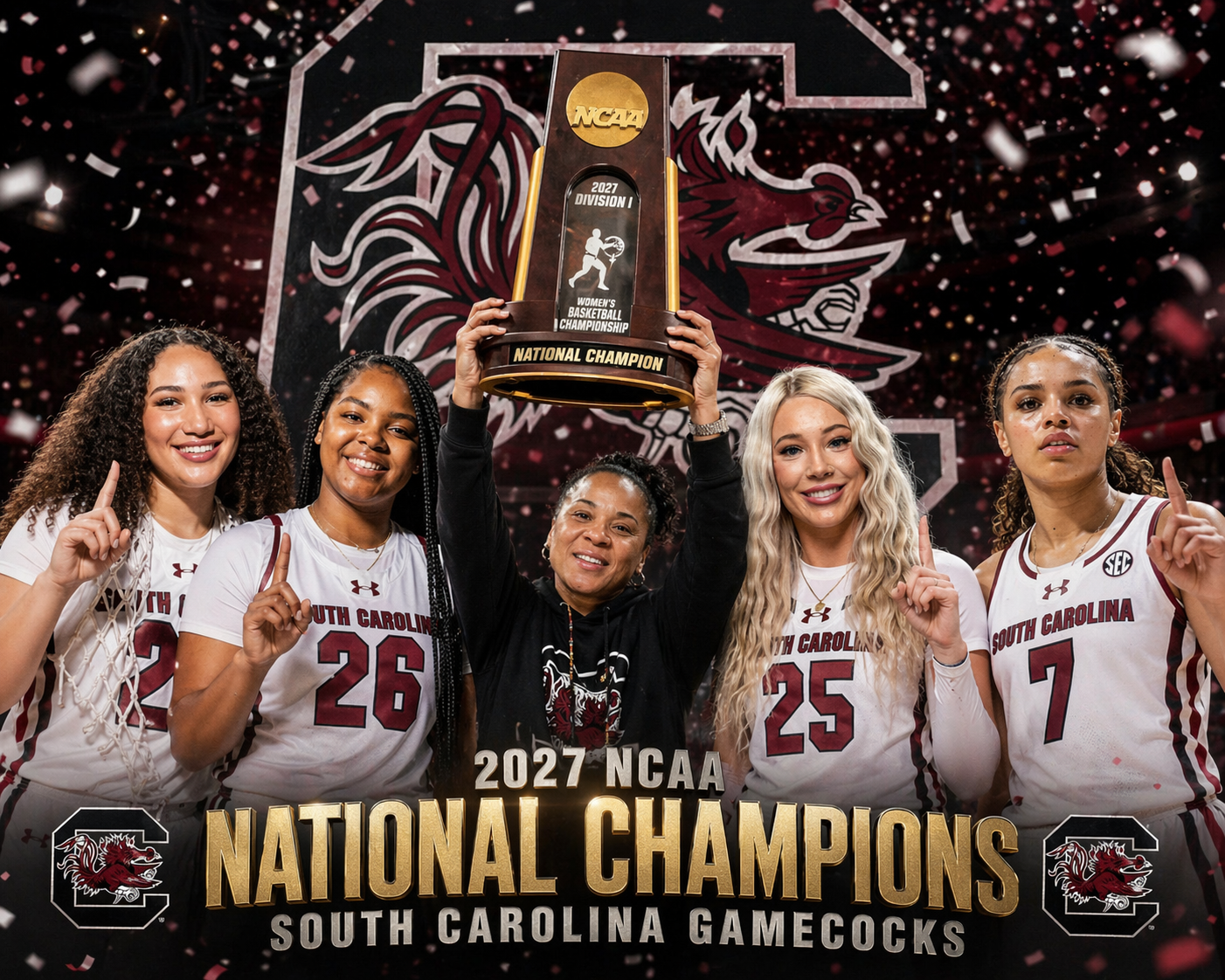
South Carolina enters 2026-27 as a legitimate national championship contender — arguably the second or third most likely team to cut down the nets in April 2027 behind UConn and perhaps Oklahoma State. The program has retained every player from a historically productive roster, added the transfer portal’s most complete guard, and returns two full-season contributors who sat out this past year.
The dynasty is not cracking. It is recalibrating. Dawn Staley has done this before — absorbed departures, reloaded the roster, and returned hungrier than ever. The difference this time is the weight of two consecutive championship losses, a roster that knows what falling short feels like, and a coaching staff that has seen exactly where the program breaks down.
Revenge tours are often the most dangerous kind. South Carolina’s 2026-27 season has every ingredient of one.
About The Author